
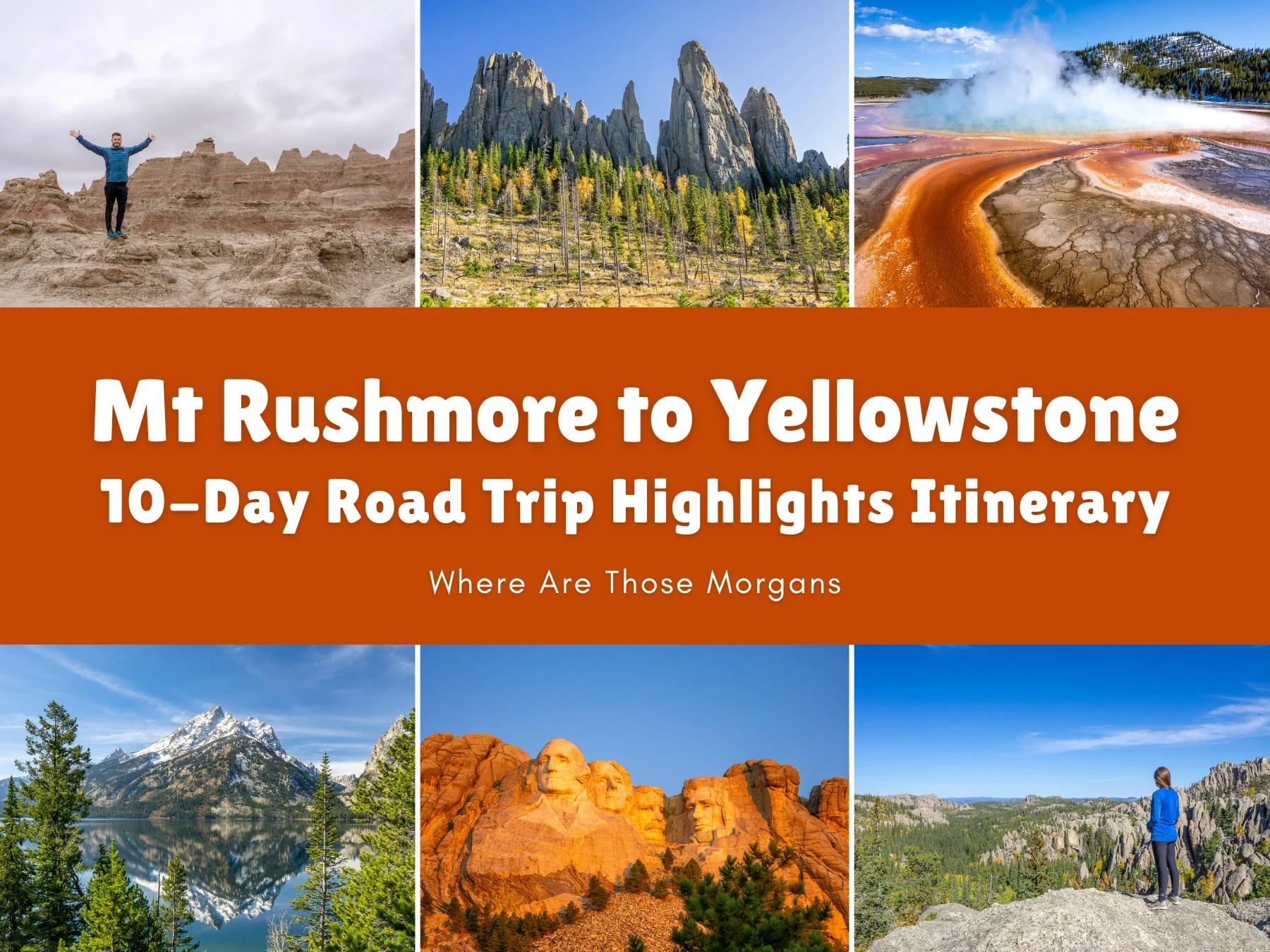
We first drove from Mount Rushmore to Yellowstone back in October 2019 during a 3 month road trip we took out west from Upstate New York. It was our first time visiting either South Dakota or Wyoming, so we didn’t have much of an idea about what to do other than the obvious Mt. Rushmore, Yellowstone and Grand Teton. In the end we managed to put together a fairly decent itinerary, but we missed a few major stops and we definitely didn’t give ourselves enough time in each place to hit all the highlights.
Then in April 2021, we moved from NYC to Seattle. But instead of flying, we took a cross-country road trip which again included driving from South Dakota’s Black Hills to Yellowstone. We had a better idea of timing and what else to see the second time around, so we were able to tick off tons more popular attractions and find some hidden gems. Our major issue this early in the year? Snow. There were a lot of road and trail closures in both regions, which ended up being a massive disappointment.
Hi, we’re Mark and Kristen Morgan. We left our scientific careers in 2018 to become travel writers and photographers, and since then our expert guides have helped millions of travelers take better trips. Read more about us.
Why trust us with your road trip plans? We’ve driven the route twice in different seasons, we know what’s worth it and what to skip, and we figured out the ideal timeframe. As always, every photo in this guide is ours.
After driving from Mt Rushmore to Yellowstone twice and learning from our mistakes, we figured out exactly how we’d plan this road trip if it was our first time all over again. All things considered, we think 10 days is the perfect amount of time to see the best of each region, keep costs from getting out of control, and maximize efficiency without feeling too rushed. Our 1,283-mile route from Rapid City, SD to Jackson, WY takes around 31 hours to drive, so it’s no joke.
This is easily one of our favorite scenic road trips in the US, and following our perfected step-by-step 10 day itinerary will help you make absolute the most of your time. We include 4 days in the Black Hills, one day for the long drive to Cody, WY and 5 days split between Yellowstone and Grand Teton. It’s honestly an amazing experience, and we’re sure you’re going to love following our first-timer’s route. Let’s dive in.
Note: Our content is reader supported and contains affiliate links. If you make a purchase through one of these links, we may earn a small commission at no extra cost to you and it helps us keep this site running.
Road TRip Planning
📖 Digital guidebook: Download our Mt Rushmore to Yellowstone 46-page road trip guidebook.
📞 Personalized help: Book a call with Mark to plan the perfect itinerary based on your travel style and goals.
Getting To The Black Hills
We drove our car from Upstate NY to South Dakota both times we visited the Black Hills and Yellowstone, so we didn’t need to fly into Rapid City airport or pick up a rental car. Arriving from the east via I-90 meant Badlands National Park was the first major attraction we reached, which is the ideal starting point for this route. It was a heck of a drive, but having our own car saved us a lot of money on a rental.
The first time in early October 2019 we pitched our tent in Badlands primitive Sage Creek Campground but it collapsed at 3:00 AM due to strong winds (not a great start!), so the second time in April 2021 we stayed at Best Western Plains Motel in Wall the night before day 1 of this itinerary. The budget hotel was okay, but next time we’d definitely book Badlands Frontier Cabins which looks fantastic.
Okay, but what if we were flying into the region to begin the road trip? Ideally, we’d arrive the evening before, pick up our pre-booked rental car at Rapid City airport (with a drop-off set for Jackson Hole or Salt Lake City), drive 50 minutes to Wall, grab dinner at Red Rock, and spend the night at Badlands Frontier Cabins. But worst case, we’d take the earliest flight possible on the morning of day 1, pick up the rental car and drive straight to Badlands National Park.
Where we’d stay the night before day 1: Wall is the closest place to Badlands with a few reasonable restaurants and hotels, but it’s tiny and there’s really not much going on. Rapid City is larger and would be a far better place to stay for foodies and atmosphere. That said, our preference is instant access to the park on day 1, so we’d stay in Wall again next time.
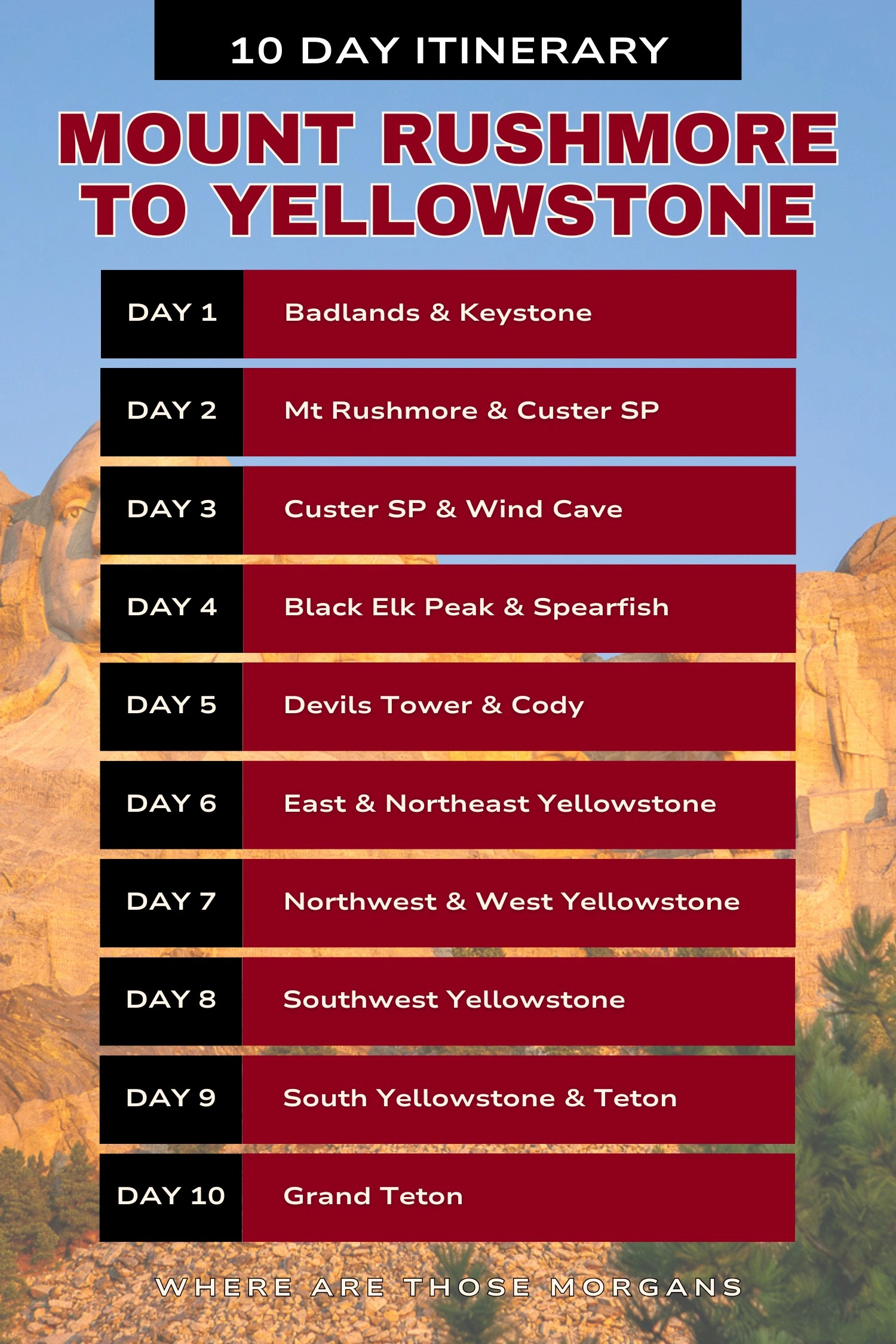
Day 1: Badlands & Keystone
- Distance: 141 miles
- Time: 3 hours
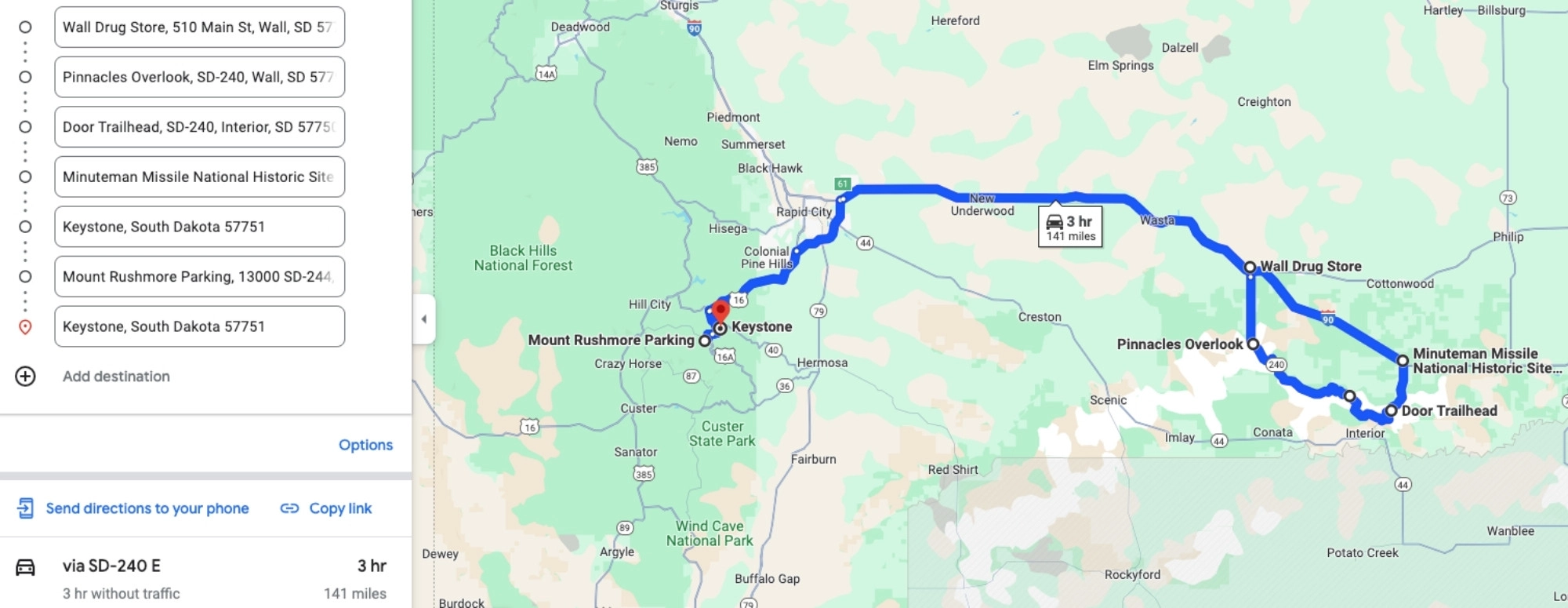
We’d set an early alarm, grab massive coffees, food and plenty snacks for the morning, check out of the hotel, and drive into Badlands for sunrise (it costs $30 per vehicle, we used our America the Beautiful Pass for “free” entry). We had bad luck with sunrise both times, so we’d love to do it next time with better conditions.
The park’s west entrance called Pinnacles is only 10 minutes south from Wall, and Pinnacles Overlook is just a few minutes further. For us, Badlands is mostly about enjoying its many overlooks, and Pinnacles is one of our favorites so it’s the perfect place to begin with sunrise. If you’re not bothered about sunrise, start with coffee at the famous Wall Drug Store and then enter the park after breakfast.
From Pinnacles, we’d slowly drive east on Badlands park loop road, stopping at every opportunity. Yellow Mounds, Panorama Point and White River Valley Overlook are the unmissable viewpoints we’d snap most of our photos before getting to the park’s hiking trails. We’d start with two easy walks at Fossil Exhibit (we listened to an interesting ranger talk here) and Cliff Shelf Trail which is a boardwalk with steps.
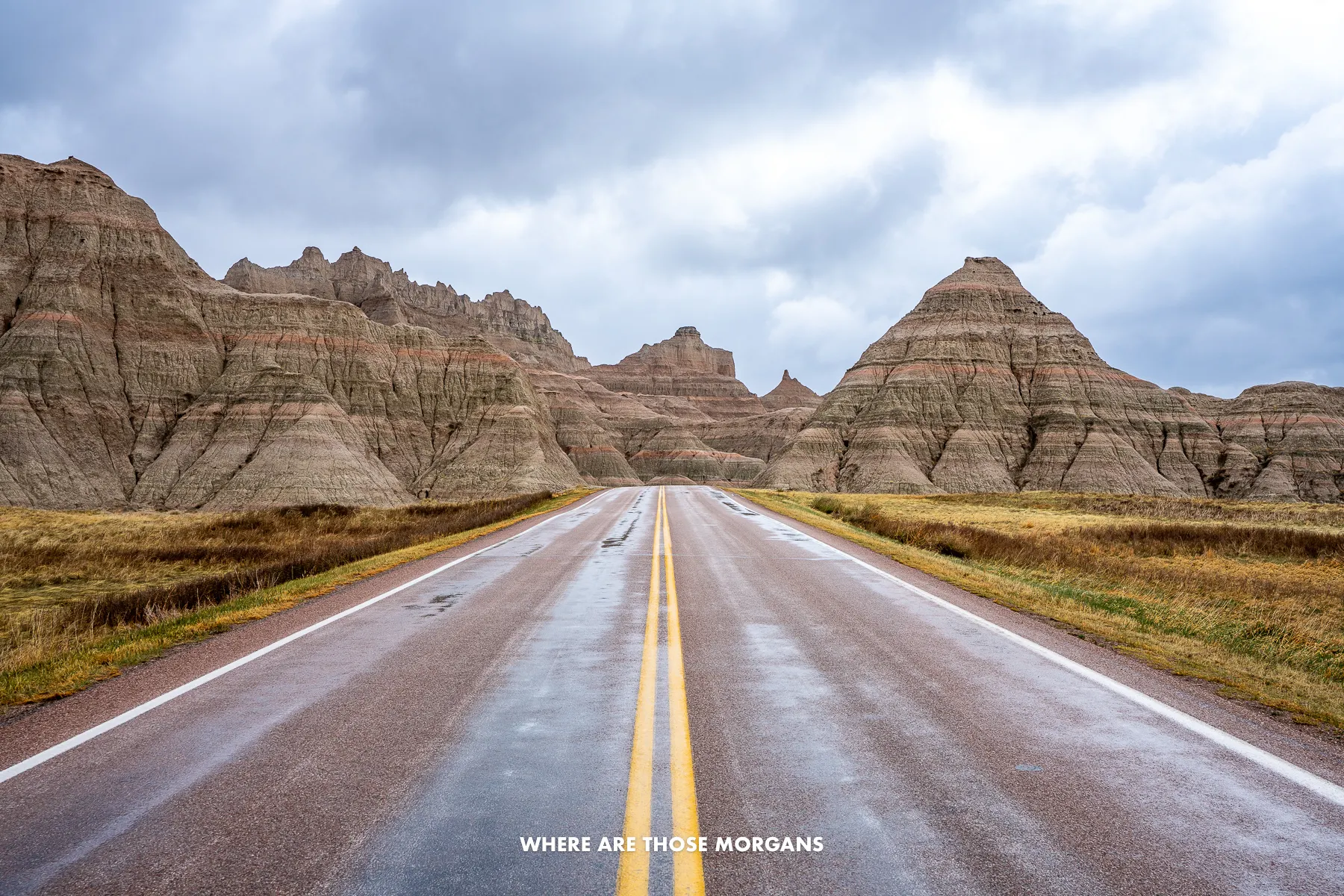
Next, we’d tackle the best hike in Badlands called Notch Trail. The short but engaging trail ends with magnificent views, and it has adventure elements like a cliff-hugging ladder climb and narrow ledges to navigate. We walked Notch Trail on both visits and think it’s well worth doing for regular hikers, but less confident hikers might want to give this one a miss.
After Notch, we’d walk up to the “Window” before hiking Door Trail which is the only path leading behind the Badlands wall. We followed the yellow flag poles to the end of trail sign both times – it’s a good one. Castle Trail is the longest hike in the park but we’d say skip it because it takes too long for this itinerary. Read our guide explaining the hikes in Badlands to learn more.
After one final stop at Big Badlands Overlook, we’d leave the park via NE entrance station and park at Minuteman Missile Visitor Center to learn about the Cold War. Honestly, we had no idea what to expect but it turned out to be a fantastic museum. A mistake we made was not realizing that NPS guided tours of decommissioned missile silos are available, but must be booked in advance. We’d 100% do it next time.
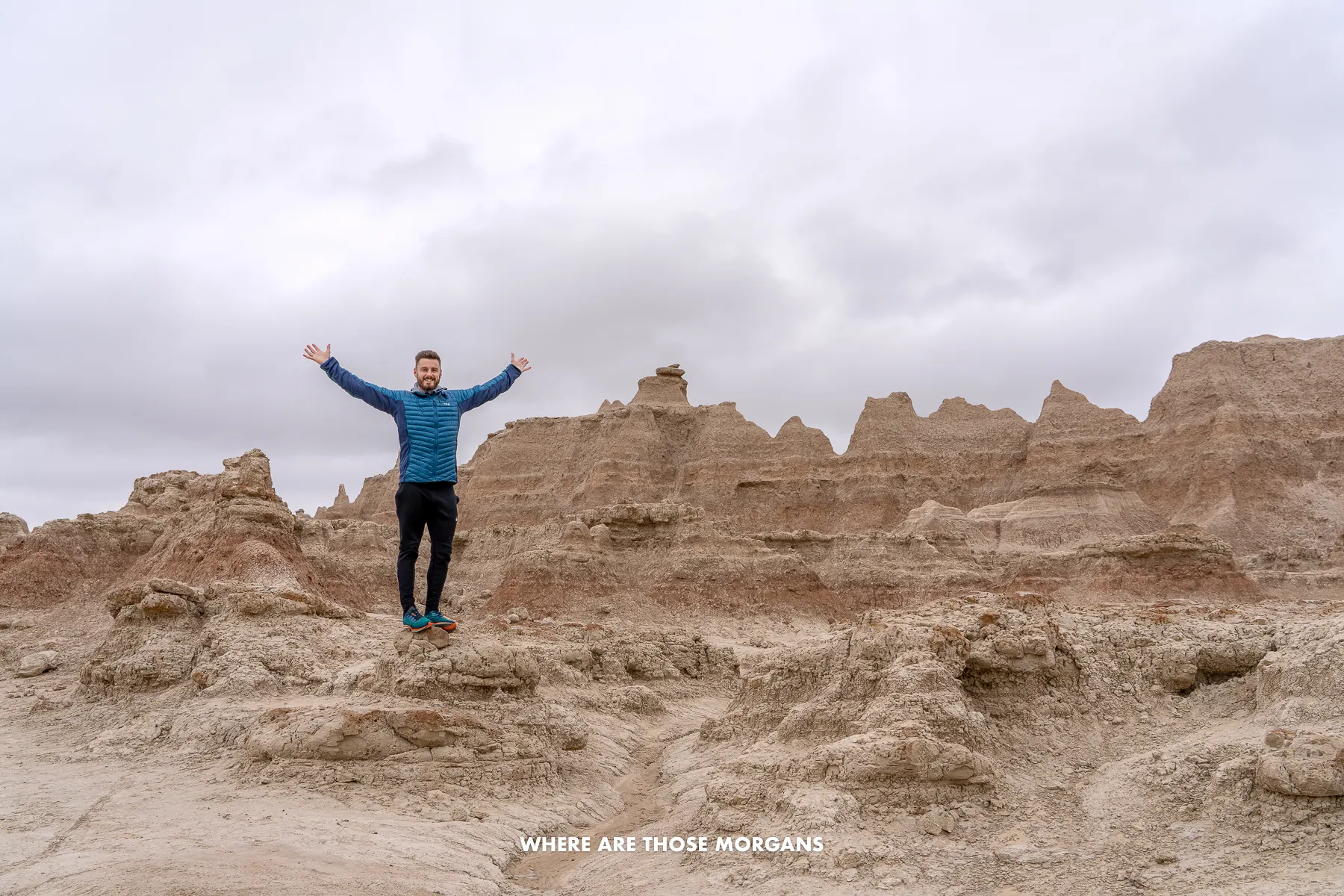
After Minuteman we’d drive back into Wall and grab a late lunch at Wall Drug Store. We thought it was a bit gimmicky and overpriced, but it was still fun to see and we’d recommend it to first-timers. It’s almost like a rite of passage in this area. Last time we got 5 cent coffee (it wasn’t the best tasting but it cost 5 cents) and homemade donuts. After lunch, we’d hit the road and drive 1 hour 15 minutes to Keystone without stopping.
In Keystone, we’d check into either the cheap Comfort Inn + Suites, the mid-range K Bar S Lodge, or the luxury glamping Under Canvas. It would be late afternoon by now, so we’d take it easy and have a slow walk along the main strip in Keystone. We’d maybe take a tour of Big Thunder Gold Mine or visit the National Presidential Wax Museum (sounds odd, but it’s legit). Then we’d grab dinner at either Cruizzers for low-key pizza or Red Garter Saloon for an Old West theme.
If we were taking this road trip between late May and the end of September, and we still had energy, we’d drive 7 minutes to see the Mount Rushmore evening lighting ceremony at 8:00 PM or 9:00 PM depending on the month (the lighting ceremony doesn’t operate October through mid-May but the sculpture is still illuminated at night).
Mark’s top planning tip: Mt Rushmore costs $10 per vehicle to park and the parking pass is valid for 1 year. There’s no fee to enter the memorial. If we did the evening ceremony, we’d make sure to keep the parking pass safe so we could use it again the next morning without double paying.
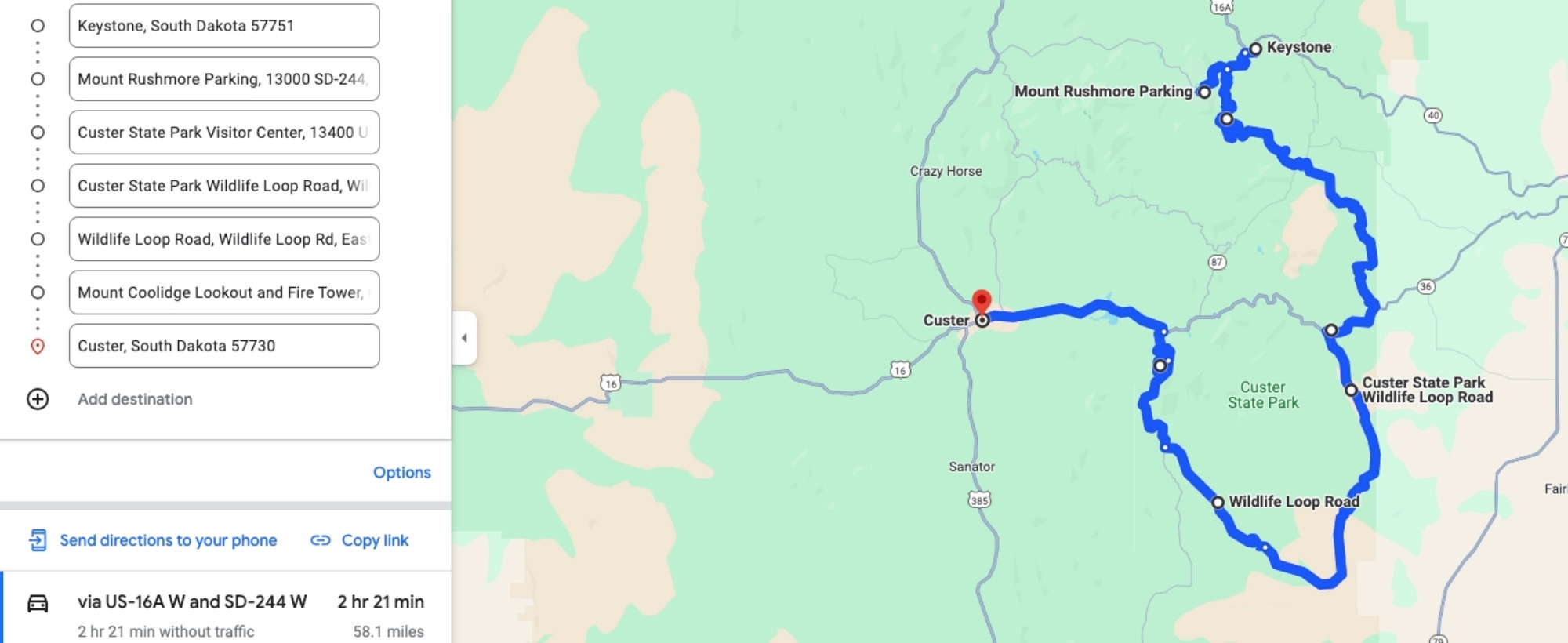
Day 2: Mount Rushmore & Custer State Park
- Distance: 58 miles
- Time: 2 hours 21 minutes
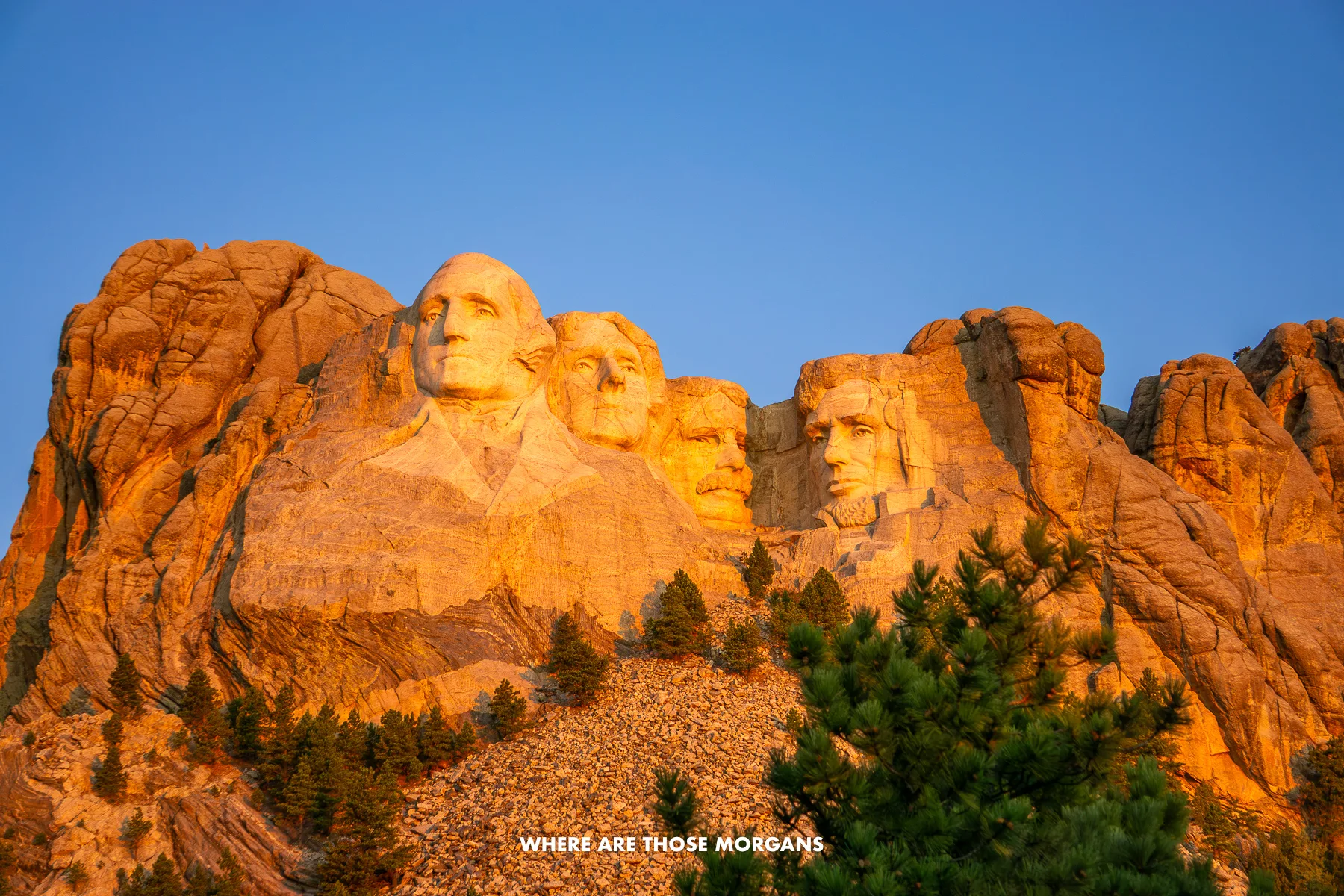
We know some people will say “it’s just a sculpture” but we were pleasantly surprised by Mount Rushmore. In October 2019, we arrived early to watch sunrise light up the sculpture, and we were honestly the only people in the grounds. It wasn’t as great in April 2021 because we had snow, and water runoff made it look as though the former presidents were crying.
We’d 100% do it for sunrise again if it was our first time because the orange and pink colors we had at dawn were stunning, but we understand the early wake up won’t be for everyone. If we didn’t go for sunrise, we’d fill up with breakfast at our hotel (or go to Fat Sams in Keystone if our hotel didn’t include it), check out of our hotel, and arrive at the memorial by around 8:00 AM.
Using the parking pass from the night before or paying for a new one if this was our first time, we’d enter the grounds, and walk straight to the main amphitheater to see the four presidents faces high up on the mountainside. After taking plenty of photos, we’d start walking the Presidential Trail in a counter-clockwise loop. Our first stop would be the Sculptor’s Studio for a 15-minute ranger talk about Gutzon Borglum, who designed and led the creation of Mt. Rushmore.
Once we’d completed the full boardwalk loop (it doesn’t take long), we’d head back to Keystone for lunch. Refueled, we’d then drive the super-scenic Iron Mountain Road (US-16A). We absolutely loved driving the twisting, curving hairpins and even pigtail bends. We took a time-lapse video when we drove it, so we didn’t stop but next time we’d pull over after going through one of the tunnels for a cool view of Mount Rushmore.
At the end, we’d turn right and visit Custer State Park Visitor Center to watch the welcome video narrated by Kevin Costner. Then we’d buy or display our pre-purchased Custer State Park Entrance License which costs $20, is valid for 7 days, and will be required for the next two days of the itinerary. Right below the visitor center we’d begin driving the 18-mile one-way Custer Wildlife Loop to see animals like bison, burros, coyotes and eagles roaming freely in the wilderness.
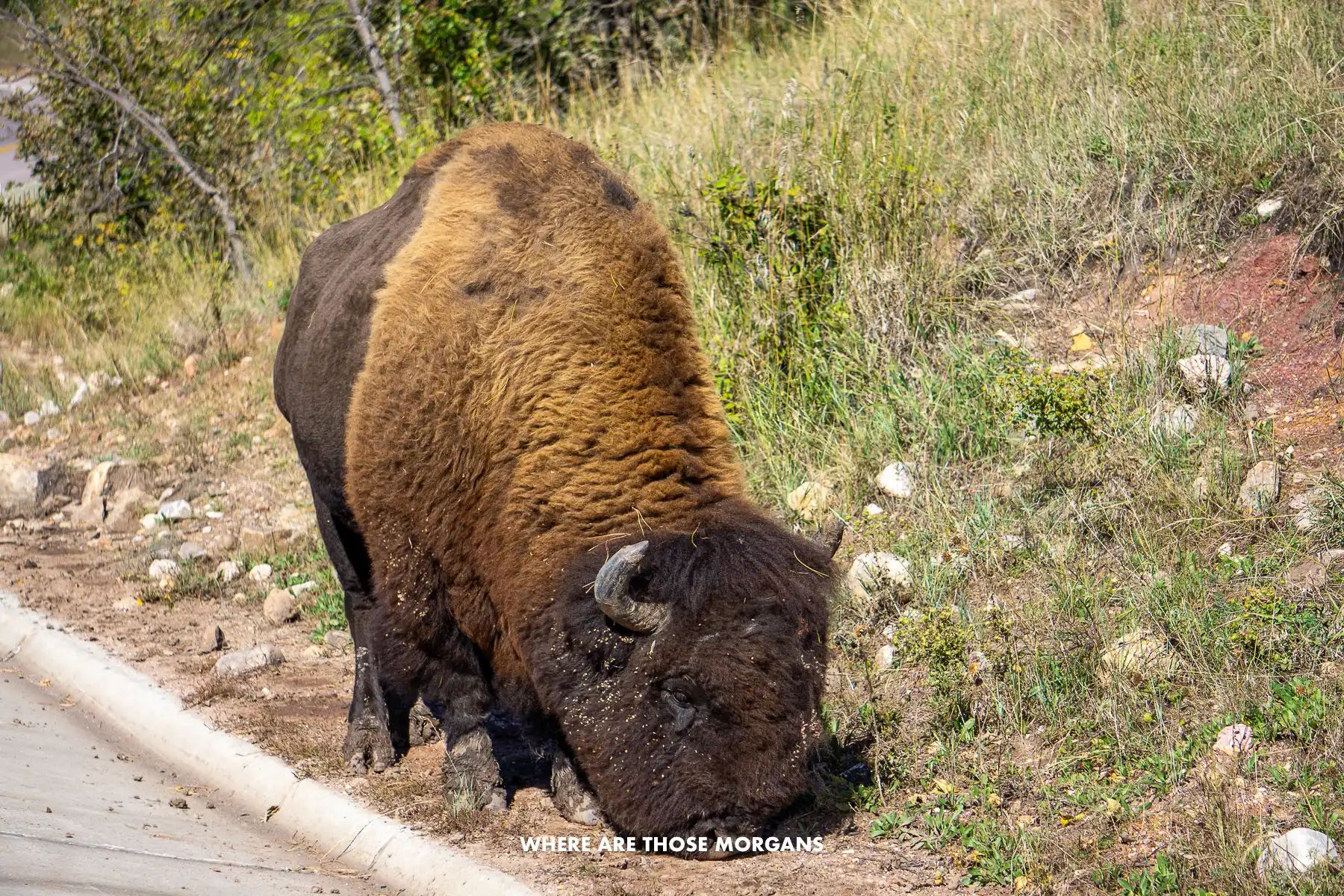
The mid-afternoon isn’t an ideal time to drive the wildlife loop for seeing the most animals, but it fits efficiently into the overall itinerary and we do revisit the wildlife loop again the next morning. So this first time would be our chance to scope it out and see certain animals that might not be out in the morning. We had burros come right up to our car in the afternoon. If we wanted to try something a bit different, we’d consider booking an official Buffalo Safari Jeep Tour, which has a 2:00 PM and 4:30 PM start time.
Near the very end of the wildlife loop, we’d drive up a gravel road to Mount Coolidge Lookout and Fire Tower for 360-degree views of the region. Frustratingly, we didn’t know about it until after our second trip so we haven’t been able to do it yet. It’s on our list for next time, and to be honest we might do it for sunset. From the viewpoint, we’d drive 20 minutes to Custer and stay at either the budget Rocket Motel, the mid-range Bavarian Inn (we stayed here in 2021 and it was excellent), or the luxury EO Bungalows.
Day 3: Wind Cave & Needles Highway
- Distance: 87.5 miles
- Time: 2 hours 53 minutes
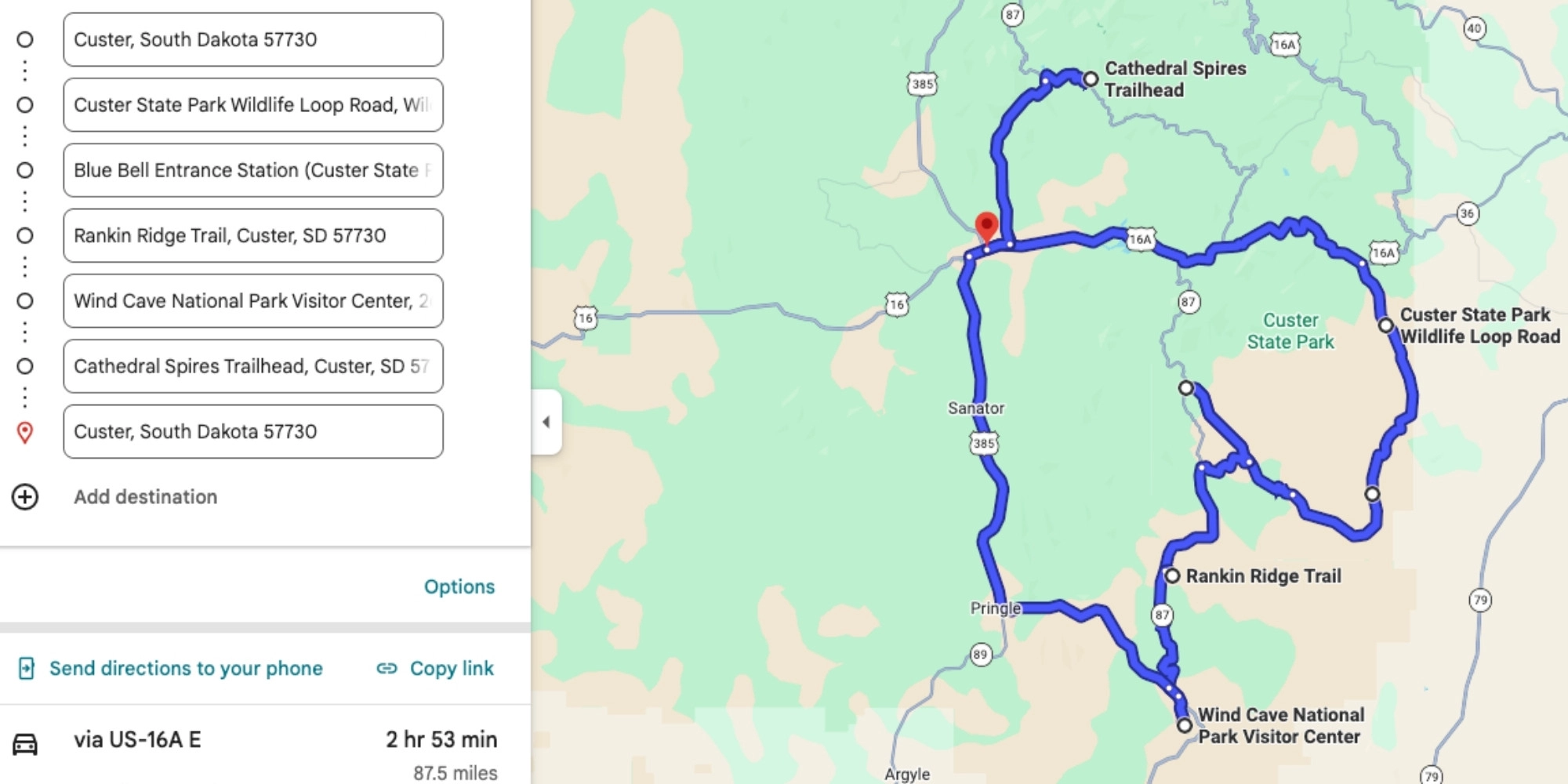
We have to admit we were genuinely surprised at the huge amount of fun things to do near Mount Rushmore. After two trips to the Black Hills, we’d go as far as saying it’s one of the most underrated places we’ve visited in the US. So we’d really make the most of our days by getting another early start, grabbing breakfast in Custer (either Hjem A.M., Miner’s Cup, or Our Place), and then making our way back to drive through Custer Wildlife Loop again.
Animals are typically more active in the morning, so we’d drive slowly and be on the lookout. We actually got out of our car and walked up a small hill to a viewpoint last time, which allowed us to see more animals in distant parts of the landscape that were blocked from the road. The difference today is that near the end of the loop we’d take a left turn on SD-87 for 7.5 miles to Rankin Ridge Trail within Wind Cave National Park boundaries.
We’d hike the 1-mile round trip loop trail, stopping at the summit for far reaching valley views from an old fire tower. And after the hike, we’d continue to Wind Cave Visitor Center to check in for our cave tour. We skipped Wind Cave in 2019 but we visited in 2021 and thought it was well worth the drive down. Cave tours can be booked in person on the day or up to 4 months in advance through this official recreation.gov page.
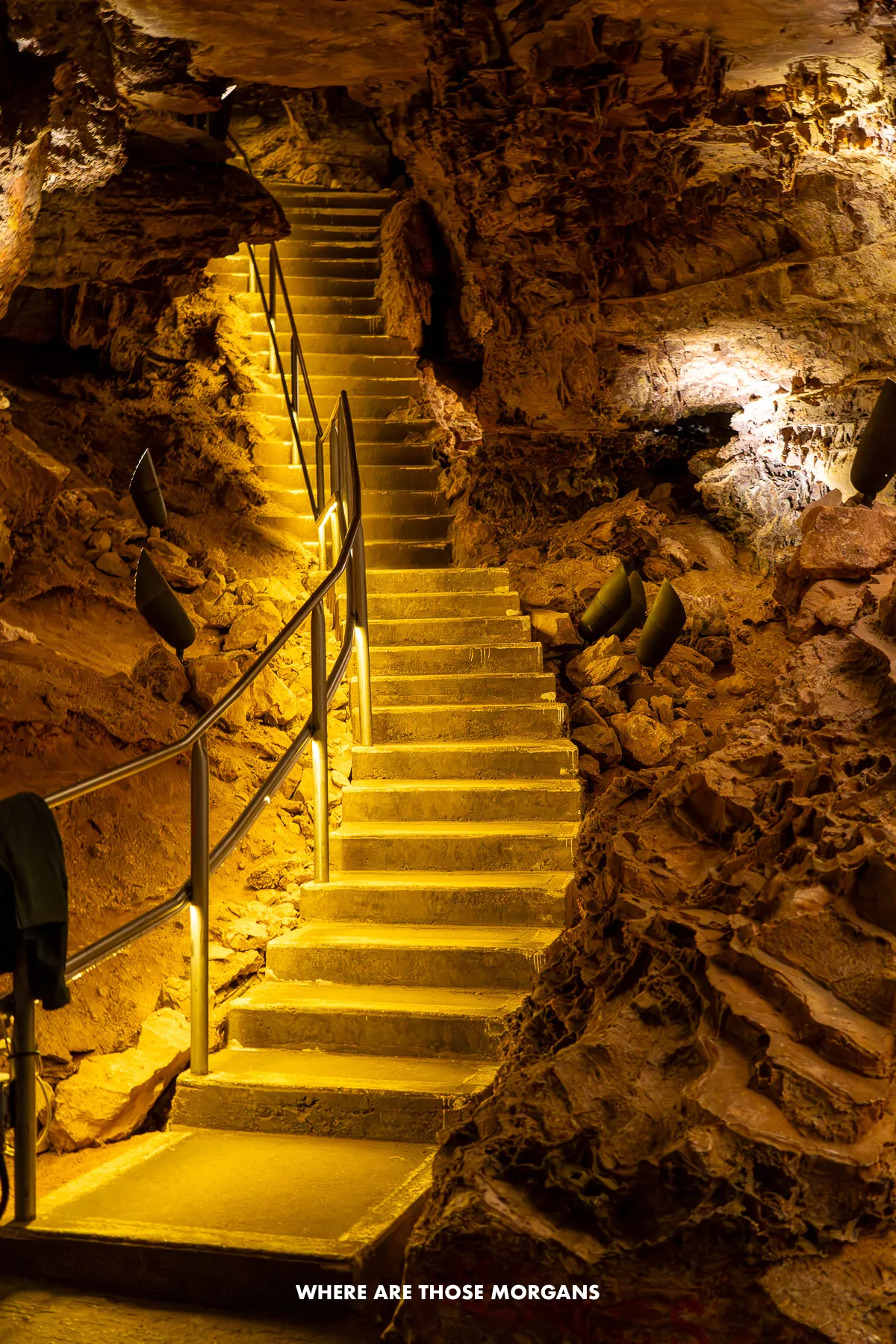
We did the 1 hour 15 minutes long “Natural Entrance” tour, which covered around 0.6 miles underground and had maybe 300 steps. It was very early in the season in April, so we were able to turn up on the day and join the next available tour for $17 each. But if we planned this road trip from May through September, we’d definitely book the 11:20 AM time slot in advance. It’s important to know you must arrive no later than 30 minutes before the tour begins, so that’s 10:50 AM for this itinerary.
After our cave tour, we’d drive back to Custer for a late lunch. Compared to Keystone’s pretty poor offerings, Custer has lots of excellent places to eat – we like Skogen Kitchen, The Custer Wolf and Black Hills Burger & Pizza Co.
Then in the mid-afternoon we’d head up SD-89, turn right onto the incredibly picturesque Needles Highway, and hike the awesome Cathedral Spires Trail (using our Custer State Park pass for entry). Cathedral Spires is a moderately difficult 1.7-mile round trip hike with 500 feet elevation gain through ponderosa pine forest that ends in a kind of amphitheater surrounded granite needle-like rocks. It’s cool.
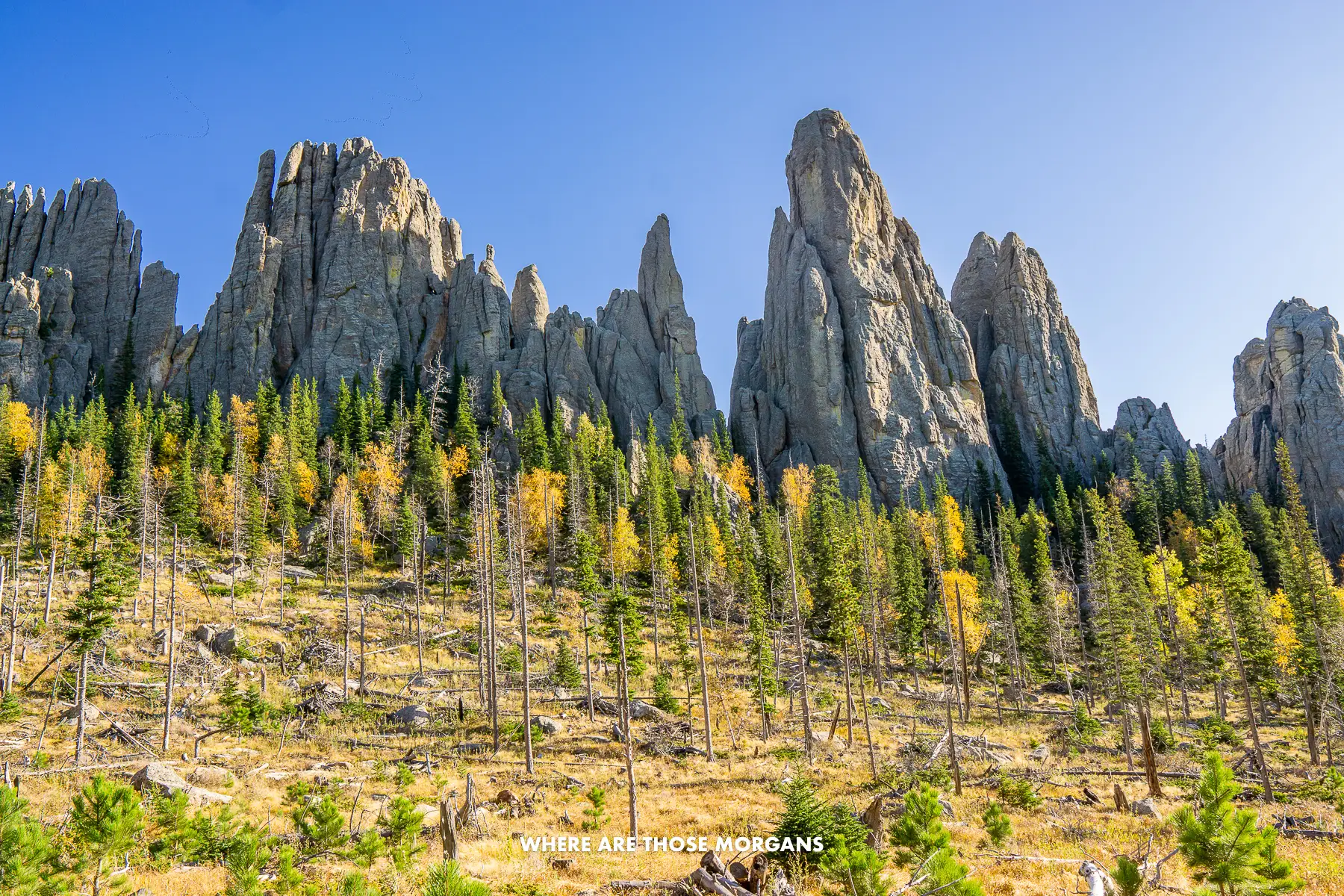
It would be close to sunset by the time we finished the hike, so we’d either drive back along the same section of Needles Highway, or we’d continue driving east to complete the full eastern portion of the scenic highway as it twists and turns through the Black Hills. Once back in Custer, we’d head out for dinner and a beer at The Custer Beacon, before spending a second night at the same hotel.
Kristen’s cave alternative: If Wind Cave tours are sold out for your date or you arrive and there aren’t any same day tickets left, try Jewel Cave instead. It’s 30 minutes drive northwest. They run similar tours and the cave is just as impressive.
Day 4: Black Elk Peak & Spearfish Canyon
- Distance: 103 miles
- Time: 2 hours 33 minutes
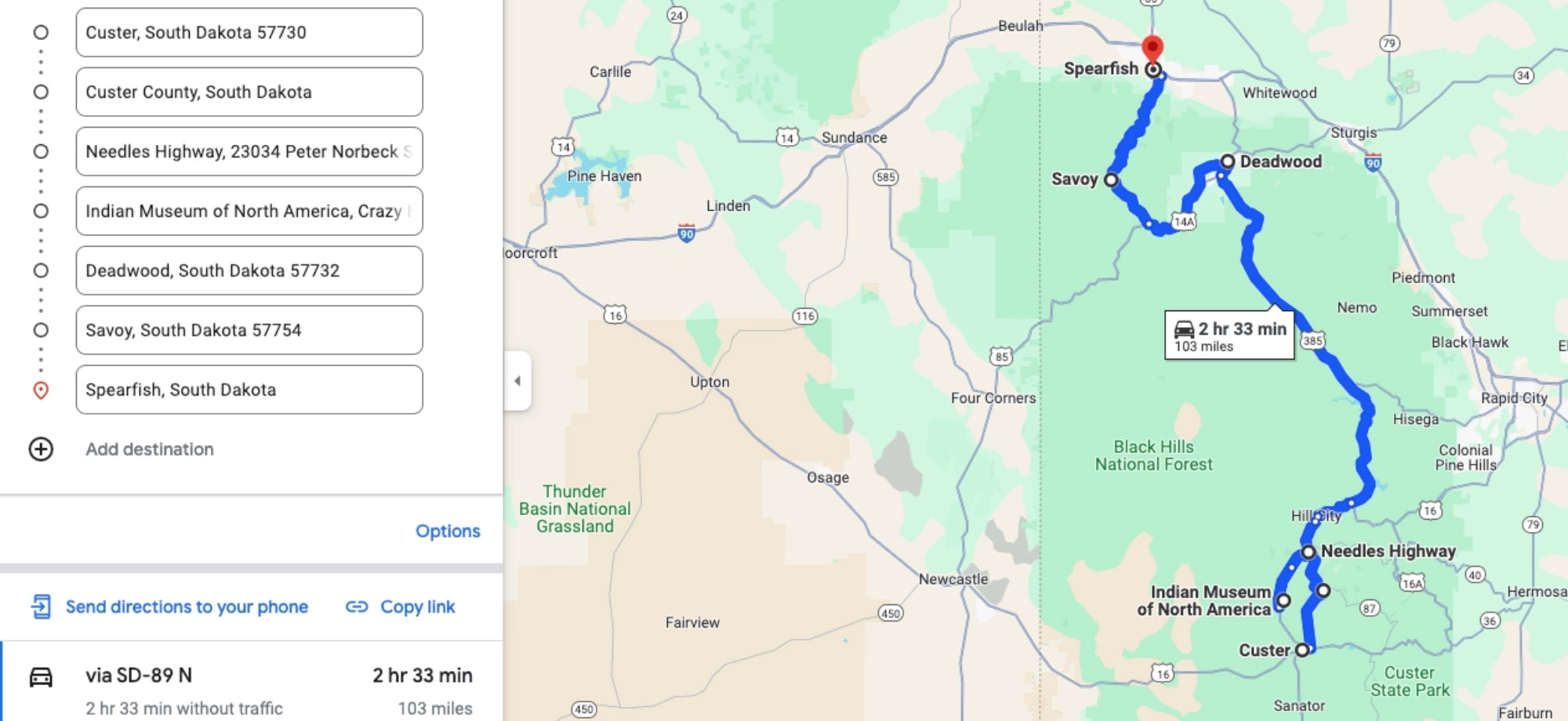
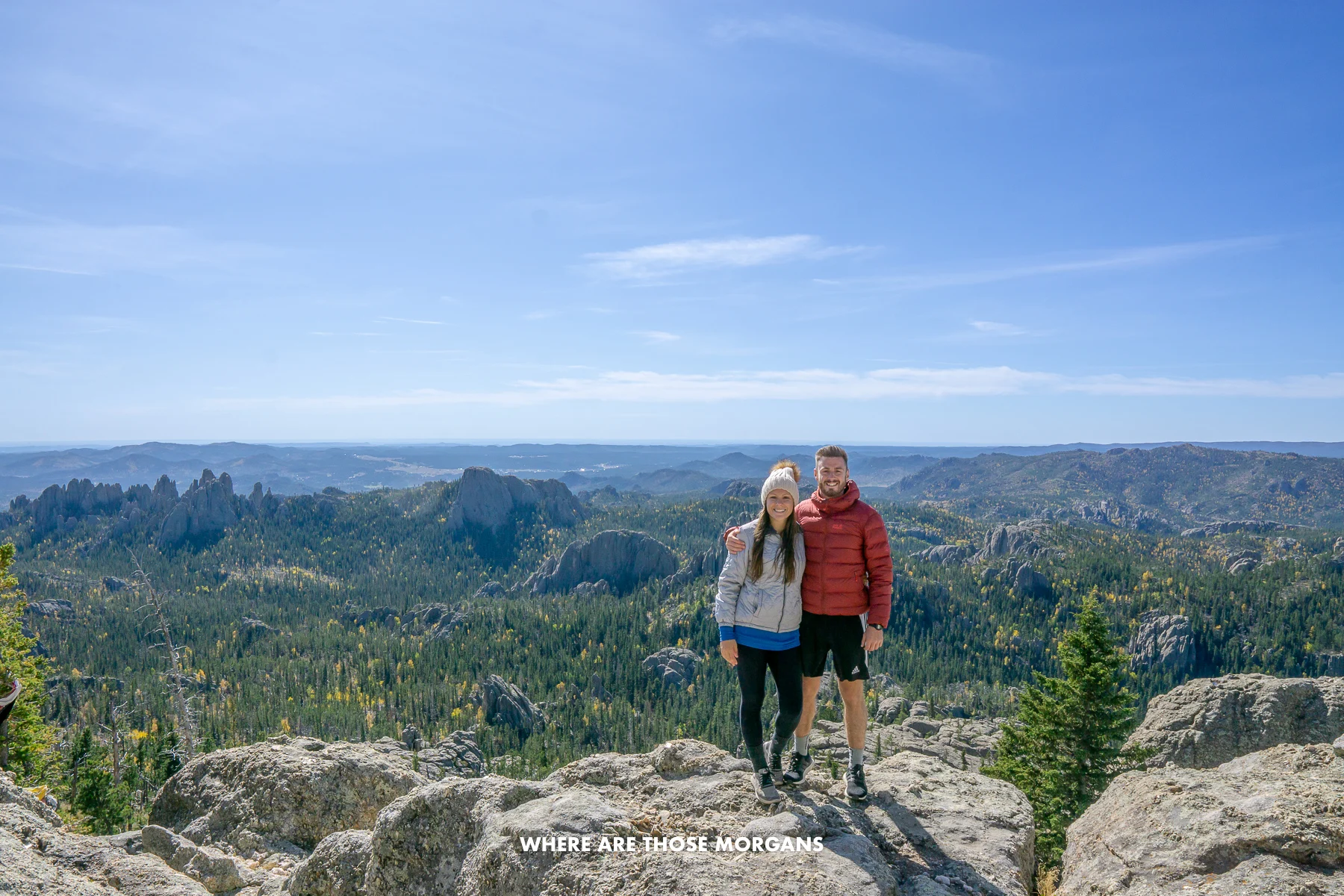
After a hearty early breakfast, we’d drive 15 minutes north to Sylvan Lake, use our Custer State Park pass for entry, and park as the road dead-ends in a circular lot. Then we’d grab our day packs, make sure we had plenty of water and snacks, slap on some sunscreen, and hike the moderately difficult 7-mile round trip Black Elk Peak Trail with around 1,500 feet elevation change.
It took us around 4 hours to climb up trail #9, eat an early lunch at the old stone fire tower with horizon-reaching 360-degree views over 4 US states, then descend on trail #4. The summit views were awesome and we wanted to hike it again in 2021 but it was closed due to heavy snow. On the way back down #4 we would have added a spur hike to Little Devils Tower but we didn’t have time. We’ve included Black Elk Peak in our guide to the top US hiking trails.
We’d aim to be back down at Sylvan Lake by 1:00 PM latest. If we were down much earlier and still had energy, we’d hustle around the adventurous 4-mile Sunday Gulch Trail on the west side of Sylvan Lake. Otherwise, we’d spend half hour chilling by the lake – or we’d jump in the lake if it was a hot day.
Next, we’d hop back in the car and head west on the scenic Needles Highway, stopping for more photos of tunnels and hairpin bends, before arriving into Hill City and grabbing a quick bite at Downtown Deli & Bakery (this only opened in 2024 but looks perfect for a late lunch).
Optional: After Needles Highway and before going to Hill City, you could drive 8 minutes south to Crazy Horse Memorial. We went in 2021, and while it was interesting to learn about the history and construction, we thought it was overpriced at $30 for the two of us (bear in mind Badlands is $30, Yellowstone is $35, and Mt. Rushmore is $10). Having done Crazy Horse, we personally wouldn’t include it in our itinerary if it was our first time again. But that’s just us – if you have a special interest in the history of this site, or you don’t hike Black Elk Peak, now’s the time to visit Crazy Horse Memorial.
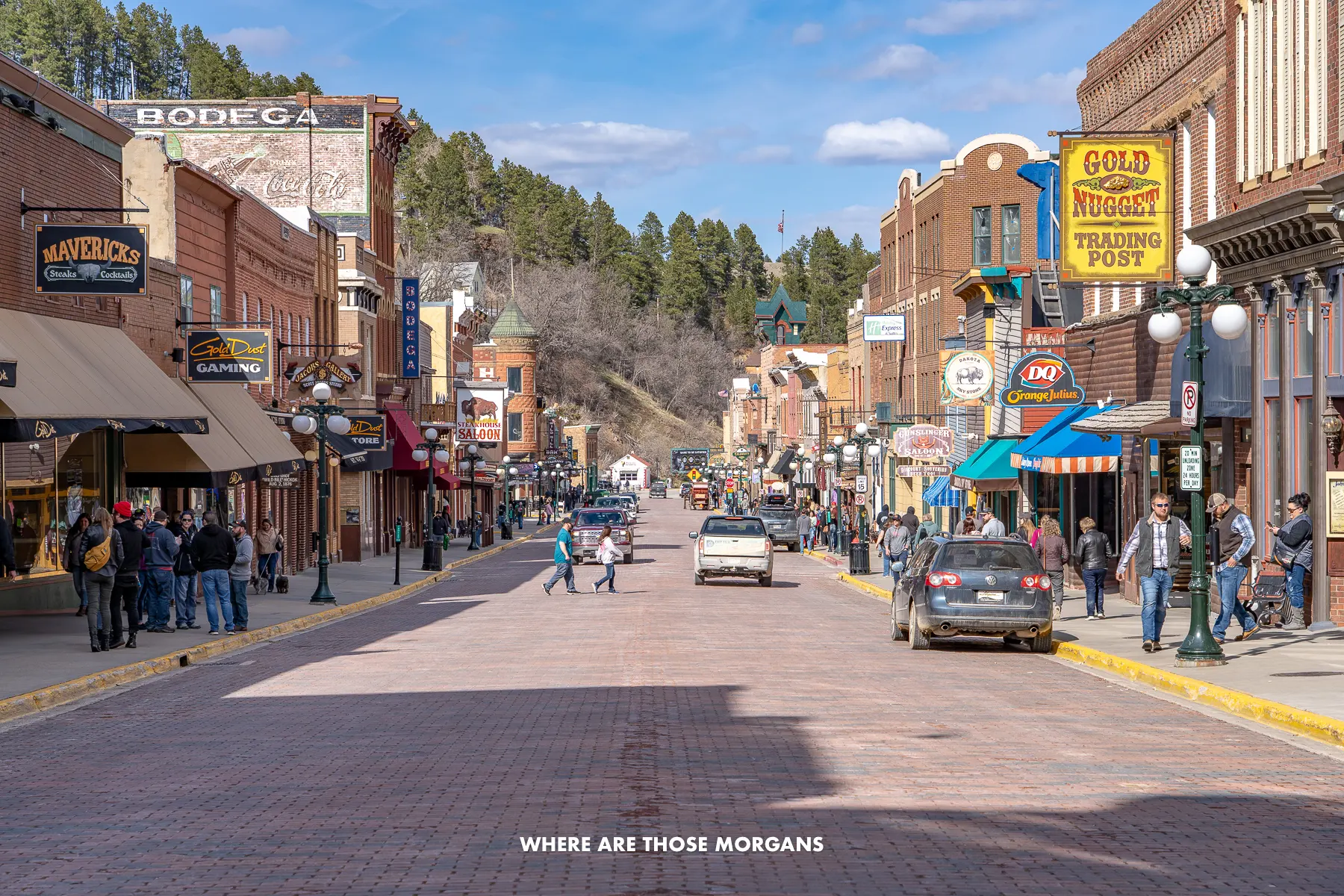
From Hill City, we’d drive 1 hour north to Deadwood. After parking, we’d walk the historic main street to see famous sites referencing wild west gunslingers and cowboys, like Wild Bill Hickok who was shot at Saloon No. 10, Calamity Jane, and Al Swearengen from the HBO series Deadwood. We didn’t expect it to be so casino and bachelor party heavy, but we still enjoyed seeing the preserved late 19th century architecture.
After a quick hot chocolate along Deadwood’s main street, we got back in the car and took 14-ALT through Lead to Cheyenne Crossing and onto the awesome Spearfish Canyon. We had no idea the 20-mile long Spearfish Canyon would be so scenic – it was all gradual downhill cutting through a deep limestone canyon with a 35mph speed limit. We stopped at Roughlock Falls, Eleven Hour Gulch and Bridal Veil Falls, and we actually hiked the fun Devils Bathtub Trail.
Once we arrived in Spearfish in 2021, we grabbed dinner at Killian’s and checked into Best Western Black Hills for an early night, ready for the big driving day on day 5. It worked really well, but next time we’d consider booking Spearfish Canyon Lodge to stay inside Spearfish Canyon for a more secluded experience.
Mark’s lodging tip: Spearfish was very quiet which worked well for us getting an early night. If you want something a bit more lively on day 4, stay at Celebrity Boutique Hotel or The Lodge At Deadwood in the much more vibrant Deadwood instead, and begin with Spearfish Canyon first thing the next morning.
Day 5: Devils Tower & Cloud Peak Skyway
- Distance: 361 miles
- Time: 6 hours 5 minutes
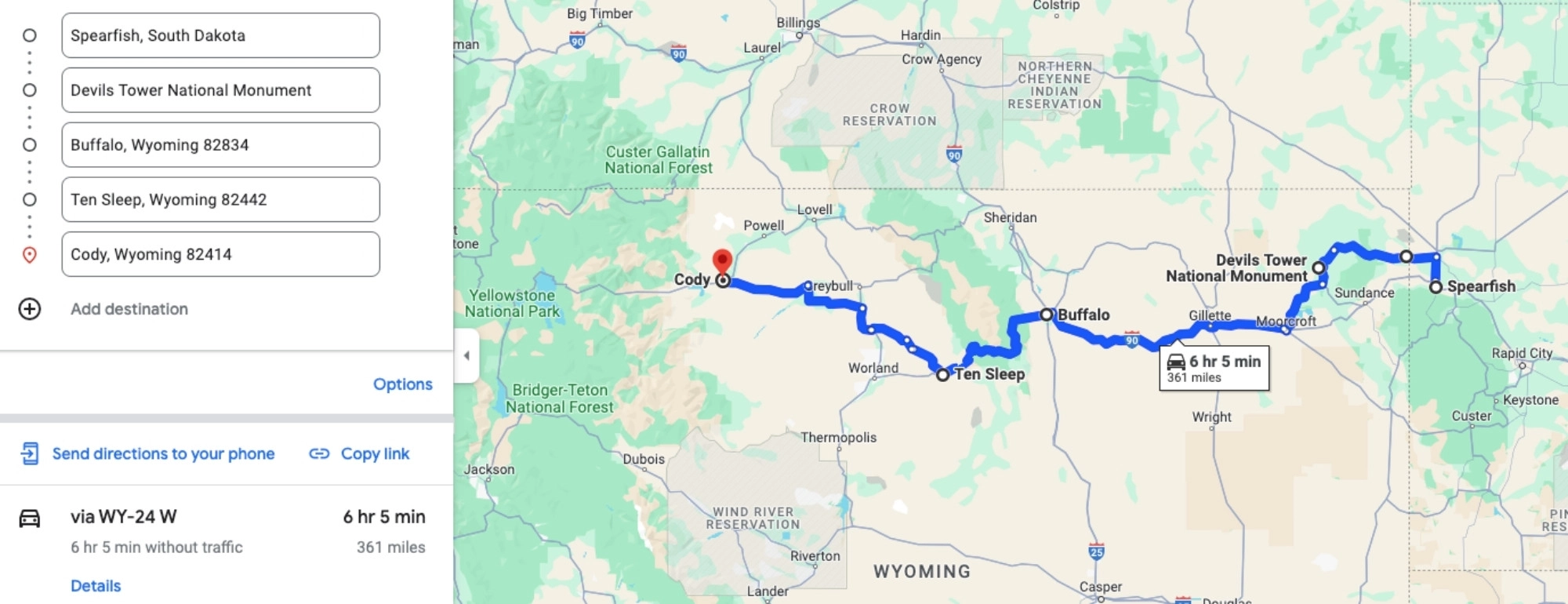
We know 361 miles and 6 hours 5 minutes of driving doesn’t sound like it’s going to be a fun day. But trust us, after doing it twice we can tell you it’s not as bad as it sounds. The worst part of the day for us both times was the boring stretch of I-90 from Moorcroft to Buffalo, otherwise it’s a super-scenic route with barely anyone else around.
From Spearfish, we drove for just over 1 hour on US-85, SD-34, and WY-24 to Devils Tower National Monument because we knew it would be quieter and more enjoyable than the slightly quicker I-90 route. After using our America the Beautiful Pass for entry (it costs $25 per vehicle without a pass), we drove straight to the top and parked at the visitor center at around 9:00 AM.
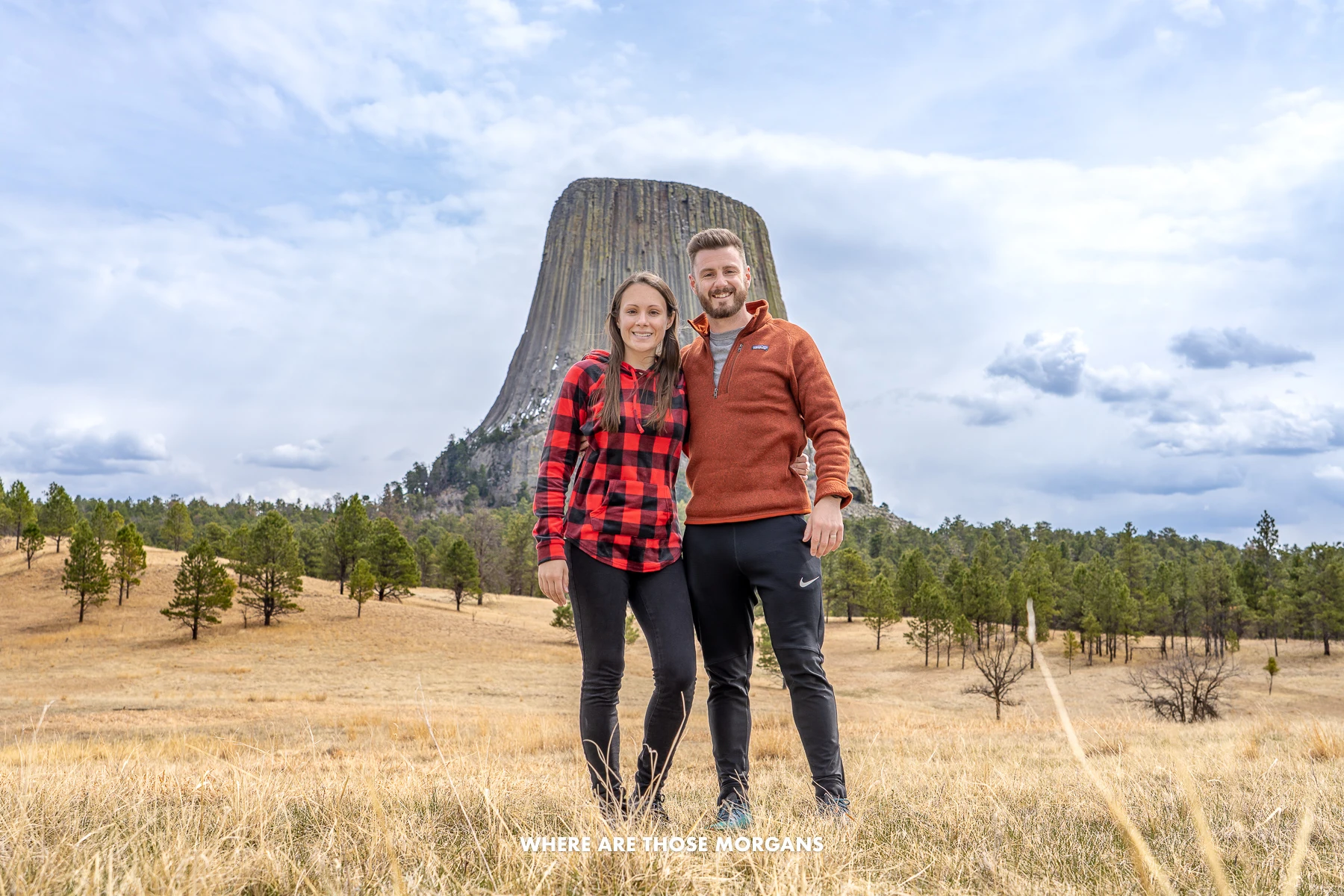
The first thing we did after arriving was slowly walk an easy, flat and paved path leading around the base of Devils Tower. It was well worth doing because it gave us different perspectives of the unique igneous rock columns, and we saw climbers way up near the top. Afterwards, we stopped at Joyner Ridge Trailhead for the best middle-distance view looking back over the tower. This is where we got our favorite photos.
We did also stop a few more times on the way out of Devils Tower but none of them were worth it, so straight from Joyner Ridge we’d drive south to Moorcroft and get on I-90 until stopping for lunch in Buffalo. We ate at the Busy Bee Cafe right above Clear Creek. From Buffalo, we had two route options to reach Cody – Cloud Peak Skyway or Bighorn Scenic Byway. We chose the quicker Cloud Peak Skyway in 2019 and loved it so much that we picked the exact same route again in 2021.
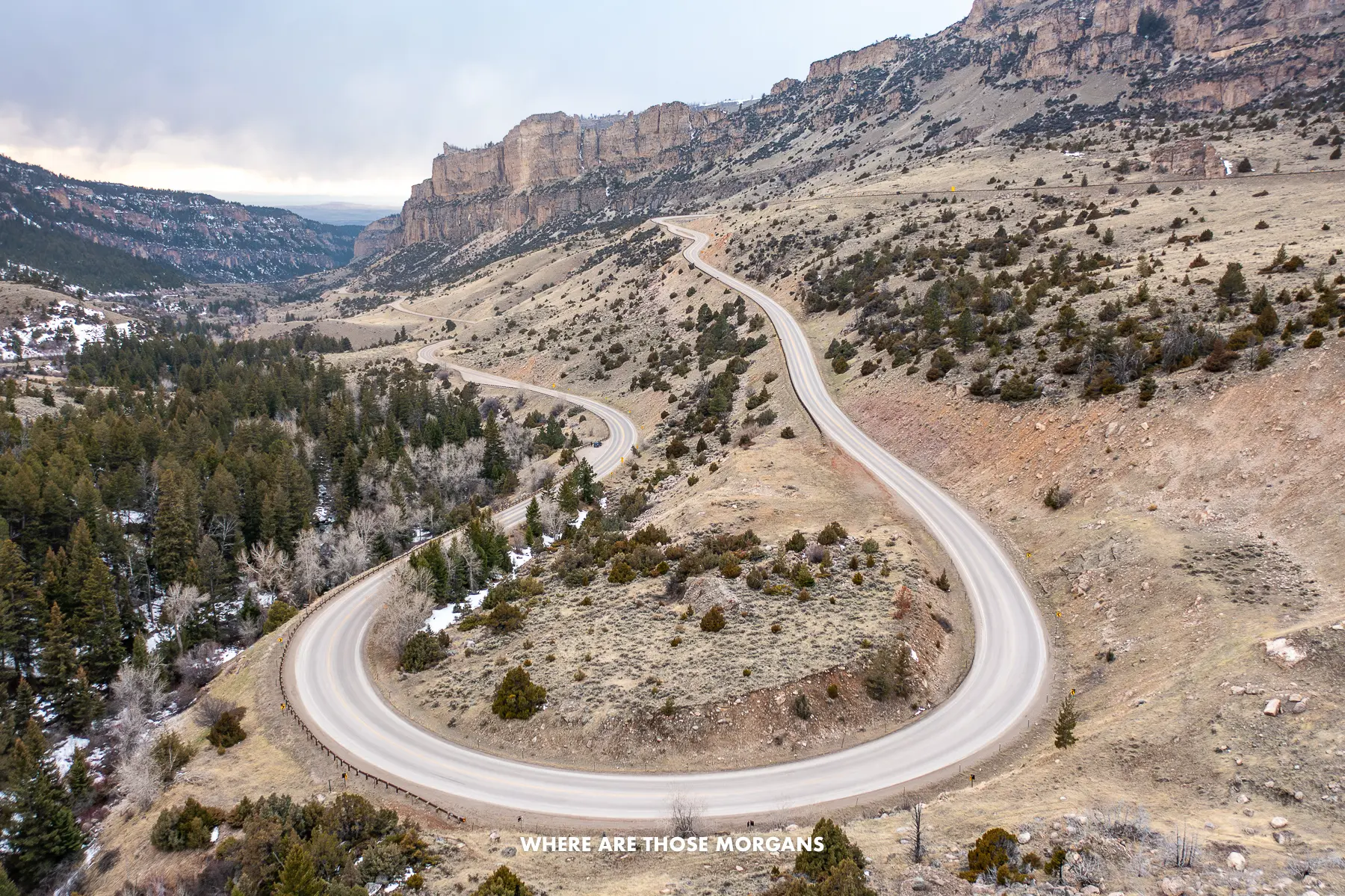
The Cloud Peak Skyway from Buffalo to Ten Sleep is non-stop scenery, views and fun driving. It climbs the southern Bighorn Mountains then drops into a dramatic narrow canyon, and we even put our drone up for a few photos the second time. Both times we drove from Ten Sleep to Cody, we honestly saw maybe 2 or 3 other cars.
After arriving into Cody, we’d have a quick look around the Buffalo Bill Center of the West before it closed at 5:00 PM, then we’d grab dinner at 8th Street at the Ivy or Michael’s Tacos, before checking into the budget Cody Cowboy Village, the mid-range The Cody Hotel, or the luxury Chamberlin Inn. We stayed in Cody before entering Yellowstone both times we drove this road trip, but the alternative at this point is to continue into the park through east entrance and stay at Lake Yellowstone on night 5 instead.
Optional: We had quite a few comments and emails asking about how to include Little Bighorn Battlefield into the drive from Mt Rushmore to Yellowstone. If you want to add it, head north on I-90 from Buffalo but instead of turning off for Bighorn Scenic Byway, keep driving for 1 more hour into Montana to the National Monument. Then simply turn around, and take Bighorn Scenic Byway to Cody later in the day.
Like this post? Get the full guidebook.
Get our full tips, recommendations and bonus daily route maps as a downloadable PDF, yours to keep, offline-ready, for $9.99.
Day 6: East & Northeast Yellowstone
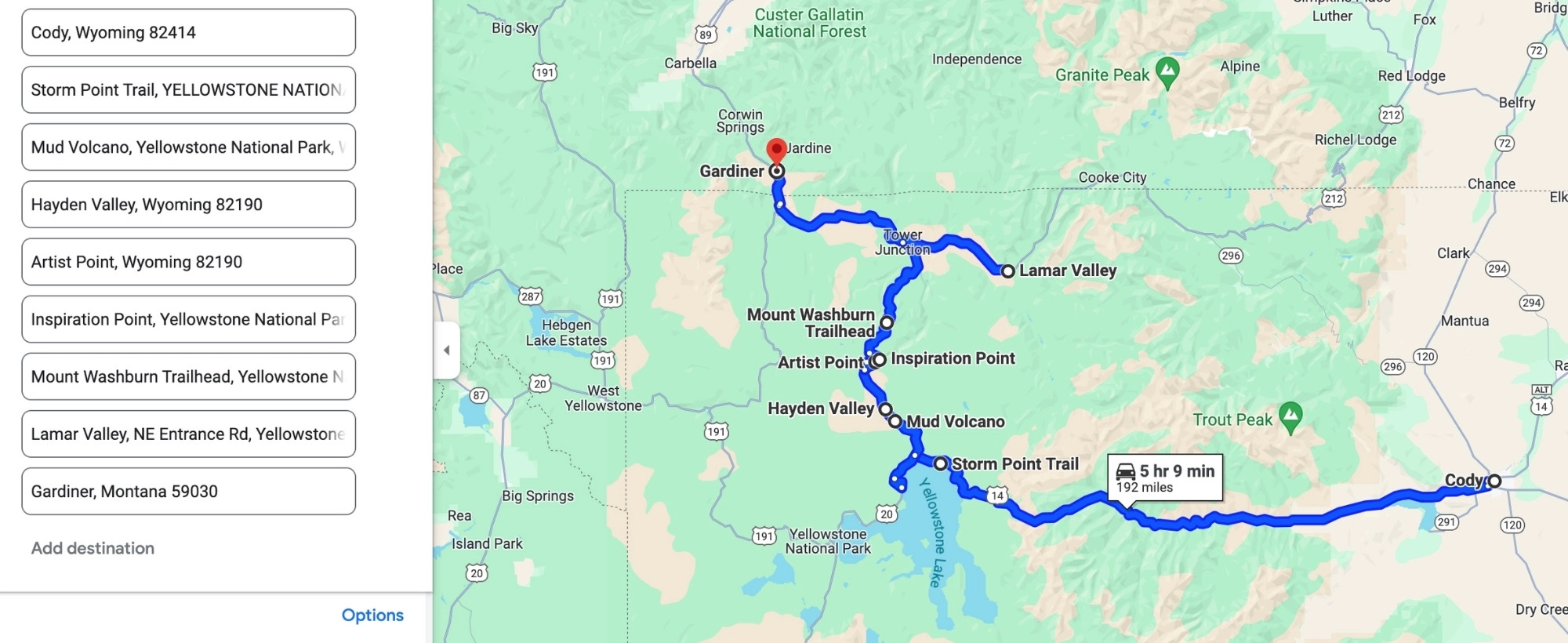
- Distance: 192 miles
- Time: 5 hours 9 minutes
Funnily enough, both times we stayed in Cody, the next day we couldn’t actually enter Yellowstone via its east entrance which is the whole point of staying there. In October 2019, the road was technically open until the end of the month, but a big snow storm passed through overnight and we woke up to them closing the road, so we had to drive Chief Joseph Scenic Byway and enter through Cooke City instead.
Then in April 2021, the road from Cody to Yellowstone Lake wasn’t even open for the season. We knew that, but we liked Cody and the drive in through Cooke City and Lamar Valley (which is open year round) from our first time, so the plan was to go the exact same route. Only this time we had an even bigger snow storm overnight – and this one closed east entrance, Chief Joseph Scenic Byway, and even Cooke City. So we had to drive from Cody to Gardiner, which took us almost 4 hours. That was the trade-off we had for fewer crowds.
If it was our first time, we’d still go through Cody but we’d plan the trip in June or September to avoid these unexpected closures. So having already double checked east entrance is open (it’s usually open start of May until end of October), we’d get a very early start, eat a decent breakfast in Cody, and head west to Yellowstone Lake via the park’s east entrance. Yellowstone entry costs $35 per vehicle, but we’d use our America the Beautiful Pass.
A little known secret is that east entrance approach and Yellowstone Lake can have decent amount of active wildlife early in the morning, so we’d keep our eyes peeled. If we wanted a real challenge, we’d consider hiking Avalanche Peak on the way in, but that would eat into our day too much so we’d probably leave it for this trip. Instead, we’d blow the cobwebs off with a gentle walk along the easy trail to Storm Point for cliffside views over Yellowstone Lake.
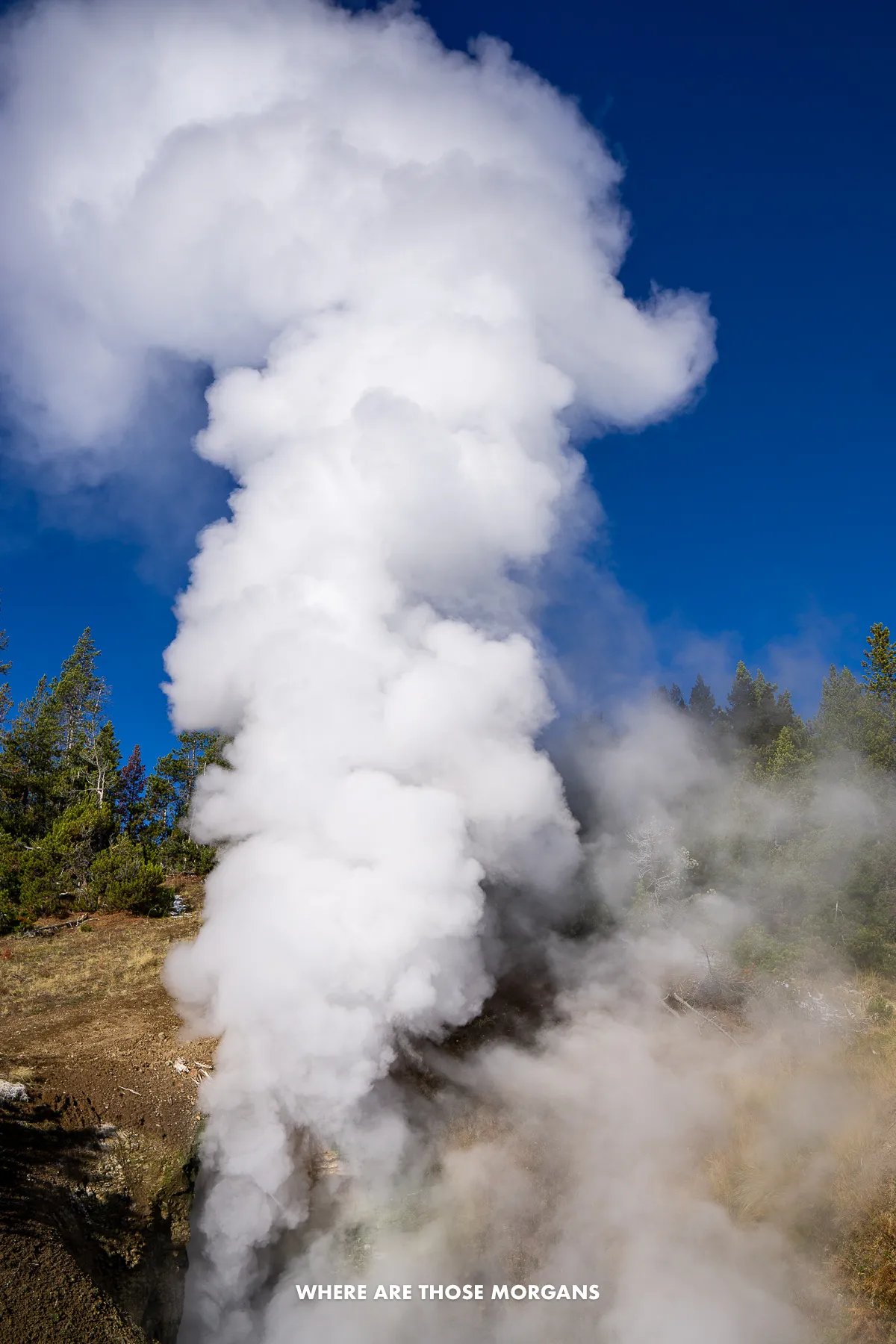
Next, we’d turn right onto Yellowstone’s Grand Loop Road and drive 10 minutes to see the Mud Volcano. We remember this thermal area being one of the smelliest and ugliest in the park, but in a good way. Dragon’s Mouth Spring is the standout feature, it’s like a cave opening with hot water churning, loud crashing sounds and steam intensely billowing out. The bubbling mud pots here are also well worth the stop.
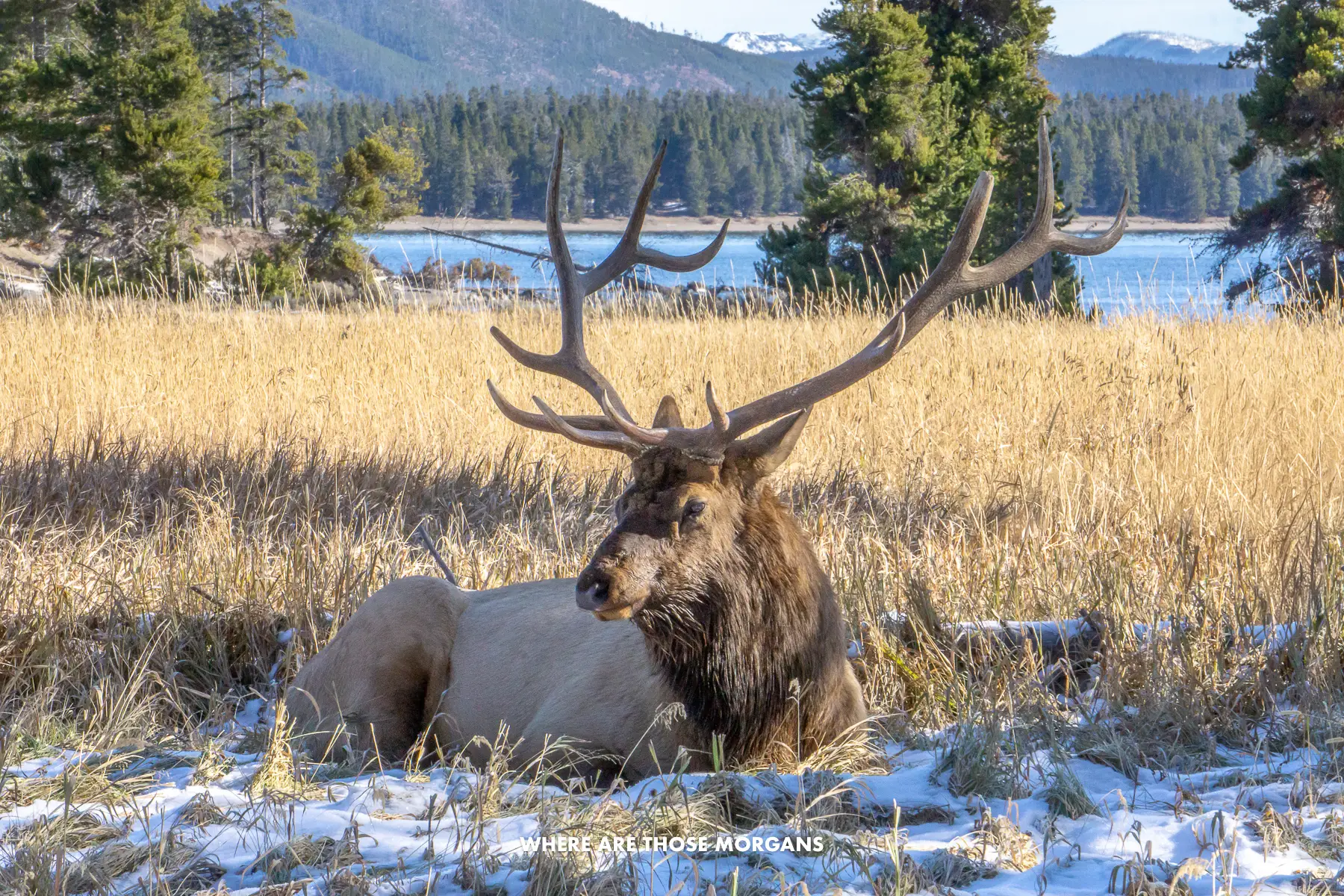
It’s a 20 minute drive from Mud Volcano to Grand Canyon of the Yellowstone without stopping, but we would plan to stop often because this stretch is called Hayden Valley, and it’s one of the best wildlife spotting areas in the park. Animals tend to disappear during the day, so we’d make sure it wasn’t too late in the morning by the time we arrived into Hayden Valley – we’ve seen coyotes, elk, and bald eagles here across our two trips.
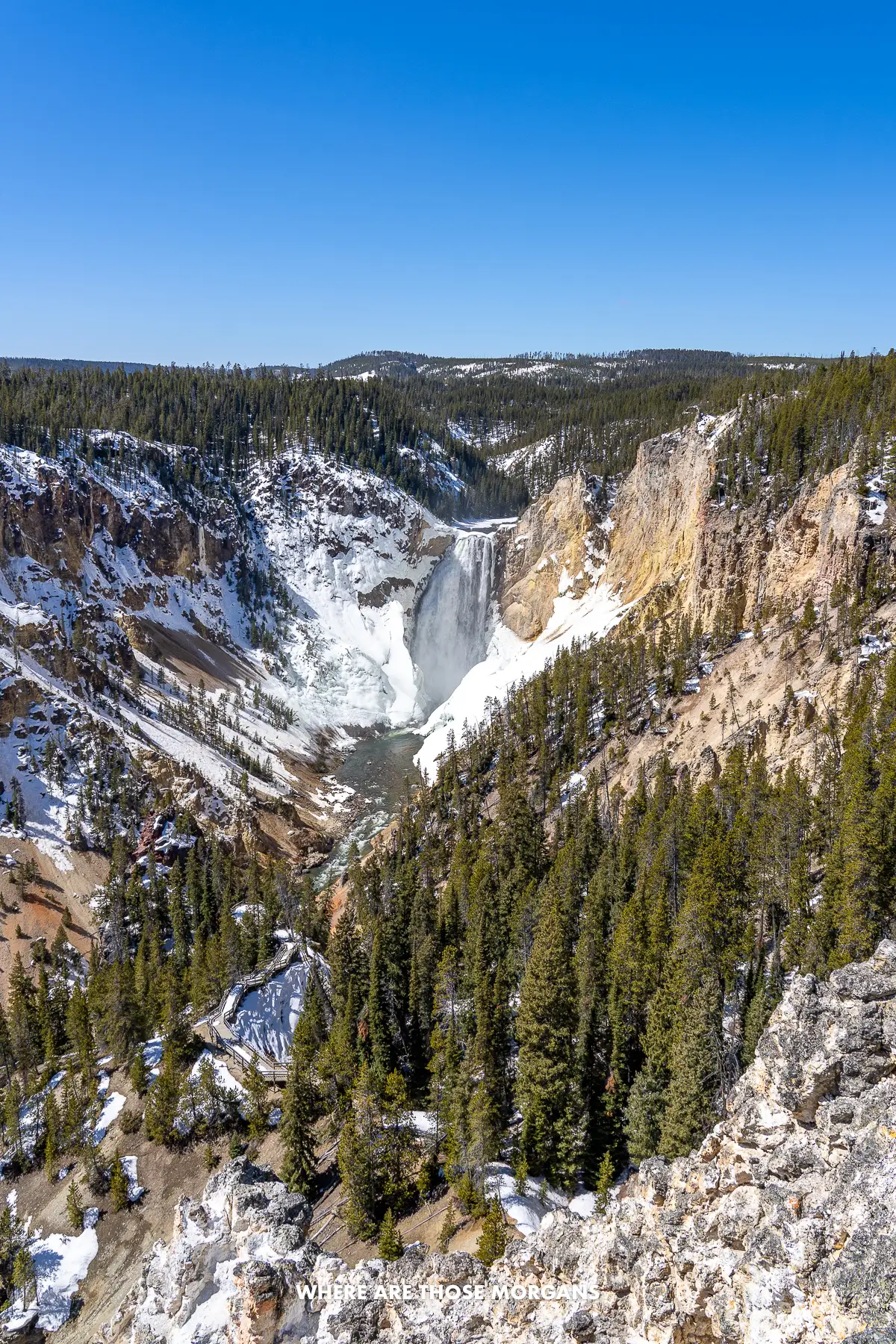
After hopefully seeing loads of wildlife, we’d take a right onto S Rim Drive to see the Grand Canyon of the Yellowstone close up. First, we’d stop at Upper Falls View for a quick photo, then we’d head back to the best viewpoint of Lower Falls called Artist Point at the end of the road. We photographed a moody sunrise from here in 2019. Next, we’d switch sides of the canyon and take N Rim Drive for more views from different perspectives.
By now we’d be starving, so we’d definitely stop at Canyon Village for lunch. We actually stayed at Canyon Lodge in 2019 and ate dinner at Canyon Eatery – it was like a buffet-style canteen, the food was okay, it did what it needed to. On the plus side it was very quick, which helps with this itinerary because there’s a lot more to get through.
After lunch we’d drive 10 minutes north to Dunraven Pass and hike the most popular trail in Yellowstone to the summit of Mount Washburn. It’s a 7-mile round trip hike with 1,400 feet elevation gain, and we’d expect it take us a good 4 hours if we didn’t hang around. We’re still yet to hike it because the road was closed both times we visited Yellowstone, but we’d add it to our itinerary if it was our first time and we visited between mid-May and mid-October when the road is open.
Back in the car, we’d drive 20 more minutes north and park at Tower Falls Trailhead. We’d take a short and easy walk to see Tower Fall at a minimum, and if we felt like we had time and energy we’d consider going down the steep switchbacks for a close up of the canyon (this is not essential and we only recommend it for strong hikers).
No matter how we spent the afternoon, we’d prioritize driving into Lamar Valley around dusk. Even if we had to skip something else like hiking Mt. Washburn, we’d make sure to be out in the heart of Lamar Valley as darkness creeps in because it’s the best place in Yellowstone for wildlife. We’ve only driven through it during the day and with snow on the ground, but we know it can be like a theme park in peak season, so we’d drive up to Slough Creek Campground and hope to see more animals away from the main road.
Now, we’d have a few options for where to stay on night 6. Roosevelt Lodge is the most efficient place for doing Lamar Valley at dusk and then again at dawn, but the only food option isn’t great and the lodge sells out quickly. Our in-park alternative would be Mammoth, either the lodge or cabins – we stayed in a cabin in 2019 and enjoyed it, but again we were limited to the Mammoth Dining Room for dinner and breakfast.
That leaves Gardiner just outside park boundaries near Mammoth, which has plenty of hotels and restaurants. If we needed to do it on a budget we’d stay at Yellowstone Big Rock Inn, otherwise we’d stay at Yellowstone Riverside Cottages or Yellowstone Gateway Inn again – we’ve done both and they were superb. Staying in Gardiner would give us more choice over food, but it would also mean more driving.
Kristen’s no hiking tip: We have to admit this day would be a bit of a rush with the Mt Washburn hike included, so if we wanted a more relaxing experience we’d skip the hike, slow down, and make the other stops last a bit longer.
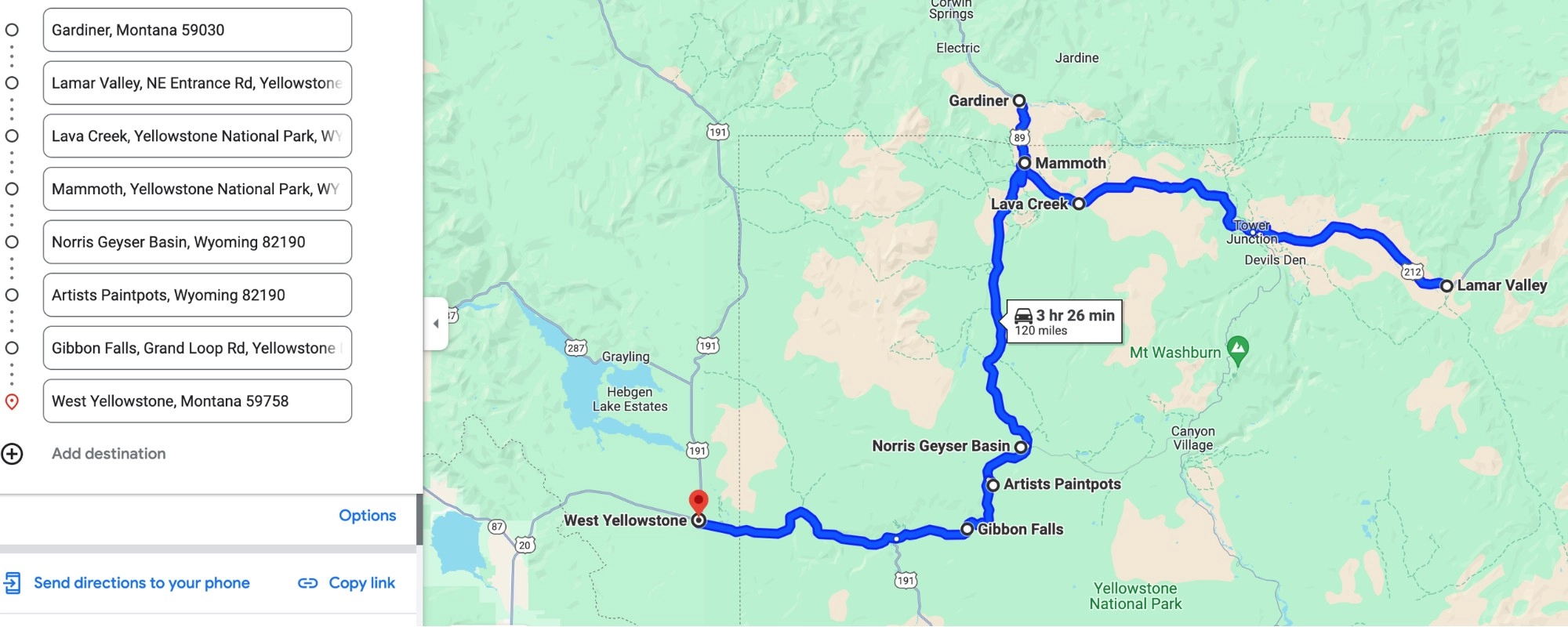
Day 7: North & West Yellowstone
- Distance: 120 miles
- Time: 3 hours 26 minutes
We love hiking, and we typically put trails at the top of our list wherever we go. But in our opinion Yellowstone isn’t a place to prioritize hikes, it’s a place to prioritize two things – geyser basins and wildlife. They are what make this place so unique. So no matter where we spent night 6, we’d set an early alarm and make our way back into Lamar Valley for dawn (well before sunrise) for our best shot at seeing active animals, before the first wave of morning crowds arrived and scared the wildlife away.
After a (hopefully!) successful sunrise with wolf, elk, bison, and maybe even grizzly bear sightings, we’d make our way to Mammoth Hot Springs. If we really did want to do a bit of exercise, we’d stop on the way across and hike the short and easy trail called Lava Creek to Undine Falls. Otherwise, we’d wait until Mammoth, where we’d slowly walk the upper and lower boardwalk trails leading to vibrant staircase-like travertine terraces.
Both times we visited the Mammoth area, we spent a good two hours enjoying the unique geothermal features. Nowhere else in the park is like it, so again we’d make sure we gave ourselves plenty of time to see it all. By now, we’d definitely be ready for a spot of lunch, so we’d either eat at Mammoth Dining Room, or we’d drive 10 minutes to Gardiner for more food options like the popular Cowboy’s Lodge and Grille and Paradise Deli for a tasty sub or salad.
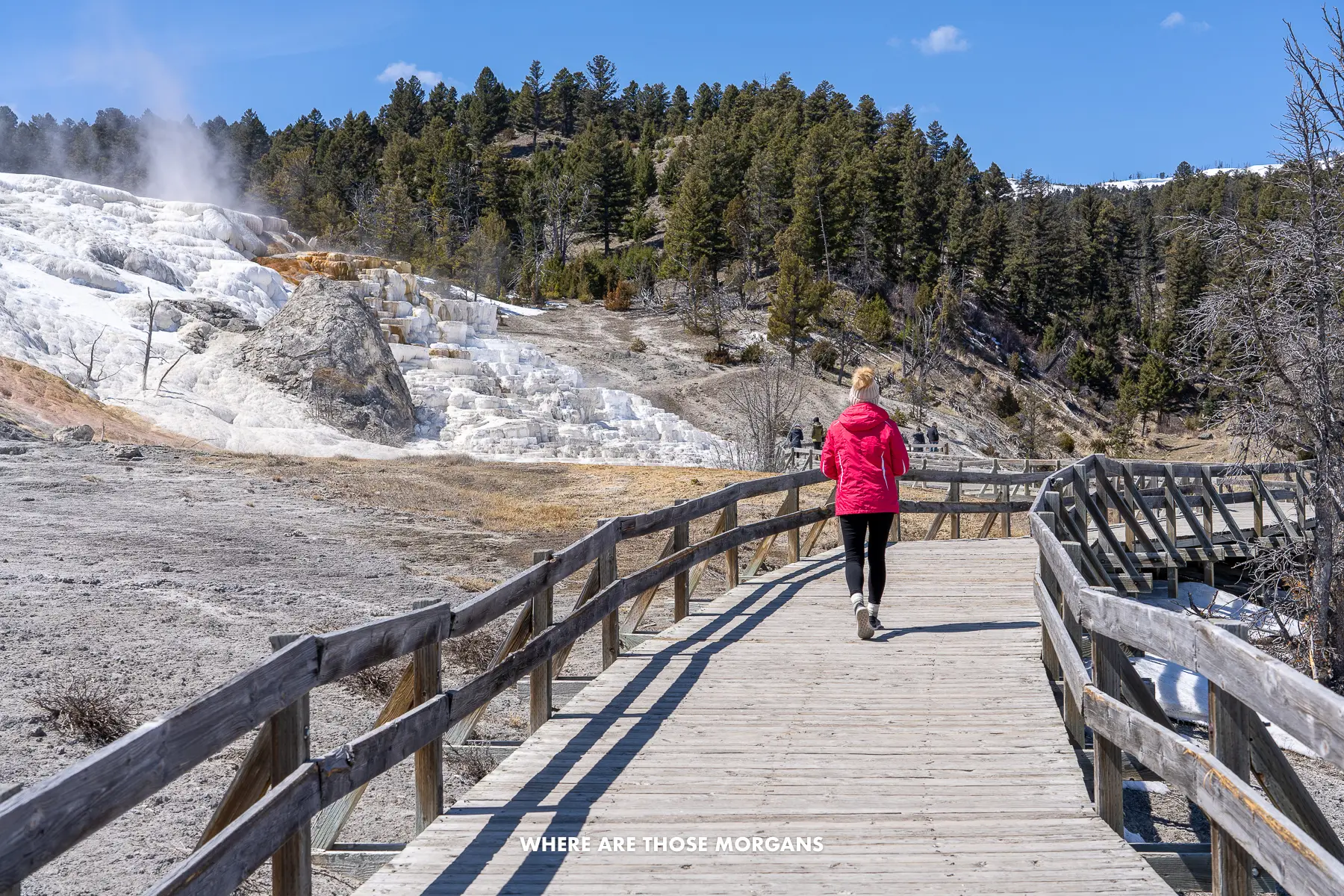
After lunch we’d make our way south on Grand Loop Road. We’re almost certain we’d see bison walking on the roads around Mammoth Village (both times we visited there were loads roaming around the whole area), but we’d be hoping to get stuck in another proper bison jam a little further down the road after leaving Mammoth. Along with a few other cars, we had to pull over and wait for a good 3 or 4 minutes for a massive herd of bison to pass by on the road in 2021, which was cool to see.
One thing that surprised us first time around was how little there was to see between Mammoth and Norris Geyser Basin. We had another look on our second trip, but confirmed nothing was worth the time. So we’d wait until reaching Norris to get out of the car again. Now, Norris is split into two distinct sections called Back Basin and Porcelain Basin, and it’s one of the most significant geyser basins in Yellowstone, so we’d allow for a good few hours to see both sides.
Why is Norris significant? It’s the hottest geyser basin in the park, it has the world’s tallest active geyser called Steamboat Geyser (which we watched erupt several times), and it’s one of the most geologically active thermal areas. We also found Norris to be less manicured, and a bit more alien-looking than any other basin. So other than the Old Faithful area (which we get to on day 8), we think Norris is one of the most interesting basins in Yellowstone. Another of our favorites was the unusual deep red colored Echinus Geyser, which is an acid-water geyser, rather than alkaline.
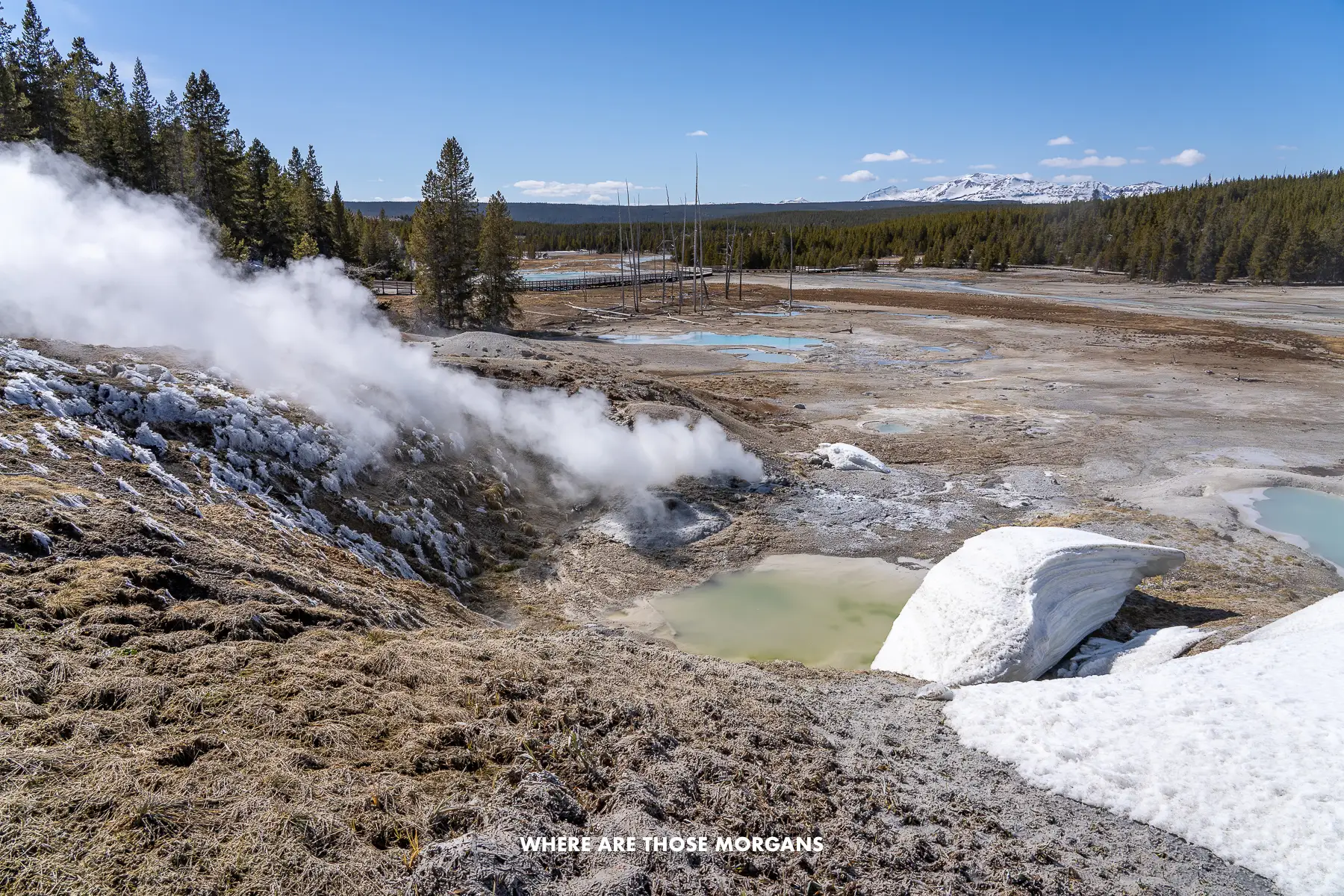
After Norris, we’d drive through the beautiful Gibbon Meadows, turn left and park to hike what we think is one of the best hidden gems in Yellowstone called Artists Paintpots Trail. It’s an easy 1-mile round trip walk that leads to a loop at the end with our favorite bubbling mud pots and colorful pools (the orange colored pools are super intense). We’d definitely do Artists Paintpots again if it was our first time, but walking the loop at the end is important because that’s where the bubbling mud is found.
Next on the road is Monument Geyser which we haven’t done yet, and we’d probably skip it again next time. We would stop on the roadside to quickly see Gibbon Falls because it requires no effort at all. Terrace Spring is another easy stop to make but we don’t think it’s essential. Then there’s Purple Mountain Trail which looks awesome but it’s a bit of a beast and we wouldn’t have time.
Instead, we’d leave the park via west entrance and arrive into West Yellowstone. We’d check into the budget Elkhorn Cabins, the mid-range Kelly Inn, or the luxury Explorer Cabins, and then go out for dinner at Firehole Bar-B-Que.
Kristen’s in-park lodging tip: Logistically speaking, it would be more efficient to stay at either Old Faithful Inn or Old Faithful Lodge Cabins instead of West Yellowstone. Plus, it’s cool to stay in the park. Check for availability and prices at the lodges and compare to hotels outside the park. Just remember, outside the park you’ll find much better food options, and some hotels have indoor pools for the kids.
Day 8: Southwest Yellowstone
- Distance: 64 miles
- Time: 1 hour 45 minutes
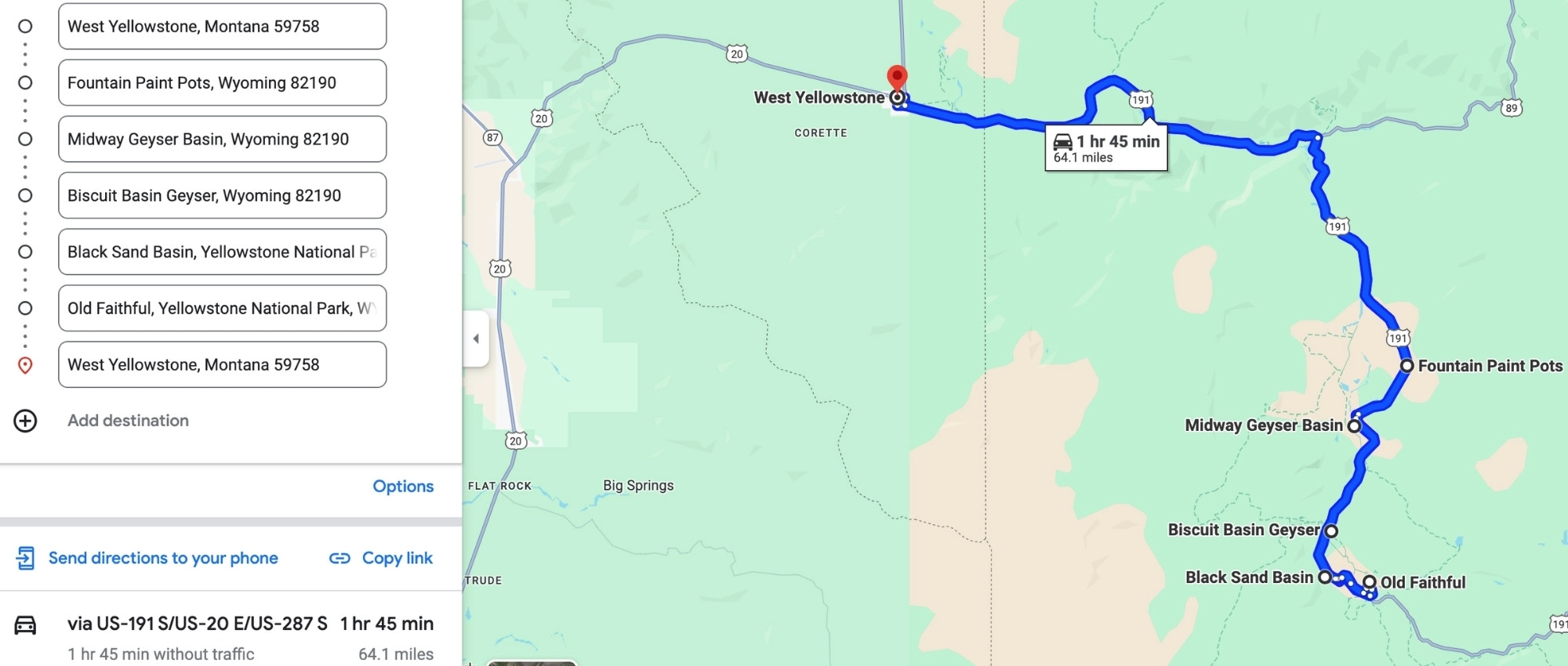
This is the big hitter day dedicated to enjoying the best of what makes Yellowstone so famous; unique geysers and vibrant hot springs. But it’s also a more relaxing day with less driving and more geothermal action, which would make a nice change from spending so much time in the car. We’d actually allow ourselves a more chilled morning to recharge the batteries, and eat a slow-paced breakfast at Running Bear Pancake House.
Then we’d change into swimming gear, pack towels and spare clothes, jump in the car, enter the park with our America the Beautiful Pass, get on the Grand Loop Road heading south and then take a right turn onto the one-way Firehole Canyon Road. First, we’d pull over to see Firehole Falls, it’s nothing special but worth a quick stop. Then we’d continue until near the end of the one-way road and park near the vault toilets. We’d descend the boardwalk, navigate the rocks, and get in the thermally-heated Firehole River for a swim (it’s about 80°F or 27°C).
Swimming in the river would be a unique experience, but we’re yet to do it because it’s only open late May through early September. Dried and changed, our next stop would be Fountain Paint Pot Trail in Lower Geyser Basin. It’s a short boardwalk loop, so we’d only need 30 minutes here to snap photos of the billowing geysers and fumaroles.
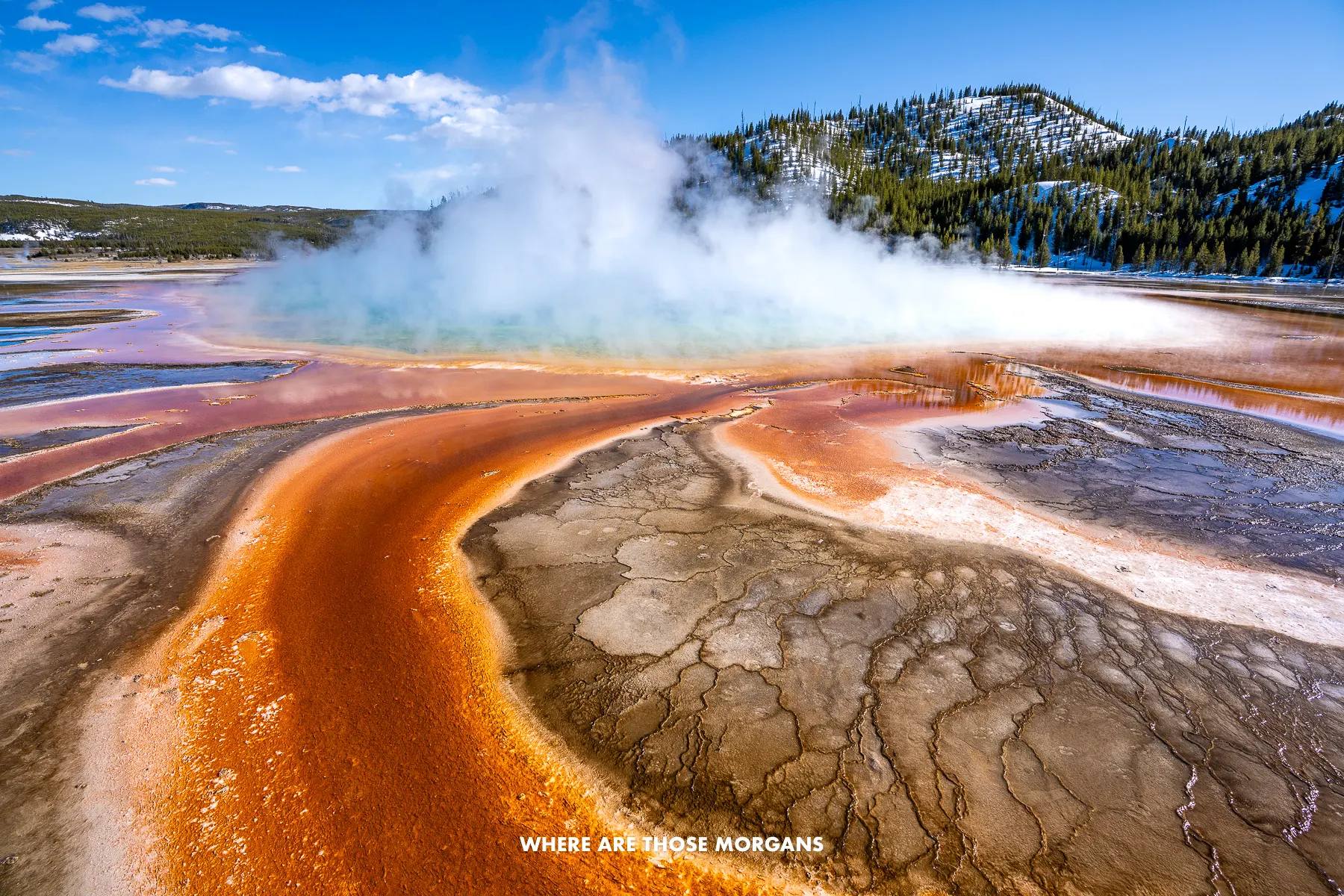
Next, we’d drive down to Midway Geyser Basin, cross the Firehole River Bridge and go clockwise around the wooden boardwalk. We’d pass by the super-steamy Excelsior Geyser Crater first, this was frozen solid one time and so steamy we couldn’t even see the water the other time we visited. Then we’d reach one of our favorite features in the entire park, the striking Grand Prismatic Spring. The colors are almost unbelievably vibrant, like someone has painted it using only the brightest versions of each color. And to complete the loop, we’d snap photos of Opal Pool and Turquoise Pool on the way out.
Our next stop would be Fairy Falls Trail parking lot, so we could hike the first 0.7 miles (1.4 miles round trip) to reach Grand Prismatic Spring Overlook and take the most iconic Yellowstone photo. If we had plenty of time and energy, we’d continue hiking the full easy 5-mile round trip trail to the stunning Fairy Falls waterfall. As travel photographers, we were gutted Fairy Falls trail was closed both times we visited Yellowstone, the first time due to snow and the second time due to heavy grizzly bear activity.
After the hike we’d continue south, park at Biscuit Basin, see Black Opal Pool, walk the boardwalk loop and then hike the easy 2.3 mile round trip trail to Mystic Falls. A little further south we’d pull in for a quick walk around the small Black Sand Basin and to see Emerald Pool. Then we’d drive into the massive sprawling Old Faithful complex, park our car, and head into Old Faithful General Store Grill for a very late lunch at the only decent eatery. There are other food options here, but honestly they’re not great.
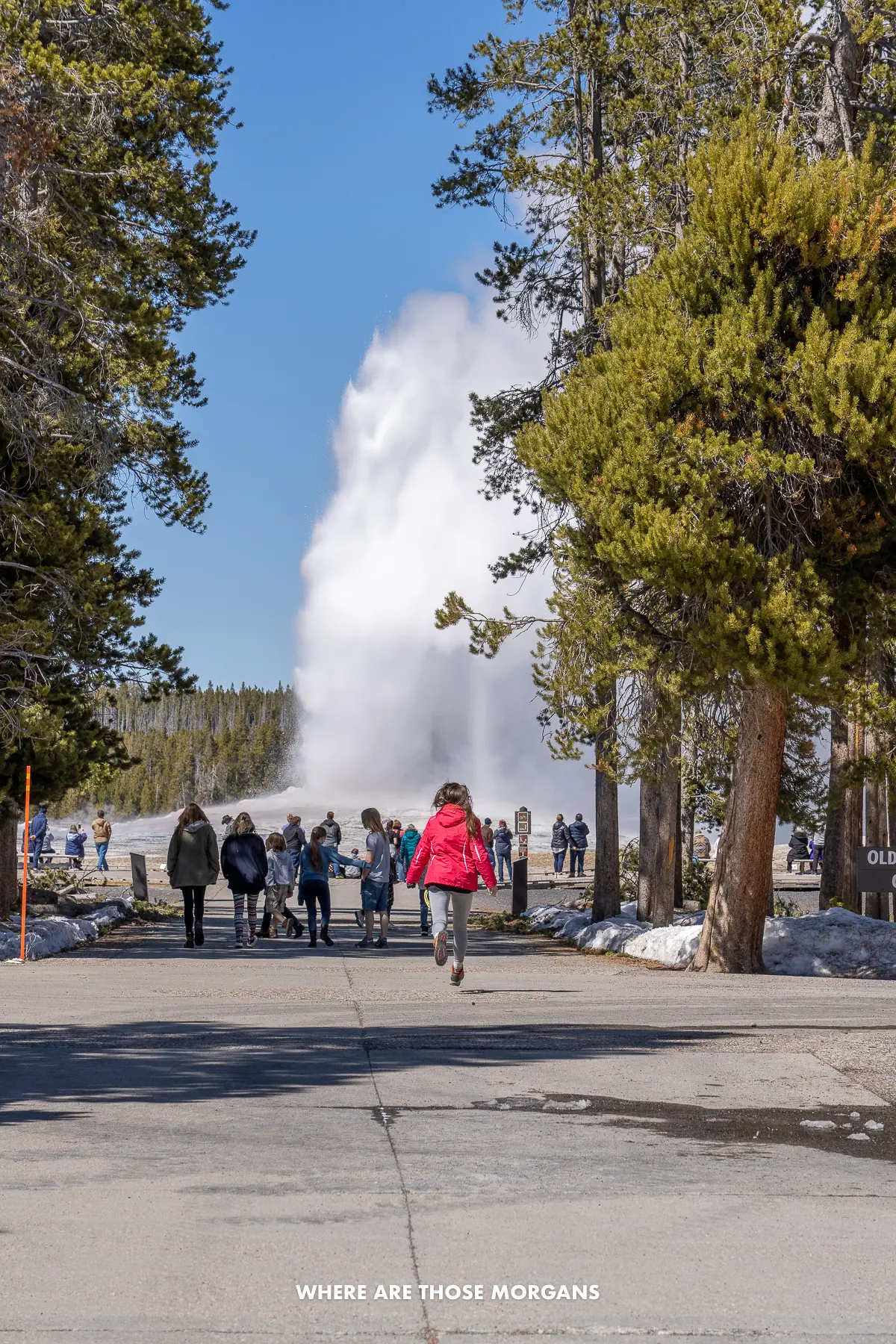
Now, we think the single biggest mistake people make at Yellowstone is only visiting Old Faithful Geyser in the Upper Geyser Basin. This area has the highest concentration of geysers in the world, so there’s a lot more to see. After lunch, we’d sit on the bleachers and wait for our first Old Faithful eruption. We’ve seen it go off maybe 10 times now, but we remember how cool it was to see it for the first time. With that out of the way, we’d begin walking clockwise on Upper Geyser Basin Trail.
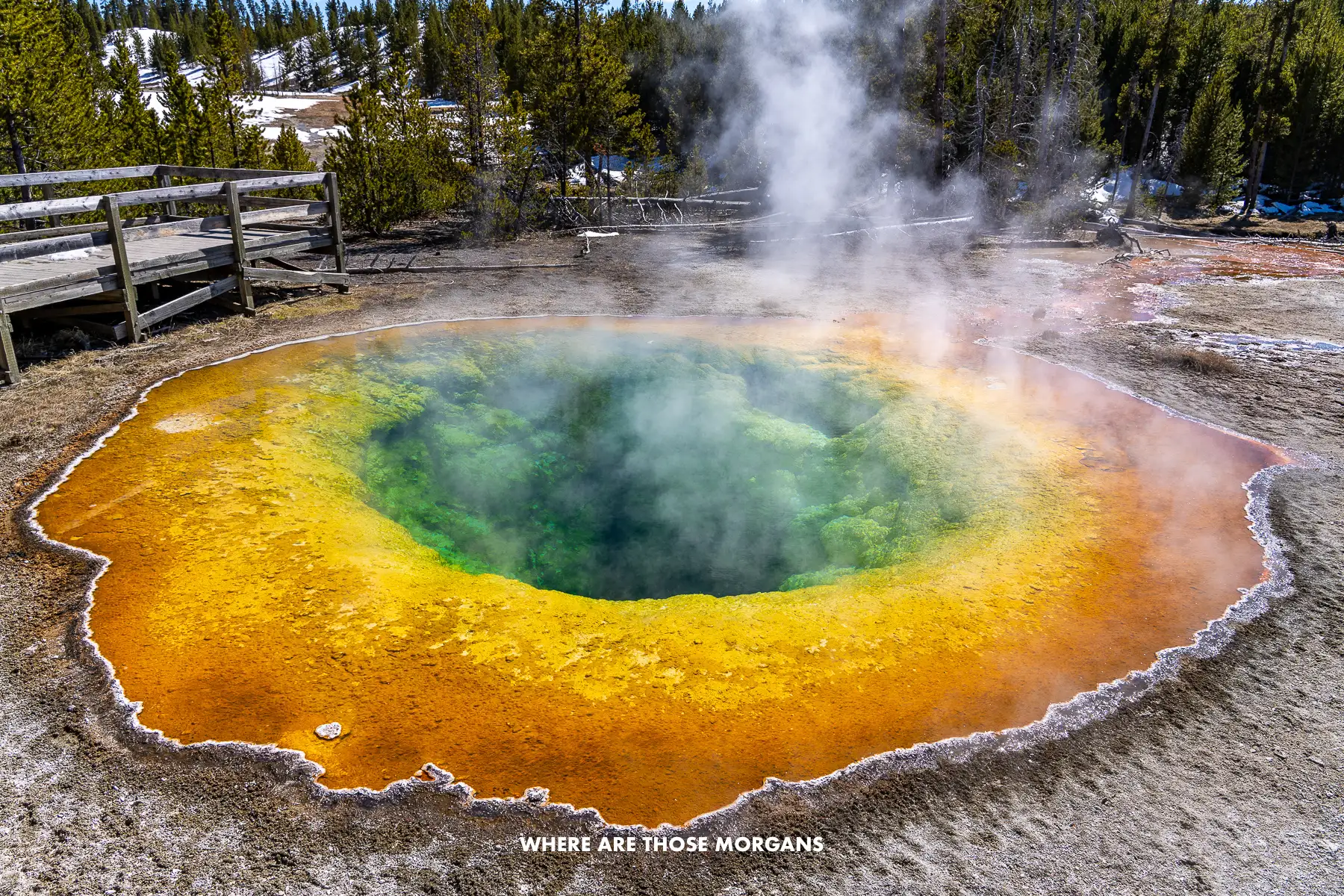
Our first stop would be the intriguing Castle Geyser, then Sawmill Geyser, Belgian Pool, Grand Geyser, Chromatic Pool, Giant Geyser, Culvert Geyser, and finally the incredibly striking Morning Glory Pool – maybe our single favorite geothermal feature in Yellowstone. We had this entire walk to ourselves in April 2021, while everyone else sat watching Old Faithful. On the way back we’d complete the loop by passing Liberty Pool, seeing the cluster of geysers and springs around Geyser Hill, and hiking up to Observation Point to watch Old Faithful erupt from a higher up vantage point.
If we were staying at Old Faithful, we’d stay up at Observation Point for sunset and then grab dinner. But we’d more likely be staying in West Yellowstone, so we’d drive back up the loop road and take a right onto the one-way Firehole Lake Drive to watch a stunning sunset reflecting in Great Fountain Geyser. Then we’d drive out of the park and grab dinner at The Buffalo Bar.
Day 9: South Yellowstone & Grand Teton
- Distance: 129 miles
- Time: 3 hours 19 minutes
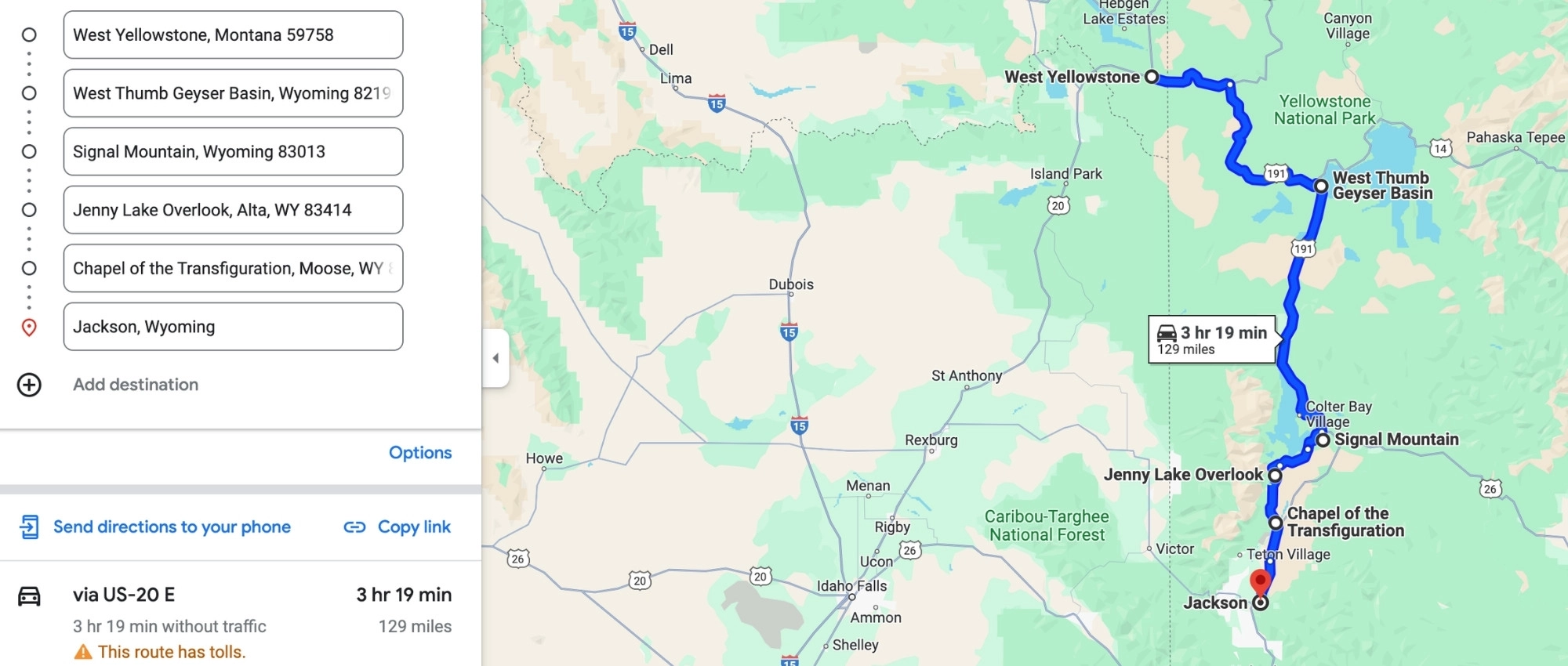
In October 2019, we spent 4 days in Yellowstone and 2 days in Grand Teton. We weren’t sure if those time frames were going to work out, but they were perfect. Grand Teton fully deserves at least one full day, if not two, so if we drove this route again for the first time we’d spend most of day 9 and all of day 10 in the park. After checking out, we’d start with a drive-thru coffee and breakfast burrito at Go-Go Espresso Cafe in West Yellowstone, then we’d enter the park and drive beyond Old Faithful.
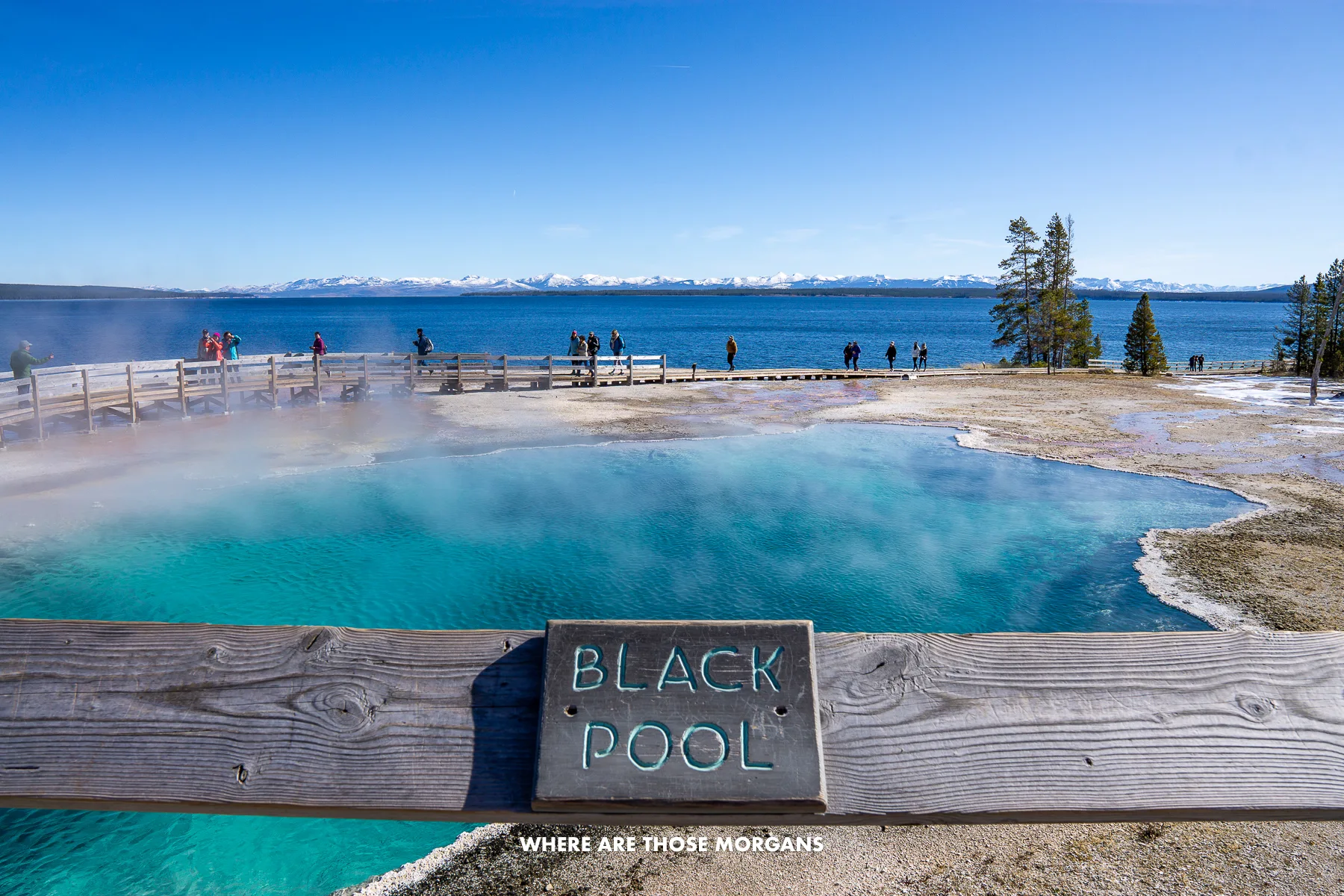
Our first quick pit stop would be to see Kepler Cascades, then we’d pass over the Continental Divide, before descending into West Thumb Geyser Basin. We thought West Thumb’s setting on the edge of Yellowstone Lake and with views of the Absaroka Mountains was stunning, and we couldn’t understand why it was so quiet when we visited in 2019. Anyway, we definitely wouldn’t miss it this morning. We’d walk the basin boardwalk loop for 45 minutes, stopping to see Fishing Cone and Abyss Pool among many other lakeshore thermal features.
Around 11 miles south on John D Rockefeller Jr Memorial Parkway, we’d drive past Lewis Lake and stop not long after it to see Lewis Falls. Further south yet, we’d consider stopping to see Moose Falls via a short rocky trail, before crossing into Grand Teton boundaries and stopping for our first real view of the Teton range at Jackson Lake Overlook. It’s a beautiful view, but it gets even better. Now would be the perfect time for lunch, so we’d go to Leek’s for pizza, John Colter’s for barbecue, or Pioneer Grill for diner style food.
After lunch we’d take a right onto Teton Park Road, drive over Jackson Lake Dam, and take a left onto Signal Mountain Road. It’s a 5-mile drive up the narrow, steep and twisting road to the 7,720-ft summit. At the very top, we’d soak up immense views over the entire Jackson Hole valley, but our favorite view is from a little further back down called Jackson Point Overlook. A short walk here led us to a staggering view of the Teton Range and Jackson Lake from a unique elevated vantage point, so we wouldn’t miss it next time.
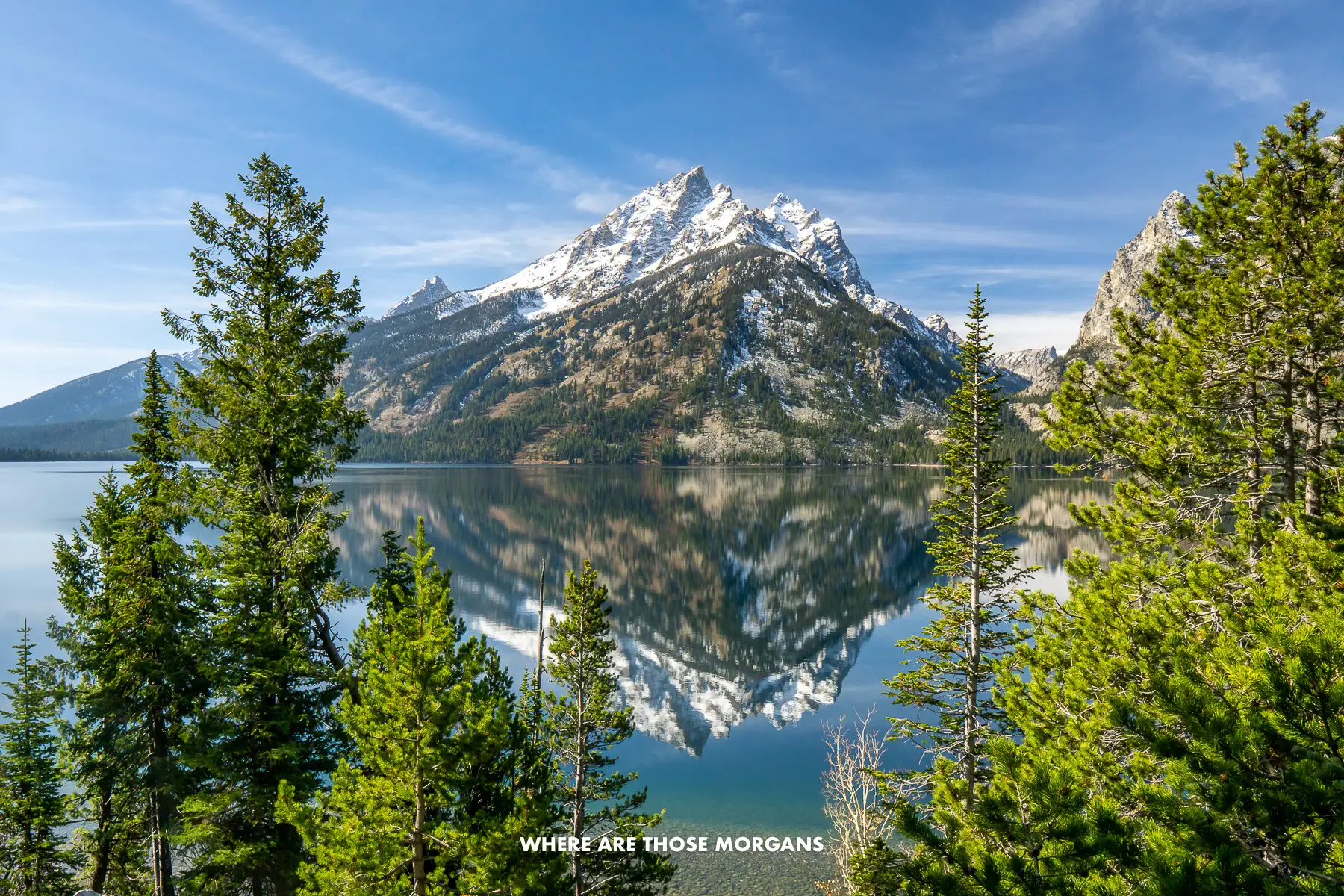
Back on Teton Park Road, we’d stop at every turnout, before taking a right turn after Mountain View Turnout onto Jenny Lake Road. This would lead us to String Lake, where we’d get out for a quick walk and photos, before continuing Jenny Lake Overlook for one of the single best photo ops on this whole road trip – a direct view of what we think is Teewinot Mountain reflecting in the lake behind evergreen trees in the foreground.
Our final stop of the day would be Chapel of the Transfiguration to see the famous “mountains through the church window” view, then we’d drive 12 miles to Jackson and check into the budget Cowboy Village Resort, the mid-range Inn on the Creek, or the luxury Huff House Inn. In the evening, we’d walk to Jackson Town Square to see the famous Elk Antler Arch before grabbing dinner at one of many excellent eateries. We remember Hand Fire Pizza having a lively atmosphere, but we’d probably pick whichever exotic cuisine we most liked the sound of, especially after so many “American-style” restaurants from the previous 8 days of the road trip.
Kristen’s lodging tip: We absolutely recommend Jackson as the place to stay when visiting Grand Teton, and we’d stay there again next time because we like having diverse food options. But if you’d rather spend your last few nights inside the park surrounded by nature, take a look at the various park lodges.
Day 10: Grand Teton
- Distance: 74 miles
- Time: 1 hour 55 minutes
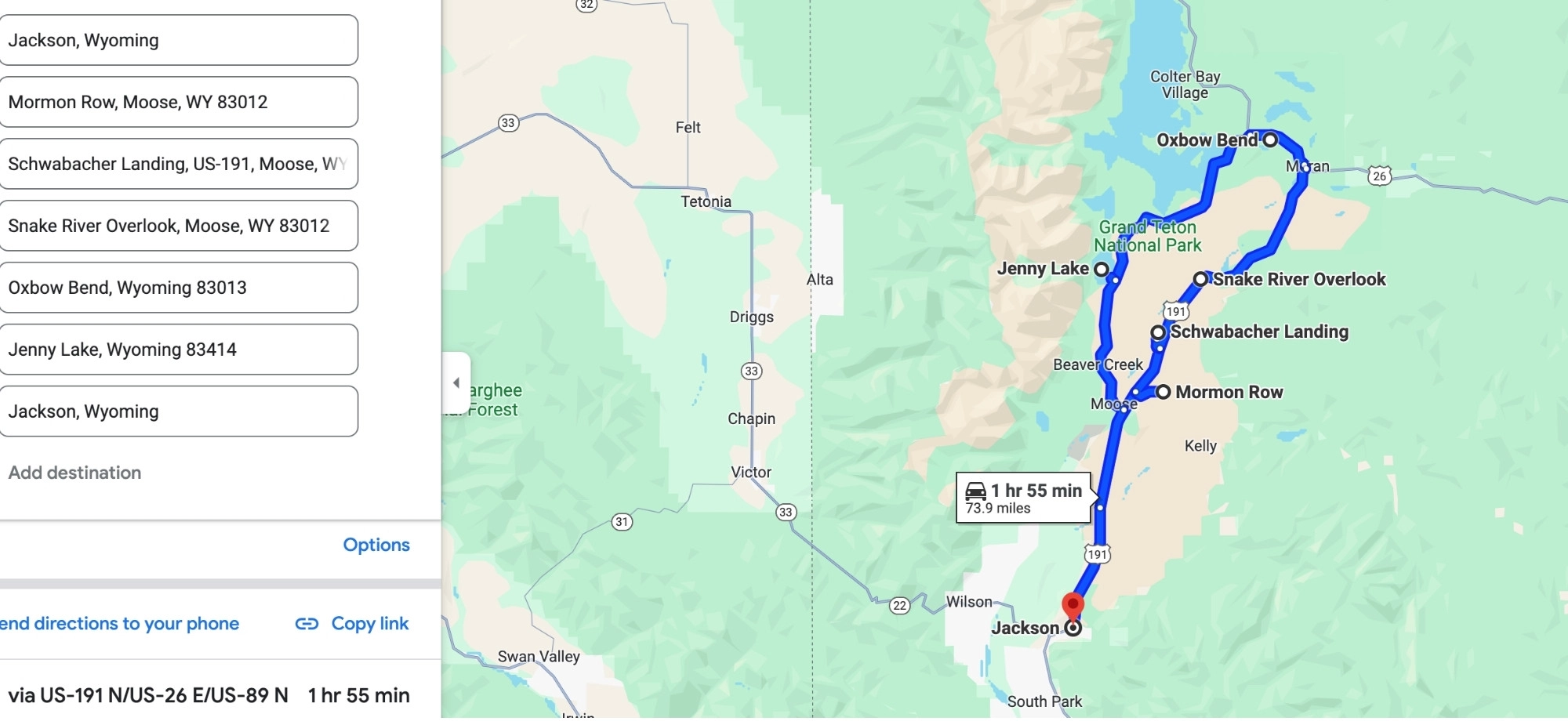
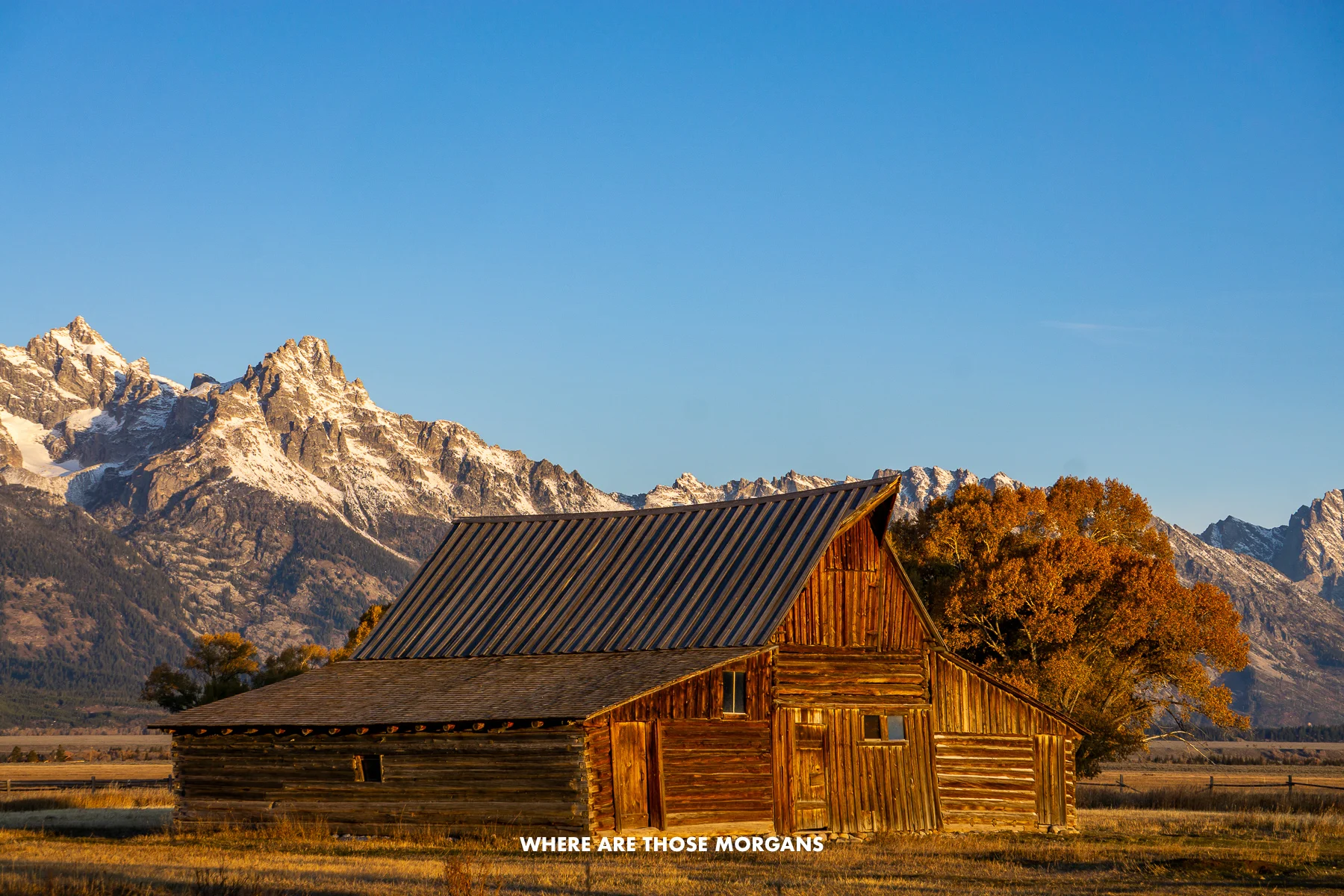
The biggest problem we’d face in Grand Teton is deciding between Mormon Row and Schwabacher Landing for sunrise photography. We’ve done both and they’re amazing, but we’d say Mormon Row just about edges it for us because the wooden barns are such unique foreground subjects. Now, if you’re not bothered about sunrise photography, stay in bed, eat a relaxing breakfast and pick this itinerary up later in the morning.
We’d grab big coffees and ideally some breakfast snacks, jump in the car, and drive 30 minutes to Mormon Row. We really liked John Moulton homestead, but in our opinion T.A. Moulton Barn is even more photogenic, so that’s where we’d set up our tripod and camera ready for the sunrise. There’s a lot of great spots to capture different perspectives of the dawn sunlight illuminating the Teton Range and barn doors.
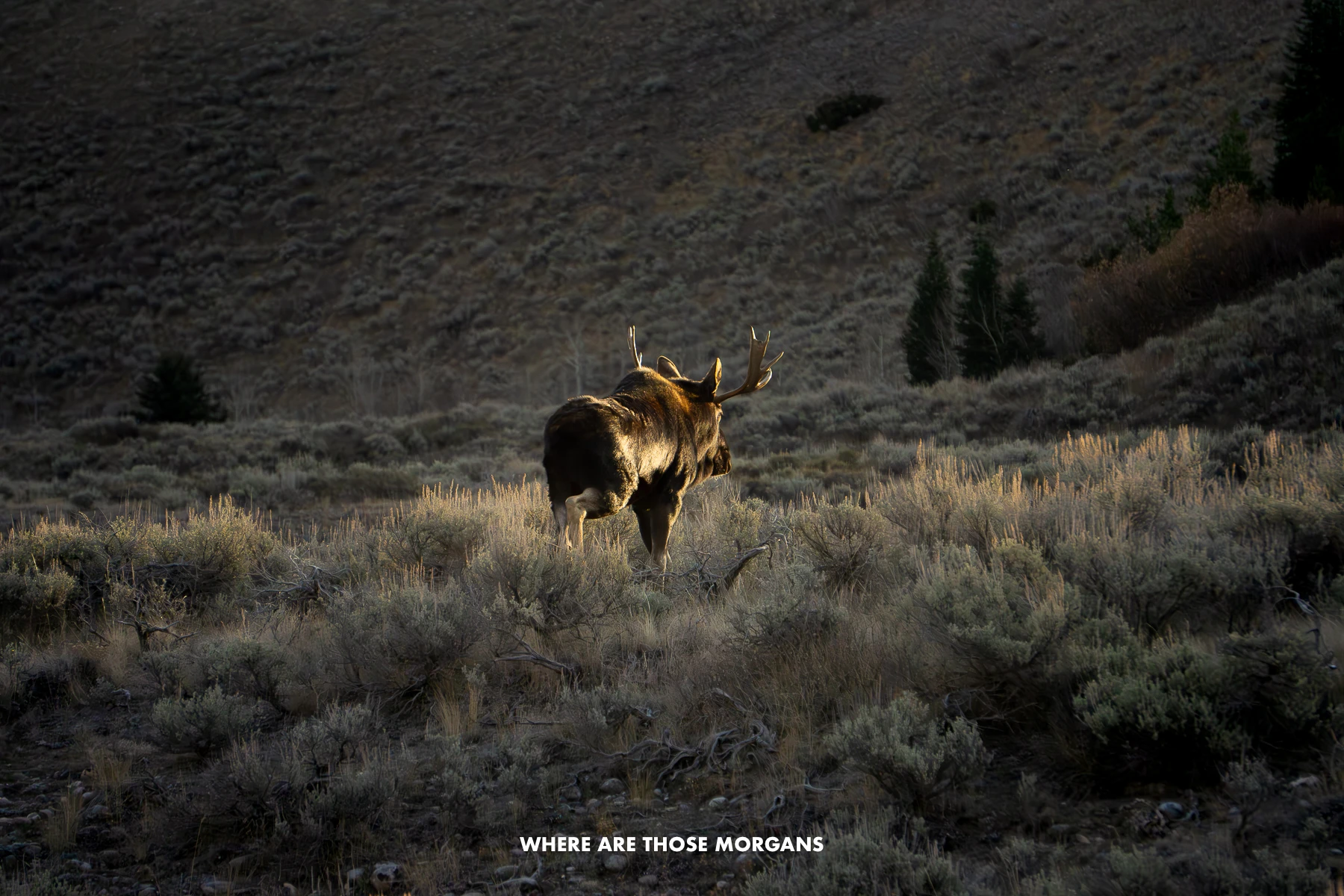
With just one sunrise, we’d maybe consider splitting it between the two popular spots. So when it felt right, we’d jump in the car and hotfoot it 15 minutes from Mormon Row to the tiny parking area at Schwabacher Landing. We’d hustle along the riverside for a few minutes to find the perfect angle and then capture yet more dramatic sunrise photos. This time it would be the Teton Range and evergreen trees reflecting in the Snake River like a mirror. In 2019, we watched otters playing on ice and a moose walked not far from us.
Next, we’d stop at Snake River Overlook, J.P. Cunningham Cabin, Elk Ranch Flats Turnout and Oxbow Bend for yet more superb views of the mountains. Then we’d return to Jenny Lake, but this time we’d park near the visitor center and plan to spend most of the day there. If we had nothing left in the tank after an intense 10 days, we’d consider relaxing on the shores, taking a swim, or floating on inflatables.
But the more likely outcome is we’d push ourselves to hike Cascade Canyon Trail instead. To reach Cascade Canyon, we’d need to get to the west side of the lake. So we’d either walk 2 miles around Jenny Lake or take a ferry service for $20 round trip to west shore boat dock, which cuts this part of the hike.
From there it’s a short burst uphill to Hidden Falls and again to Inspiration Point. This would be a good turnaround point for lots of hikers, but we’d continue into Cascade Canyon for more stunning views and excellent wildlife spotting. Later in the day, we’d enjoy a celebratory end of trip beer with dinner back in Jackson!
Flying Out Of Bozeman
Now, there are plenty of other possibilities for start and end points on this road trip. We’re not going to cover them all because this guide is already long enough! We love our route ending in Jackson because it maximizes time in Yellowstone and Grand Teton, and it provides flexibility for both the flight home and rental car drop-off with Jackson Hole, West Yellowstone, Bozeman and Salt Lake City airports all within reasonable driving distance.
That said, the only other variation we’d give serious consideration to is re-routing the Yellowstone and Grand Teton portion of this itinerary so the trip naturally ends in Gardiner, MT with the purpose being logistical efficiency for flying home out of nearby Bozeman airport, which we know has more flight options than Jackson Hole. This alternate route also works much better for onward to travel to Glacier National Park. In truth, we don’t think it flows as well geographically through Yellowstone, but here’s how we’d do it this way instead:
Days 1-5: Pick up a one-way car rental from Rapid City airport with Bozeman set as drop-off. Itinerary remains exactly the same.
Day 6: Enter Yellowstone via east entrance, drive down to West Thumb, continue south into Grand Teton and follow our day 9 from the main itinerary.
Day 7: Follow day 10 of our main itinerary, except don’t go back to Jackson after Jenny Lake, instead drive up to Old Faithful and spend the night there.
Day 8: Full day at Upper, Midway and Lower Geyser Basins. Basically follow day 8 of our main itinerary but in reverse. Then instead of staying in West Yellowstone, drive to Canyon Lodge and stay there.
Day 9: Artist Point on South Rim of Grand Canyon of the Yellowstone for sunrise photography, or Hayden Valley at dawn for the best chance of seeing wildlife. Then Mud Volcano, before turning around and going back to see Lower Falls from both sides of the canyon. After lunch at Canyon, hike Mt Washburn and stay either in Canyon again or Roosevelt as a backup.
Day 10: Lamar Valley at dawn for more wildlife spotting, drive back (not ideal) to see Norris Geyser Basin, and then up to Mammoth for the afternoon. Stay in Mammoth, Gardiner or even drive up to Bozeman for airport or make tracks up towards Glacier.
Mark’s planning tip: Instead of driving from Spearfish to Cody on day 5, you could drive to Jackson instead. It’s 8 hours 30 minutes instead of 5 hours 20 minutes which would make for a pretty awful day, but it would allow for days 6 and 7 in Grand Teton before doing days 8, 9 and 10 in Yellowstone from south to north and leaving via Gardiner for Bozeman.
Doing The Route In Reverse
Since first publishing this guide back in 2021, we’ve had a lot of comments and emails asking about how to do it in reverse. Now, we haven’t done it the other way around, but here’s a top level summary of how we would plan it (including picking up a one-way car rental pick up at Jackson Hole airport or Salt Lake City airport with drop-off set to Rapid City and staying in Jackson the night before):
Day 1 – Grand Teton: Mormon Row, Signal Mountain, Jenny Lake, hike Cascade Canyon. Stay in Jackson.
Day 2 – Teton & Yellowstone: Schwabacher Landing, Snake River Overlook, Oxbow Bend, West Thumb Geyser Basin, stay in Old Faithful.
Day 3 – Yellowstone: Full day Upper, Midway and Lower Geyser Basins. Stay in West Yellowstone.
Day 4 – Yellowstone: Norris Geyser Basin, Mammoth, Lamar Valley at dusk. Stay in Roosevelt or Canyon.
Day 5 – Yellowstone: Grand Canyon of the Yellowstone, Hayden Valley, Mud Volcano. Stay in Cody.
Day 6 – Cody to Spearfish: Drive Cloud Peak Skyway and I-90 to Devils Tower. Stay in Spearfish.
Day 7 – Black Hills: Drive Spearfish Canyon to Deadwood, west Needles Highway, Sylvan Lake, hike Black Elk Peak. Stay in Custer.
Day 8 – Black Hills: Wind Cave, Rankin Ridge, east Needles Highway, hike Cathedral Spires. Stay in Custer.
Day 9 – Custer & Mt Rushmore: Custer Wildlife Loop, Iron Mountain Road, Mount Rushmore. Stay in Keystone.
Day 10 – Badlands: Full day in Badlands with Minuteman Missile Museum. Stay in Rapid City.
This is a very rough and basic outline of how we’d do it in reverse. We don’t think it flows quite as nicely as our main itinerary, but it still works just fine. The main thing to look out for is setting off on the Black Elk Peak hike no later than midday on day 7. Otherwise, it’s mostly about making sure to be in the right places at the right times of day.
The thing about this road trip is there’s so much wiggle room for tweaking both the Yellowstone/Teton and Black Hills regions based on personal preferences. If you’d like to talk through a personalized itinerary to suit your travel style and goals, book a call with us so we can sit down and create the perfect plan.
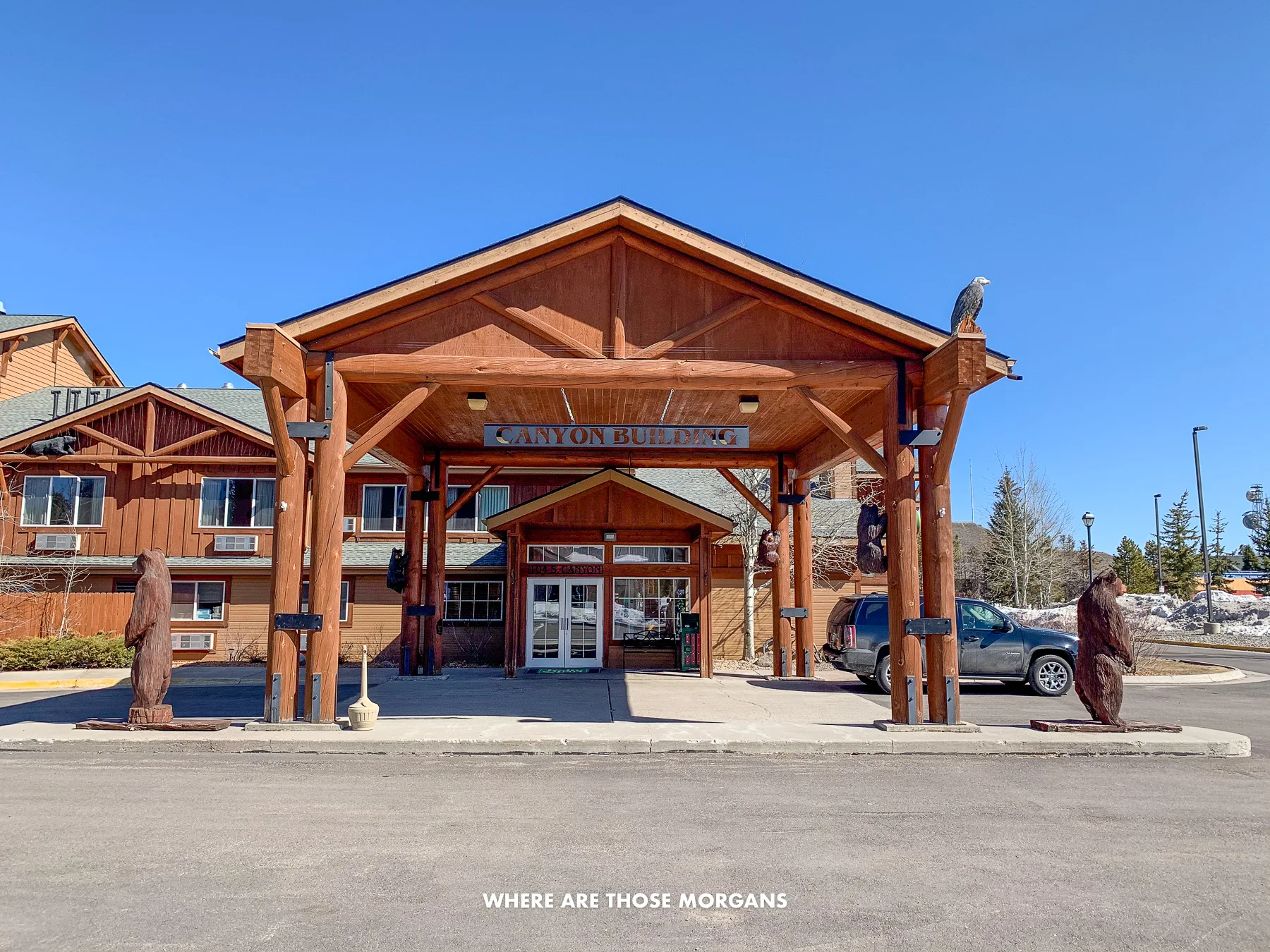
Logistics & Planning Tips
Start/end: Our itinerary begins in Rapid City, SD and ends in Jackson, WY with 10 full days available for the road trip. You might need to add a day traveling to Rapid City and day traveling from Jackson. If Jackson doesn’t work for a flight home, drive to West Yellowstone, Bozeman or Salt Lake City airport instead.
Hotels: Accommodation can be a real problem on this road trip, especially around Yellowstone. We don’t think you’ll have too many issues in the Black Hills, except in peak months of July and August, but even so we would still book every single hotel as far in advance as we could. The worst thing you can do is wing it last minute, that just won’t work. We know changing hotel almost every night isn’t ideal, but it’s the best way to keep this road trip efficient.
Opening dates: Yellowstone’s roads are fully open between early May and the end of October. If you plan to follow our road trip itinerary from Mount Rushmore to Yellowstone in shoulder seasons, you must make sure the east entrance road and the roads leading to Old Faithful and Grand Teton in the south are open. Here’s the opening and closing dates for the various roads around Yellowstone.
When to drive it: Getting the balance right between avoiding crowds, keeping costs down and having good weather is hard. Summer trips are going to have better weather, but it will be busier and more expensive at hotels. Whereas visiting in spring or fall to avoid crowds and benefit from cheaper hotels can mean running into problems with snow and road closures (like we had both times). We think June and September are the two best months on balance.
Weather: In spring and fall the weather can be super volatile, which can close roads and hiking trails without much notice. Check Yellowstone’s live conditions and Grand Teton’s live conditions to stay on top of closures.
Attractions: We strongly recommend buying an annual national parks pass which is called America the Beautiful Pass. For US residents it costs $80 for a full year, and on this road trip alone you’d save $55 between Yellowstone, Grand Teton, Badlands and Devils Tower. For non-US residents the cost of this pass has increased dramatically, it now costs $250. But non-US residents entering certain parks individually have to pay a surplus of $100 per person, and that includes Yellowstone and Grand Teton. Without a pass it would cost a couple $325, so the saving is still $75.
How Much Does It Cost?
It’s not easy to give an exact figure on how much a road trip like this will cost because we don’t know if you’ll book cheap or luxury hotels, and if you prefer sit-down meals three times a day or sticking to quick cheap eats. But based on our two experiences, we’ll give you a rough ballpark figure for what we think the average couple should expect to spend.
Hotels were our biggest expense both times, especially around Yellowstone and Grand Teton. We didn’t book hotels in advance because we were traveling in shoulder season and winging it. But if we took this trip in peak months between late May and late September, we would 100% book hotels in advance to get more availability and better rooms at cheaper prices, particularly at park run lodges. Overall, we’d try to keep hotel costs around $250 per night on average for the whole trip for a total of $2,750 (including the night before day 1).
Food is so subjective, but we aimed for around $100 per day for both of us to eat three meals, totaling roughly $1,000 for the trip. Some hotels included breakfast, and we took advantage of those. We avoided fancy sit-down dinners where possible, and we didn’t splurge on $8 Starbucks coffees. Entry prices for all attractions covered in our itinerary totals $210 (or $165 with America the Beautiful Pass) for US residents, and gas would cost somewhere around $180 (1,283 miles at an average of $3.45/gallon and 25mpg).
So all in, we think a couple using a personal vehicle is likely to spend along the lines of $4,000 total for 10 days, and of course it will be more for a family of 4 who need more or bigger hotel rooms. But a couple or family who also need to pay for flights and a rental car for 10 days would need a much larger budget. We can’t account for flights, but it looks like this car rental with pick up at Rapid City airport and drop off at Jackson Hole airport could cost around $2,000, which significantly increases the overall cost.
Next Steps
We hope our road trip itinerary helps with planning your trip to see Mt Rushmore, the Black Hills, Yellowstone and Grand Teton.
If you’d like more personalized help, we offer expert travel planning consultations where we answer any questions you have and plan out your entire itinerary step by step. See our packages and reviews.
Still researching for your trip?
- Here’s our first-timers Yellowstone travel guide
- These are Yellowstone’s top attractions
- Here’s where to stay around Yellowstone
- What to know about Yellowstone in April
- What to expect at Yellowstone in October
- This is how to visit Mt Rushmore
- Here’s what to do near Mt Rushmore
- Follow our Black Elk Peak trail guide
- Here’s what to do in Custer State Park
Finally, we recommend reading our South Dakota travel guide and Wyoming travel guide to get more helpful tips and advice for your trip.
Happy travels,
Mark and Kristen
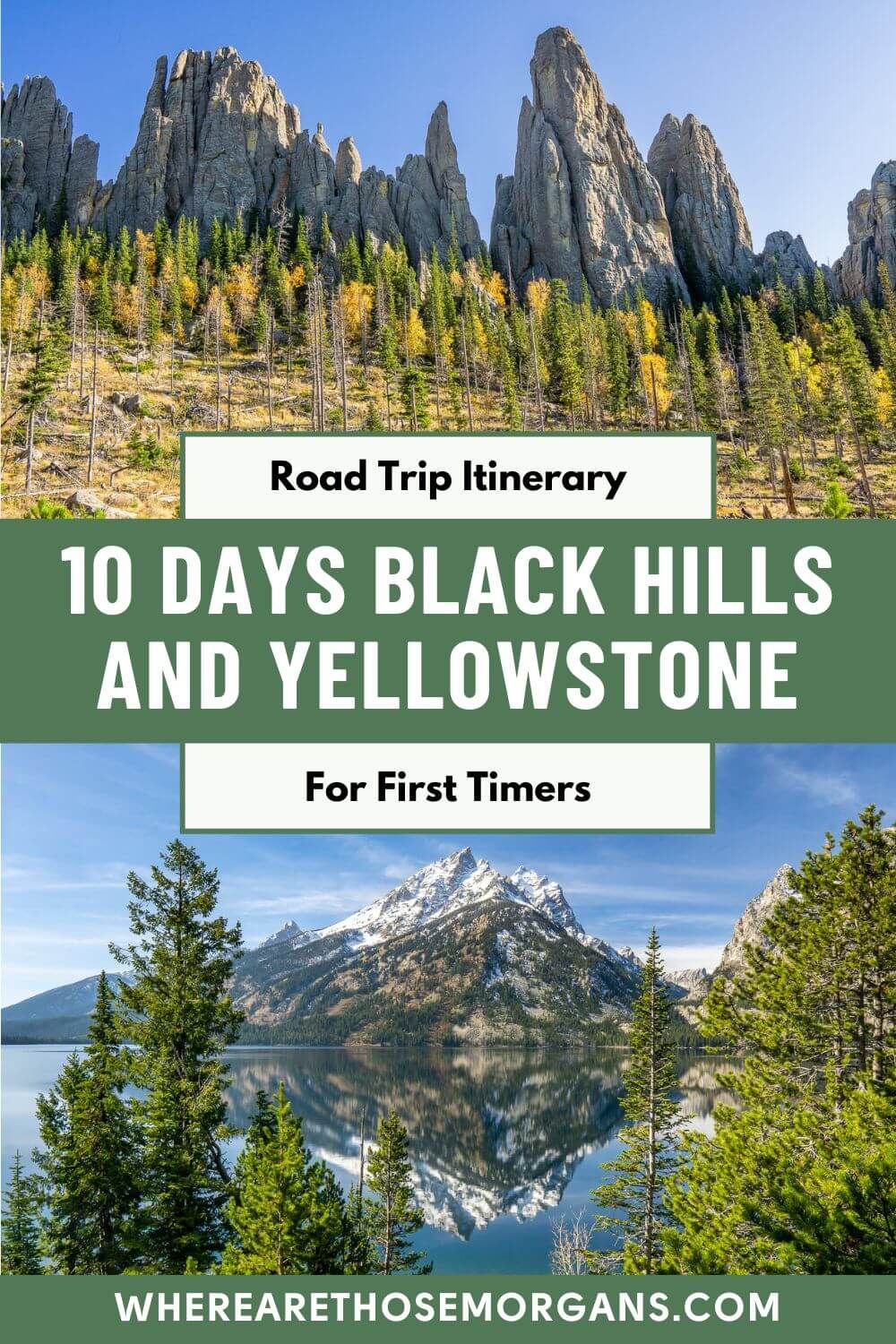
Enjoy this Guide? Pin it for Later!
All Rights Reserved © Where Are Those Morgans, LLC. Republishing this article and/or any of its contents (text, photography, maps, graphics, etc.) in whole or in part is strictly prohibited.
Mark and Kristen spent 6 years traveling the world, visiting over 40 countries across 4 continents and more than 30 US states. They created Where Are Those Morgans in 2018 to help others plan the best possible vacations by writing authentic travel and hiking guides based on their real experiences.
Since the arrival of baby Maya in late 2024, Mark and Kristen’s extensive travels have slowed down but they still take plenty of trips. Where Are Those Morgans now helps millions of travelers each year to visit new places and hike new trails through information-packed blog posts and expert travel guidebooks. Read more about Mark and Kristen.
Hi Morgan’s,
We are planning a trip out west the first week of June. We would like to do your trip in reverse order. Any helpful hints you could give us would be greatly appreciated. It’s getting closer and we’re getting excited.
Thanks,
Cathy
Happy to hear you’re planning this trip, Cathy – it’s a fantastic route. We’ll send you a private email.
Hey there!
Thank you so much for your site and detailed travel plans! My kids are way past Maya’s age and we are trying to make one more family memory before we embark on a new season of life. We would like to take the opposite route, starting in Yellowstone and traveling to Mt. Rushmore. You would think it would be easy to just reverse the itinerary but I’m struggling! Could you give me a quick turnaround…which hotels/locations I would land in if we were doing the trip backwards? That would be amazing!
Hey Sharon, thanks for your comment! We sent you a private email.
Thank you so much for the detailed itinerary. It’s going to help so much with our trip. My question is we’re flying into Rapid City from Ohio and once we get to Cody. I wanted to change it a little bit and go south and hit the Tetons first ending our trip in Bozeman to fly back. What do you recommend in changing that for a good route?
Hi Heather, it’s a great idea to fly into one airport and out of another to keep your trip as efficient as possible. If you want to do the Tetons first, read our Salt Lake City to Yellowstone itinerary and follow it from Day 3 to Day 7 – it goes into Grand Teton, then south Yellowstone and ends in Mammoth which is perfect for Bozeman. Have a great trip!
Thank you so much that’s helpful. Would you recommend from Cody to go to East Yellowstone and then from there to Jackson?
Yes definitely go through Yellowstone and down to Jackson. It doesn’t matter that you’ll be coming back up the same way, it’s far more scenic (and shorter) than going around from Cody to Jackson on US-26. Or there is another option – instead of going to Cody, you could drive straight to Jackson from the Black Hills. If we did it that way, we’d drive over the Bighorns on Cloud Peak Skyway to Worland, then head south to Thermopolis (they have hot springs you can go in) and through Grand Teton to Jackson. It would be a longer driving day but at least you’d be in Jackson ready for the next morning, rather than having to drive 4 hours from Cody to Jackson after a long drive across to Cody the day before. Hope that helps!
Do any of your itineraries include driving Beartooth highway?
We drove a portion of the Beartooth Highway after leaving Cody and following WY-296 (Chief Joseph Scenic Byway) to Cooke City and entering Yellowstone through Lamar Valley. And 296 was a lovely drive. But the better part of the Beartooth Highway is between Billings and Cooke City, so you could do it if you take I-90 across from South Dakota and turn off after Billings instead of going the route we suggest over the Cloud Peak Skyway from Buffalo to Ten Sleep and Cody.
Thank you so much!!
We are planning this trip the week of 4th of July. Where would you suggest the best place to stay on the 4th of July for celebrations?
Hi Tonya, Mt Rushmore would be a good place to spend 4th July evening for a fireworks display, so you could stay in Keystone (or Custer/Hill City). Devils Tower also puts on a fireworks display if you’ll be at the end of your SD part of the road trip by the 4th. Cody, Jackson Hole and West Yellowstone also do put on a show, so you can really be staying in lots of the places within our itinerary. Have a great time!
Hi Guys,
The guide looks great and I am planning to go in May of 2024. I find that it is very difficult to get one way rental car from rapid City to Jackson compared to Jackson to rapid city. So my question is if I plan my trim from Jackson to Rapid city, will it be exactly the opposite of your plan or do I need to modify the route. Appreciate any help you can provide. Thank you.
Hi Sam, glad to hear you’ll be taking this road trip in a few months. We just checked and Rental Cars have one-way hire cars from Rapid City to Jackson available in May. Hopefully you can find a good option for your dates with them. In truth, the route we created was designed to be most efficient going from Rushmore to Yellowstone (ie. being in the right place at the right time of day). You could reverse the route and it wouldn’t be too different, but it would need some slight modifications for things like Wind/Jewel Cave tours or switching the attractions around so you don’t set off on a hike too late in the day. But it’s definitely doable. Let us know how you get on and have a fantastic time!
This guide looks great, and I am just wondering if you have a price range for the trip, not including things like food. I want to do this as a couple’s trip or Honeymoon trip, so just two people. I would like to have a goal for saving up for this trip. Thanks for any help you can give.
Hi Kyle, glad to hear you’ll be driving this road trip and congrats if it’s for a honeymoon. Honestly, the cost will depend mostly on hotels. Without knowing the time of year you’ll do it or your preference for hotels (cheap and cheerful or luxury, especially if honeymooning), you should probably aim for around $150 per night on average. Hotels are cheaper in the Black Hills, more expensive around Yellowstone. Book your hotels in advance (now for this summer or fall would be ideal) to save because there’ll be more availability at park run lodges and in towns near the parks. Add in gas, food and attractions – you’re looking at something in the $2,500 – $3,000 range total for 10 days, excluding flights and hire cars. That would be for mid range hotels and eating out 3 times a day, plus entry to national parks, monuments, state parks etc. You can always go for cheaper hotels, eat at fewer restaurants or skip certain attractions to bring that number down. Hope that helps and remember it’s just a ballpark figure. Have a great trip!
@Mark and Kristen Morgan, Thank you so much; this definitely helps. Your itinerary looks like the vacation of a lifetime for us.
This is am amazing itinerary! Thank you so much. If we have more time, say, closer ti 14 or 15 days, where and how would you recommend spending that time? We love hiking, but are casual, so no summiting mountains for us.
Thanks Katie! To be honest we’ve included the major attractions in both regions, so it could just be a case of slowing things down so it’s not as action packed. Maybe add one extra day in each of the Black Hills, Yellowstone and Grand Teton. There’s loads more you can do in Yellowstone and Teton, we’ve just covered the most unmissable spots for a first visit. You could also potentially include a stop at Little Big Horn Battlefield if that’s of any interest. If you don’t mind the full-on days, maybe consider driving up to Glacier National Park after Yellowstone and Teton to spend 2 or 3 days there. Or there’s always a drive down to Salt Lake City where you can see the Great Salt Lake, Bonneville Salt Flats, Park City or hike loads of amazing trails on S Big Cottonwood Canyon Rd. Hope that helps and have a fantastic trip!
We are driving up from Kansas City the end of April to first week of May.
What do you recommend as the best way to add the Little Big Horn battlefield into this itinerary?
Thank you for your amazing itinerary. It looks to be so helpful with the trip we are planning.
Hi Steve, we’re glad to hear you’ll be driving this road trip next year. The easiest way to include Little Big Horn Battlefield is to drive I-90 directly from Devils Tower and then you can loop around to Cody from Billings. You’d be replacing the drive from Buffalo to Ten Sleep on the Cloud Peak Skyway. One thing to note is your exact dates. The east entrance into Yellowstone from Cody is projected to open May 5 2024 but any adverse weather could push that date back. You might be better off continuing on I-90 from Billings and entering Yellowstone to the north at Gardiner because that entrance is open year round. Have a fantastic trip!
We just returned yesterday from our 11 day trip which we followed as the Morgans suggested and it was truly amazing. I cannot thank you enough for your well-thought-out and easy-to-follow itinerary. I was travelling with my 13 year old twins and my 80 year old parents and we all had such an incredible time. We even stayed in the recommended hotels. It was truly a once-in-a-lifetime experience! Thank you very much!
Hi Dineen, Thank you so much for taking the time to leave this nice comment. We are happy to hear our itinerary helped you during your amazing road trip! It’s such a beautiful part of the country and your family will always have those wonderful memories! Take care, Mark and Kristen
Your 10 day itinerary from Mount Rushmore to Yellowstone is amazing! We are traveling September 7th. We so appreciate you mapping out our vacation!! What days do you recommend we pack our lunch?
Thank you, Brenda! We are happy to hear you will be following this amazing road trip route and you are doing it at a fantastic time of year. Lunch is a great question (we will update our guide soon to include potential lunch stops because it is helpful). We would suggest packing lunches on days 1 and 2 in South Dakota, as well as days 6, 7, 8, 9 and 10 in Yellowstone and Grand Teton. You can find food in Yellowstone at Canyon Village, Mammoth or Old Faithful if you really don’t want to keep eating packed lunches but they will save you a lot of time, effort and money. Eat big breakfasts and dinners if possible, and take snacks into the parks. Hope that helps and have a fantastic trip!
@Mark and Kristen Morgan,
Thank you for sharing your ideas! Do you have any Restaurant recommendations for dinner? We have made our accommodation reservations using your recommendations. We are looking so forward to our trip and you have made planning easy! Thank you again!
You are more than welcome, Brenda. Dinner is a tough one without knowing what your group likes to eat, but what we usually do is look at Google Maps and see which places have high ratings near our hotel then narrow it down to our cuisine preference. There are great places to eat in most of the places you will visit so we are sure you find the right spots each evening!
Hello,
I am trying to plan this trip for my family of 4 (2 adults 2 kids (ages 9 & 7)). This has become almost a full time job but your site has been so helpful! We are coming from MN and hoping to drive the loop up through ND – MT – WY – Yellowstone – WY – SD then back home. I have all the places and things we want to see and do but I just can’t get them straight for what to do on what days…any suggestions would be so helpful! Yellowstone is very intimidating to plan!
Hi Kristi, sounds like an amazing road trip route you have planned! We understand how you feel about planning and wanting to make the most of every day. Without knowing your priorities or how many days you have, we would suggest choosing maybe 5-10 of your top attraction priorities and making sure you allow enough time to properly visit those places. You can easily do Yellowstone in 3 full days if you move around at a reasonable pace (staying at different hotels each night helps with efficiency but it isn’t vital). Grand Teton is amazing and you can see it in one day, especially as you won’t be hiking the longer trails with young kids. The Black Hills in SD you can do quickly enough depending on exactly what you want to see. Mt Rushmore only takes a few hours and with the kids you likely won’t lose a day hiking Black Elk Peak. Judging by how much effort you are putting in to planning, we know you will have it all figured out. Have a great time with your family!
Hello! I love this itinerary as it can be so daunting planning a trip like this. Are any of the “hikes” handicap accessible? We would potentially be traveling with our older parents, some of which use motorized scooters for longer walks. Thanks
Hi Melissa, glad to hear you are planning to see the Black Hills and Yellowstone with your family. Accessibility is a great question – some of the half day adventure hikes such as Black Elk Peak in SD, Avalanche Peak in Yellowstone and Cascade Canyon in Grand Teton are of course not accessible for motorized scooters, but many of the popular stops in this itinerary are accessible via wooden boardwalks or flat paved paths. For instance, you will be able to see behind the Badlands Wall from the Windows Trail in Badlands (and so much more right from the car), you can access the amphitheater in Mt Rushmore (but not the Presidents Trail which has steps), you can circle around the base of Devils Tower WY on a paved trail, almost all of Yellowstone’s most iconic attractions like Old Faithful, Grand Canyon of the Yellowstone, Grand Prismatic Spring, Morning Glory Pool, Lamar Valley and Hayden Valley are all accessible via wooden boardwalks or right from the car. Hope that helps but please let us know if you have any more questions and we can do some more digging. If not, have a fantastic trip!
Hello,
Thank you so much for this itinerary! I was planning a trip Yellowstone on 5/18/23 and I was overwhelmed but your guide is helping a LOT.
One note – I noticed that the road section between canyon and tower fall doesn’t open until May 26 (weather pending), and that the Norris Geyser Basin is closed in 2023 until further notice.
I’m still learning about the layout of Yellowstone, but would I be fine following your itinerary if I am visiting on 5/18, or would I need to make adjustments due to road closures? If adjustments are needed, do you have any recommendations?
Thank you!!
Hi Samuel, we’re happy to hear you are planning a trip to Yellowstone in a few weeks. Yes, Norris Geyser Basin is closed until further notice (these things always happen in Yellowstone!) and the road between Canyon – Tower (Dunraven Pass) does not open until May 26th. Note these dates are “projected” and weather dependent. If you follow our itinerary and decide to visit before Dunraven Pass opens, you can combine days 6 and 7 into one day. So you would enter from Cody, see Lake Yellowstone, Grand Canyon of the Yellowstone and Hayden Valley in the morning, then drive up to Mammoth, before heading into Lamar Valley around 1-2 hours before sunset at which point wildlife is most active. You can then pick up the remainder of the itinerary. Hope that helps and have a fantastic time!
Can not thank you both enough! My sons and I will be doing this journey and using your suggestions as a guide was incredibly helpful! We are so excited.
You’re very welcome, Audrey. We hope you and your sons have a fantastic time!
This trip sounds fantastic. We are planning this trip now for late August early Sept. Is there anyway we could squeeze in Glacier if we add a couple of days? We want to do it all! We are thinking we can fly into Grand Rapids and out of Bozeman. Any thoughts? Thanks for your help,
.
Hi Tammy-Jo, great to hear you are planning this trip and yes of course you can definitely squeeze in Glacier! Instead of driving from Devils Tower to Cody (and Yellowstone east entrance), you can drive from Devils Tower to Glacier. It is a heck of a drive (maybe 10 hours) and it might be worth spending a night around 1 or 2 hours before reaching Glacier to reduce the long driving day and get a cheap room before waking up early to have a full day in Glacier. After you are done at Glacier, drive down through Bozeman and into Yellowstone north entrance near Mammoth Hot Springs. You can then drive down through one side of Yellowstone (west first for example) and down into Grand Teton, before looping back through Teton and up the other side of Yellowstone before exiting back in the north and flying from Bozeman. Hope that helps but let us know if you have any more questions. If not, we hope you have the best trip!
@Mark and Kristen Morgan,
Thanks! I will take a look at that route!
We are in San Diego, CA. What airport should we flight in and approximately how far from Mt Rushmore or the town? Also if we rent the car to start the adventure that would be arranged separately from your planed trip?
Thank you
Hi Nancy, to begin in South Dakota you will fly into Rapid City. After visiting Badlands, Mt Rushmore etc in the Black Hills, you will drive across to Yellowstone and Grand Teton. It would make more sense to drop off your hire car at either Jackson Hole airport Salt Lake City airport before flying back to San Diego. Our guide is an example itinerary for your to use, but we do not arrange hire cars for this trip. Have a great time!
@Mark and Kristen Morgan,
Thank you for taking to answer my question. I appreciated very much.
You are very welcome Nancy and have a wonderful trip!
Hi! I’m looking into this for April this year (in a month, eek). Do you think this would be good for a fam with an 11 and 13 yr old?
Hi Shan, yes absolutely this road trip is great for families with kids in the low teens. There’s plenty to keep them occupied in the form of Mt Rushmore, Devils Tower, geysers, hot springs and wildlife in Yellowstone, and towering mountain peaks in Grand Teton. However, we only recommend driving this route from May 1 through the end of October. In April, Grand Teton Loop Road is closed, Yellowstone doesn’t begin to open certain roads until half way through the month and there’s a strong chance you will get caught in snow. If we were planning a road trip at the beginning or middle of April with kids, we would do the Utah and Arizona loop instead. Start in Las Vegas, drive to Valley of Fire, Zion, Bryce Canyon, Capitol Reef, Arches and Canyonlands, Monument Valley, Horseshoe Bend, Grand Canyon South Rim, back to Vegas. Or a variation of that depending on your timeframe. Hope that helps but let us know if you have any more questions!
Thanks Mark and Kristen for your itinerary ideas. We are looking to plan a similar trip and would follow your itinerary and maybe expand it a day or 2. This would be our first and most likely only trip out west(traveling with teenagers can be a daunting task). We would be traveling late June/early July from Cincy Ohio. We normally just wing it but I hear Yellowstone area isn’t a wing it kind of place and you would want to make reservations.
We’ve thought about getting a roof top tent for our truck and winging it hoping to find camping near your itinerary stops. Or the other option would be to fly into Sioux City and out of Jackson hole and renting a Minivan and finding budget friendly hotels on a whim without reservations near your itinerary stops.
What are your thoughts??
This reminds me of planning for Disney and trying to use all the fast passes 😂
Thanks again
John and family
Hi John, thanks for getting in touch and we’re glad to hear you have a family trip planned from Mount Rushmore to Yellowstone, it’s a great option and you will definitely enjoy the stops. Honestly, in late June / early July we probably wouldn’t wing it. We hear you though – we normally wing it on road trips because we like the flexibility, but we normally travel in April, May, September and October so that is actually possible!
If you do go the flights and minivan it will cost a lot more than the rooftop tent option. You might be able to find camping but we would definitely book some campsites asap. If there are no campgrounds inside Yellowstone, look for campgrounds near Gardiner and better yet West Yellowstone. From there you can day trip into the park. Grand Teton is amazing and you will have a better chance finding camping near Moran maybe.
The obvious downside to driving with the tent is the long days you would lose driving from Cincy to the Black Hills and back from Jackson to Cincy. If we had your options, we would probably try to plan out the trip both ways, add up the costs, driving time, convenience factor and availability to come up with a best case scenario.
Hope that helps but let us know if you have any other questions. If not, have a great family trip!
What would you recommend if we are coming from Ohio wanting to do Rushmore ,Badlands out to Yellowstone. We will be driving and basically just sightseeing due to my husband health. Would you say Badlands and Rushmore in one day and keep moving west? We are going to travel to first point in one long haul from Ohio so we can try and see all the major places. Do you have information to help us with hitting all the spots starting in Ohio to Yellowstone trying to do the whole trip in a week. Wish it could be longer though. Thanks for any help you can advise. Plus if just sightseeing how long would you stay in each spot?
Hi Nikki, sounds like this going to be an incredibly action packed week. Here’s what we would do: DAY 1 – Drive 17 hours from Ohio to Wall SD on I-90, spend the night in Wall. DAY 2 – Wake up and do Badlands first, then Mt Rushmore, drive Spearfish Canyon and see Devils Tower before sunset. You can do all 4 in one day if you are quick and you won’t miss out on anything. Stay somewhere near Devils Tower or even drive to Buffalo WY. DAY 3 – Drive Cloud Peak Skyway to Ten Sleep and continue to Cody WY, before entering Yellowstone east entrance. Look around Lake, turn right onto loop road, spot wildlife in Hayden Valley and drive both rims at Grand Canyon of the Yellowstone to see the waterfalls. Stay in Canyon. DAY 4 – Drive up past Mt Washburn to Tower and head into Lamar Valley for more wildlife, drive across to Mammoth Hot Springs to see the unique springs there, continue down to Norris Geyser Basin and stay in West Yellowstone. DAY 5 – Head back into the park and explore all of Upper, Midway and Lower Geyser Basins which includes Grand Prismatic Spring and Old Faithful. Continue to West Thumb and drive all the way down through Grand Teton including Jenny Lake and Signal Mountain. DAY 6 – If you are interested, watch sunrise at either Mormon Row or Schwabacher Landing in Grand Teton, before exploring any more of the Tetons and southeast Yellowstone before beginning the long drive back to Ohio. We would leave the area via Cody so you will have completed the full loop in Yellowstone and seen Grand Teton. DAY 7 – Continue the drive back, it is around 22 hours from Cody to Ohio. Hope that helps and enjoy your trip!
@Mark and Kristen Morgan,
Thank you for responding. This is very helpful, we may need to add a couple of days. Thanks again for your help!
What would you estimate cost per person for trip if u can breakdown some items. Car/gas/night hotel stays
Hi Helen, tough question and it will have to be a real rough guess here, but you’ll be looking at something like $900 – $1000 for a 10 day hire car pick up in Rapid City airport drop off in SLC airport. Hotels are going to cost anywhere between $80 – $200 per night depending on how much of a budget you are on. You can of course stay in more expensive hotels each night if your budget allows but we’re using an average travel budget for reference. Not sure how much gas is going to be in SD and WY when you travel, but the only long distance drive is from Devils Tower to Cody. Both SD and WY have cheaper than average gas. Maybe plan for around $200 – $250 per person per day for hotel, food, car, gas and misc expenses. Hope that helps and have a great trip!
We used your itinerary for our upcoming trip September 8-19, 2022. With the flood that happened in June just curious what changes you would recommend?
Hi Kimberly, thanks for getting in touch and we’re glad to hear you have this trip planned for next month. You should still be fine to follow the itinerary as normal with entrance to Yellowstone via Cody (east entrance). The northeast entrance Cooke City to Tower road is not currently open to vehicles (nor is North entrance via Gardiner but you won’t need that one anyway). So enter via Cody as per our itinerary and follow day 6 but either stay in Mammoth Hot Springs or Canyon. If there is no availability at either, you will have to stay in West Yellowstone before picking up the itinerary on Day 7. Lamar Valley is not accessible via car at the moment which is a shame, but Hayden Valley is a great alternative for wildlife spotting. In fact, east entrance on your way into the park is another excellent wildlife spotting area. So one option would be to take day 6 more slowly and save Mt Washburn / Tower area for day 7 instead. Then you can pick up day 8 without any more disruptions. Hope that helps but let us know if you need any more help. Have a great trip!
Thank you for this itinerary it was spot on! We stayed at the J Bar and S Lodge, the Chamberlin Inn and the Parkway Inn on your recommendations and they were wonderful! I look forward to copying more itineraries by you!
Hi Sandy, we’re so glad you found the itinerary and hotel recommendations helpful! This is one of our favorite routes in the US and we’re happy to hear you had a great time. Now it’s time to start planning your next road trip…!
Hi! Awesome post, I’m looking to possibly book a trip for 6 days to see Mt Rushmore and end in Yellowstone. My boyfriend is a huge history buff and has always wanted to explore here. How would you condense this? We’re also looking to rent an RV to make overnights easier. I’d appreciate any and all thoughts. Thank you!
Thanks Cara! Great to hear you’re thinking about this trip and you can easily condense the best of both areas into 6 days with an emphasis on history. Renting an RV would make sense if you wanted to travel between places at night and be closer to each attraction by first light the next day. We would suggest cutting all hikes in our guide, don’t do Wind Cave NP or even the Custer wildlife loop. You’ll want to do Mt Rushmore and Crazy Horse. If you do Badlands we highly recommend you visit the Minuteman Missile Museum about the cold war – it’s really interesting. Then on the way over to Yellowstone you could potentially spur off to stop at Little Bighorn Battlefield. Then try to squeeze in as much of Yellowstone as you can. Hope that helps but let us know if you have any more questions!
I love this….. I love that you included Buffalo and Ten Sleep!! Several years ago I moved from central Illinois to Cody, WY. I’ve made the drive between the two places many times and this is the route I take. I actually lived (past tense – I’ve now moved back to Illinois) along the Chief Joseph Highway, not too far from Cooke City. I HIGHLY recommend driving the Chief Joseph from Cody up to the NE entrance of the park! The scenery is just amazing. The view from Dead Indian Pass is not to be missed – especially if you’re coming to it from the East side (from Cody). The drive from the pass to the end of the Chief Joseph, where it meets 212, the Beartooth Highway, is gorgeous! The closer you get to 212, the better your view of Pilot and Index Peaks…. It’s just awe-inspiring!!
Hi Michelle, thanks for getting in touch! We couldn’t miss the Buffalo to Ten Sleep drive, we’ve done it twice and loved it both times. You’re absolutely right, the Chief Joseph Highway is amazing, we drove it in October 2019 when it was covered in fresh snow and it was stunning. Anyone following this itinerary could definitely drive the scenic highway and enter Yellowstone to the NE, starting with Lamar Valley instead of Lake Yellowstone via Cody and East entrance. There are so many options for Yellowstone! Best of luck back in Illinois!
I took this trip last year! It was amazing! We used your blog as a guide and followed it pretty closely. I was amazed at the wildlife we saw and the beauty of the landscape. I would take this trip again and again. I cannot thank you enough for sharing your ideas. I’ve had both my knees replaced, so I wasn’t able to do all of the long rugged hikes and I appreciate that you took the time to score them. I have sent this article on to 2 of my cousins that are interested in this trip also. I almost forgot…we drove my soft top Jeep which also made the trip even more fantastic!
Hi Kim, thank you for getting in touch and letting us know about your trip 🙂 we’re glad to hear you found the itinerary helpful! The soft top Jeep sounds amazing – we might have to give that a go next time. Hope your cousins can also make the trip and have as much fun as you did!
Mark and Kristen, I love your itinerary; we are going to do it in reverse the first week and a half in October this fall. On October 4th, we’ll be going from Cody to Gillette and would like to travel on the Cloud Peak Skyway you mentioned and visit Little Big Horn Battlefield before we get to Gillette. Can you recommend the highways we should take to do this? Any idea if we could run into bad road conditions on our route?
Hi Tim, thanks for getting in touch and it’s great to hear you’ll be visiting Yellowstone / Grand Teton and the Black Hills. You’ll be doing the Wyoming parks at a great time without the crowds and the Black Hills are spectacular the first few weeks of October. You can easily do Ten Sleep to Buffalo on Cloud Peak Skyway from Cody to Gillette. If you want to do Little Bighorn Monument, your best bet is to take I-90 W once you reach Buffalo. It’s quite a way up (100 miles), and then you’ll be going back on yourself to get into Gillette. We did Cloud Peak later in October and the road was plowed so there should be no issues on your trip. Let us know if you have any other questions and have a great trip!
@Mark and Kristen Morgan, thanks for your response. Have you ever been on Highway 212 over to Broadus or Highway 14 to Spotted Horse, dropping down to Gillette from the north?
Hi Tim, no we haven’t done either of those two routes. We would have preferred to stay off I-90 the entire time between Black Hills and Yellowstone but we didn’t have enough time. Enjoy the trip!
It seems one-way rental car options from Mount Rushmore to Yellow Stone to Sale Lake City are pretty limited or unavailable for the May-June period. If you are flying in from the east coast (Washington DC) and want to take this trip (or reverse) what other options (coach, public transport, flights) are there if one-way car rentals are not available.
Hi Roger, yes right car rentals have been limited, unavailable or even unaffordable for quite some time now. The only way to guarantee a car at a reasonable price is to book a long way in advance. There are tour options available if you google Mt Rushmore Yellowstone bus tours, but ideally you would have your own car to drive between attractions within each region. Maybe leave it until next year but book it all up as far in advance as you can? Good luck!
We did a very similar 10 Day Itinerary, but in reverse order. We started with Grand Teton, Jackson and Yellowstone. Then traveled to Little Bighorn via the Beartooth Path/Highway. Next we visited Devils Tower and Spearfish. Followed by a drive through Blackhills to Deadwood, Crazy Horse and Mount Rushmore. Last, a visited Badlands National Park. It was a dream road trip.
I highly recommend this.
Sounds awesome, David. This exact route (or in reverse as you did it) is about as good as it gets for visiting both Mount Rushmore and Yellowstone regions.
This is the exact trip my husband and myself along with son and daughter in law want to take but they cannot take a 10 day vacation, both still working , we would be flying in from Florida and want to see alot of things around Rapid City but also Yellowstone a couple of days and fly home, probably 5 or 6 days, is that possible and still see alot, just happened on to your information about travel and really love it.
Hi Linda, glad to hear your plans of doing both Rapid City and Yellowstone! You can do both places in a short period, you’ll just have to drive a lot and we would suggest flying into Rapid City – then out of Bozeman back to Florida. You could try this: Day 1 – Morning explore Badlands, afternoon see Mt Rushmore; Day 2 – Drive Iron Mountain and Needles Highway, do Custer Wildlife Loop or hike Black Elk Peak; Day 3 – Drive Spearfish Canyon to Devils Tower and across to Cody; Day 4 – Enter Yellowstone east entrance, turn left and do West Thumb Basin morning, Old Faithful, Grand Prismatic etc afternoon stay in West Yellowstone; Day 5 – Norris Basin, Yellowstone Falls and Hayden Valley morning, Mammoth Hot Springs and Lamar Valley afternoon. Either stay in Gardiner then fly out of Bozeman or fly out on the fifth day. It will be action packed but it hits all the major highlights. Have a great trip!
I love the itinerary you have planned, but know the group I am going with can’t hike (only walks that are not too steep or uneven). What adjustments to the trip would you recommend. Also we will be driving in from Kirksville, MO, so starting at the Mount Rushmore side and will make it roundtrip.There is so much information, I’m finding it difficult to adjust. Any help you could provide would be greatly appreciated.
Hi Susan, thanks for getting in touch and we’re glad to hear you’re planning this amazing route. If your group isn’t big into hiking, we’d suggest taking things more slowly in each area. Our itinerary is very action packed and won’t suit every group doing this trip. Spend more time driving in the Black Hills, visit more local coffee shops, restaurants and bars in towns along the way. Grand Teton is beautiful so maybe include an extra day staying in Jackson in place of a long hike that we mention in the itinerary. Feel free to email us with any specific questions if you need a hand getting plans finalized but if not, enjoy your road trip!