
We didn’t do a great job picking a hotel for our first 2-day trip to Osaka in October 2018. To be fair, our budget was extremely tight, it was our first time in Japan, and we were winging it because we were traveling the world for 18 months with a fluid itinerary. We ended up booking a private room with futuristic-looking bunk beds in the practical low-budget Hotel Shin-Imamiya. It was very cheap, close to a few transit links, and had a decent location not too far from Shinsekai and Tennoji. It worked for what we wanted at the time, but we wouldn’t stay there again.
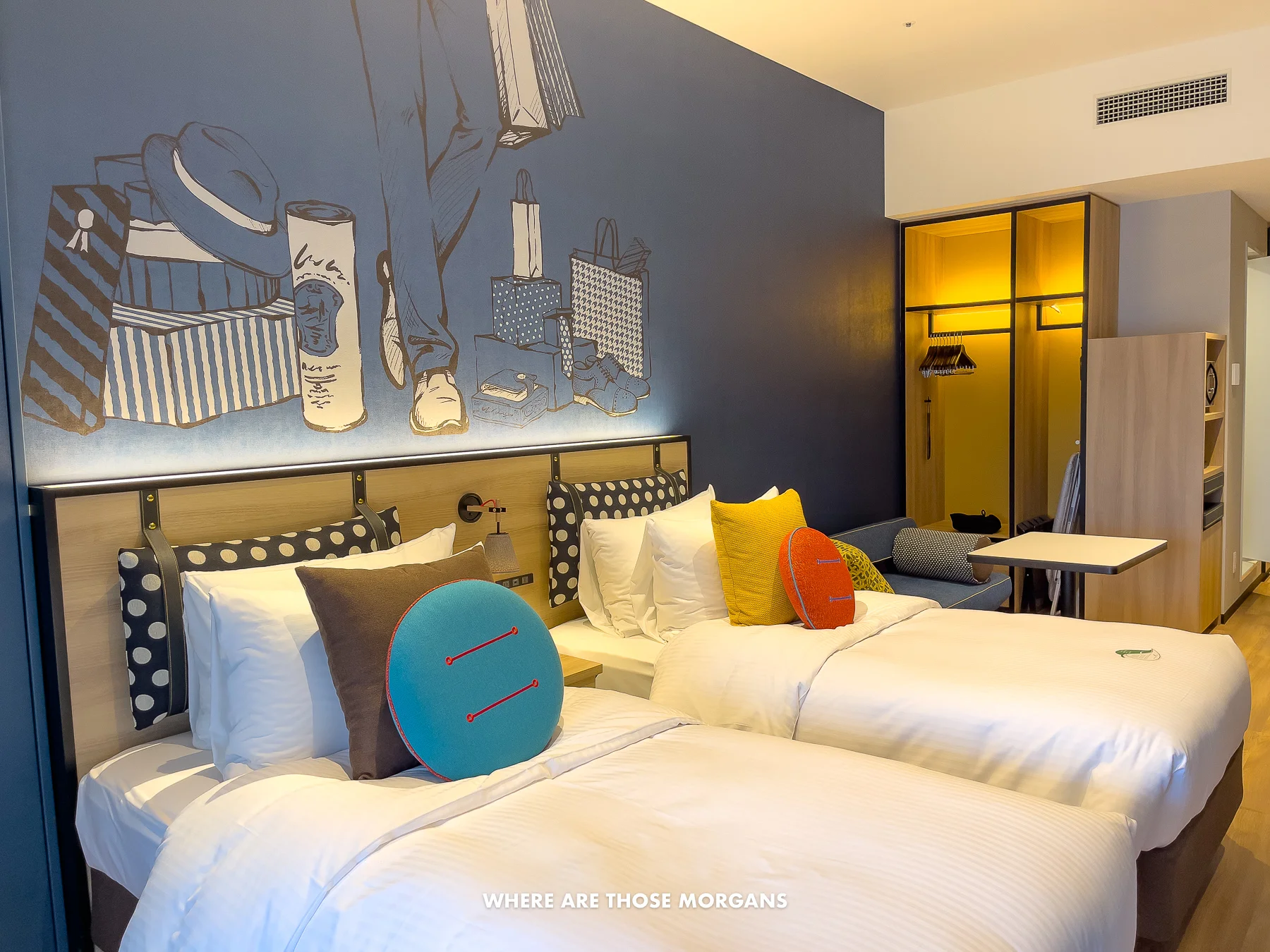
A few years later, we were back in Osaka for another 2 days in April 2023 for the cherry blossoms. This time we had a healthier budget and knew the city well from our first trip. We booked a fantastic hotel called Citadines Namba, which was located in a quieter part of Osaka’s vibrant Namba neighborhood. We chose Namba because it was the place we always gravitated to the first time, it was central to Osaka’s top attractions, it had excellent transit links, and we could easily walk to Dotonbori. And you know what? We’d stay probably in Namba again next time.

Hi, we’re Mark and Kristen Morgan. We left our scientific careers in 2018 to become travel writers and photographers, and since then our expert guides have helped millions of travelers take better trips. Read more about us.
Why trust us with your Osaka lodging? We travel the world and book hotels for a living, and we’ve stayed in two different Osaka neighborhoods, so we know it well. As always, every photo in this guide is ours.
After exploring most of Osaka’s popular neighborhoods and attractions during our two very different 2-day trips to the city, we know the areas well. We loved the balance in Namba, and we think it works best for most first-timers. But the neon-lit Dotonbori is more lively for outgoing travelers and foodie-lovers, Umeda is more upscale and sophisticated, Tennoji is quieter and cheaper, and Shin-Osaka is more convenient for bullet train access.
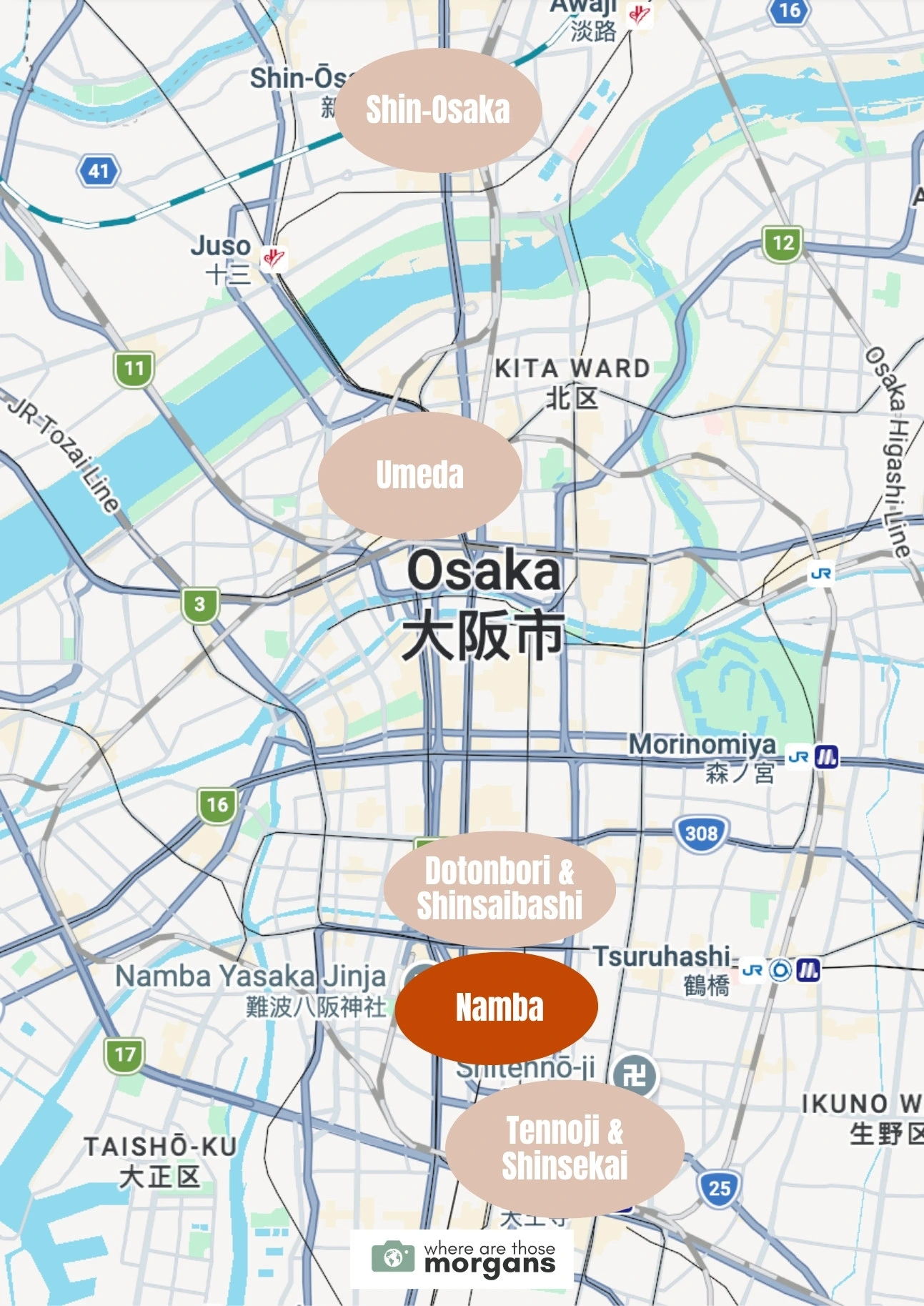
In this guide we cut right to the chase and show you the 5 areas we’d consider staying in Osaka, with pros and cons for each area based on our experiences, plus a helpful map at the end. Let’s dive in!
Note: Our content is reader supported and contains affiliate links. If you make a purchase through one of these links, we may earn a small commission at no extra cost to you and it helps us keep this site running.
Our Favorite Hotels
If you’re in a hurry or don’t want to read this full guide, here are our top hotel recommendations that we think will work for most first time visitors to Osaka – based on a balance of location, quality, value for money, previous guest reviews and our own experiences. They’re all affordable hotels that we’d happily book ourselves:
🏨 Citadines Namba: This is where we stayed in 2023 and the twin beds were like sleeping on clouds. It was in a slightly quieter area to the east of Namba station, just a few minutes walk to Kuromon Market and the Namba action.
🏨 Hotel Forza: If we wanted an affordable hotel with a high-end feel right on the Dotonbori strip, this would be our top pick. It’s got an ideal location for outgoing people who want to be in the thick of it.
🏨 Cross Hotel: For a higher-end stay in Dotonbori but without breaking the bank, Cross Hotel checks a lot of boxes. It’s cool, boutiquey and has a top location. We’d say it’s one of the most popular hotels in Osaka for first-timers.
🏨 Onyado Nono Namba: This is our easiest top pick. Onyado Nono offers a tourist-friendly traditional Japanese onsen ryokan experience with amazing ratings and affordable prices in a superb location. We stayed at this hotel chain in Nara and it was fantastic.
🏨 Hotel The Flag: For a hard to beat all-rounder, we think the affordable and boutiquey Hotel the Flag is a fantastic choice. It’s located in a quieter area of Shinsaibashi, has top ratings and the breakfast looks great.
Now, our favorite hotels in Osaka are all excellent options with top guest ratings and affordable prices, but we hope you love to research and learn about a place before you visit like we do. Keep reading to see what makes each of Osaka’s popular neighborhoods a good or bad area to stay for your trip. Within each district we’ll show you the cheap, mid-range and luxury hotels we’d consider booking.
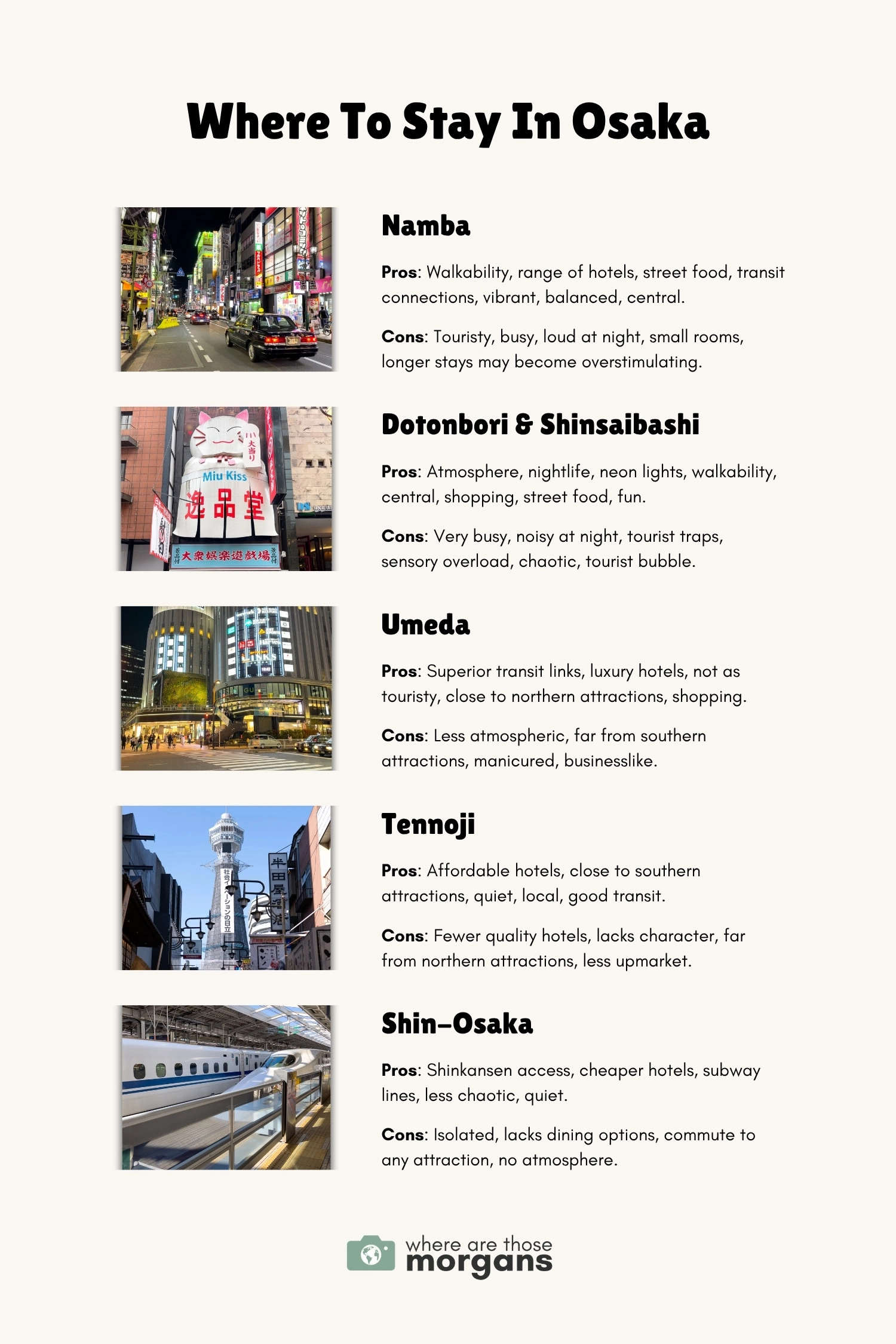
Here’s a summary of the areas we think are worth checking out:
| Area | Price | Vibe | Why? |
|---|---|---|---|
| Namba | $$ – $$$$ | Lively / Electric | Heart of everything |
| Dotonbori | $$$ – $$$$$ | Neon / Buzzy | Nightlife & atmosphere |
| Umeda | $$$ – $$$$$ | Modern / Polished | Transport & hotels |
| Tennoji | $ – $$$ | Local / Understated | Quieter & better value |
| Shin-Osaka | $ – $$$ | Functional / Business | Shinkansen access |
Namba (Balance)
The standout thing we remembered from our 2018 trip to Osaka was how much we enjoyed being in the vibrant and bustling Namba neighborhood. It wasn’t quite as touristy and chaotic as Dotonbori, but it was still full of energy and had such a fun vibe. So we felt it struck the better balance among the two most popular, centrally-located touristy areas of Osaka.
Our hotel was further south near Shin-Imamiya station (which had good transit links), but we found ourselves gravitating towards Namba any time we weren’t ticking off attractions. It was amazing for food and drinks with Kuromon Market on the doorstep, unique Shinto shrines like Namba Yasaka Jinja, and soaking up a lively atmosphere without it ever feeling over the top. So we ended up barely spending any time at all near our hotel.
Needless to say, we barely even considered staying in any other part Osaka when planning our 2023 Japan trip. We knew Namba was the right place for our travel style, but we also had the budget and knowledge to be picky. So we did a decent amount of additional research and landed on Citadines Namba. Why? Because it had sky high ratings and a quieter location on the edge but still within a few minutes walk of the chaos.
Honestly, the hotel turned out to be superb. If you travel a lot, there’s probably a few standout hotel stays you remember. For us, the twin beds (trust us, twin beds are the way to go in Japan) at Citadines Namba were among the comfiest beds we’ve ever had in a hotel. And we travel the world for a living, so that’s a bold statement.
💰 Cheap: If we wanted to book a cheap hotel in Namba, we’d start by looking at Hotel Keihan for a quieter southern location, Hiyori Hotel for omotenashi (Japanese hospitality), and Hotel Gracery Namba to be closer to Dotonbori. They’re all highly rated, affordable, and close to Namba station. Of the three, we’d pick Hiyori if they were similarly priced.
💰💰 Mid-range: On the lower end of mid-range we’d happily book Citadines Namba again. It’s in a quieter spot on the east side of the station, but the room was great and the beds were amazing. Our backups would be the trendy &Here Namba with awesome-looking apartment-style rooms and a rooftop terrace, or the upscale Fraser Residence which is pushing the higher end of mid-range but looks great for longer stays.
💰💰💰 Luxury: If we had a bit more money in the budget, we’d focus our attention on the Thai luxury Centara Grand Hotel with spa and rooftop restaurant, the artsy Hotel Royal Classic, and the classic luxury at Swissotel Nankai. Or we’d look at Mimaru Namba Station for high-spec apartment-style accommodations that would work better if we visited with our kids and wanted a trusted brand.
Our verdict: We think Namba is the most balanced place for first timers to stay in Osaka. The vibe is fun without going overboard, the food is incredible, transport links are excellent (including direct train transfers from Kansai airport), and it’s easily walkable to Dotonbori. Overall, we’d say it’s ideal for couples, groups of friends and families with older kids traveling on mid-range budgets.
Pros
✅ Walkability
✅ Range of hotels
✅ Transit connections
✅ Street food
Cons
❌ Very busy
❌ Loud at night
❌ Small rooms
❌ Becomes tiresome
Dotonbori & Shinsaibashi (Atmosphere)
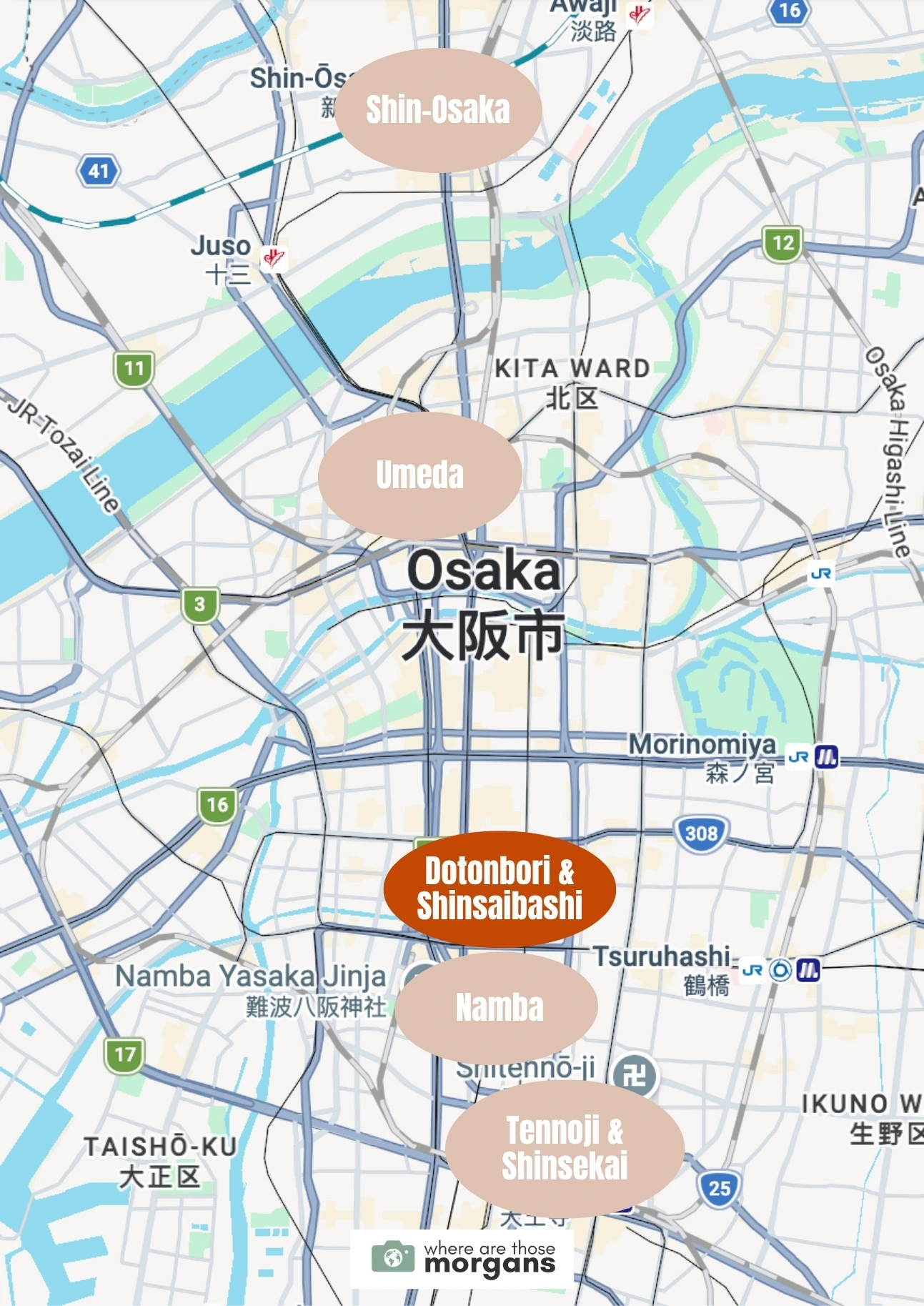
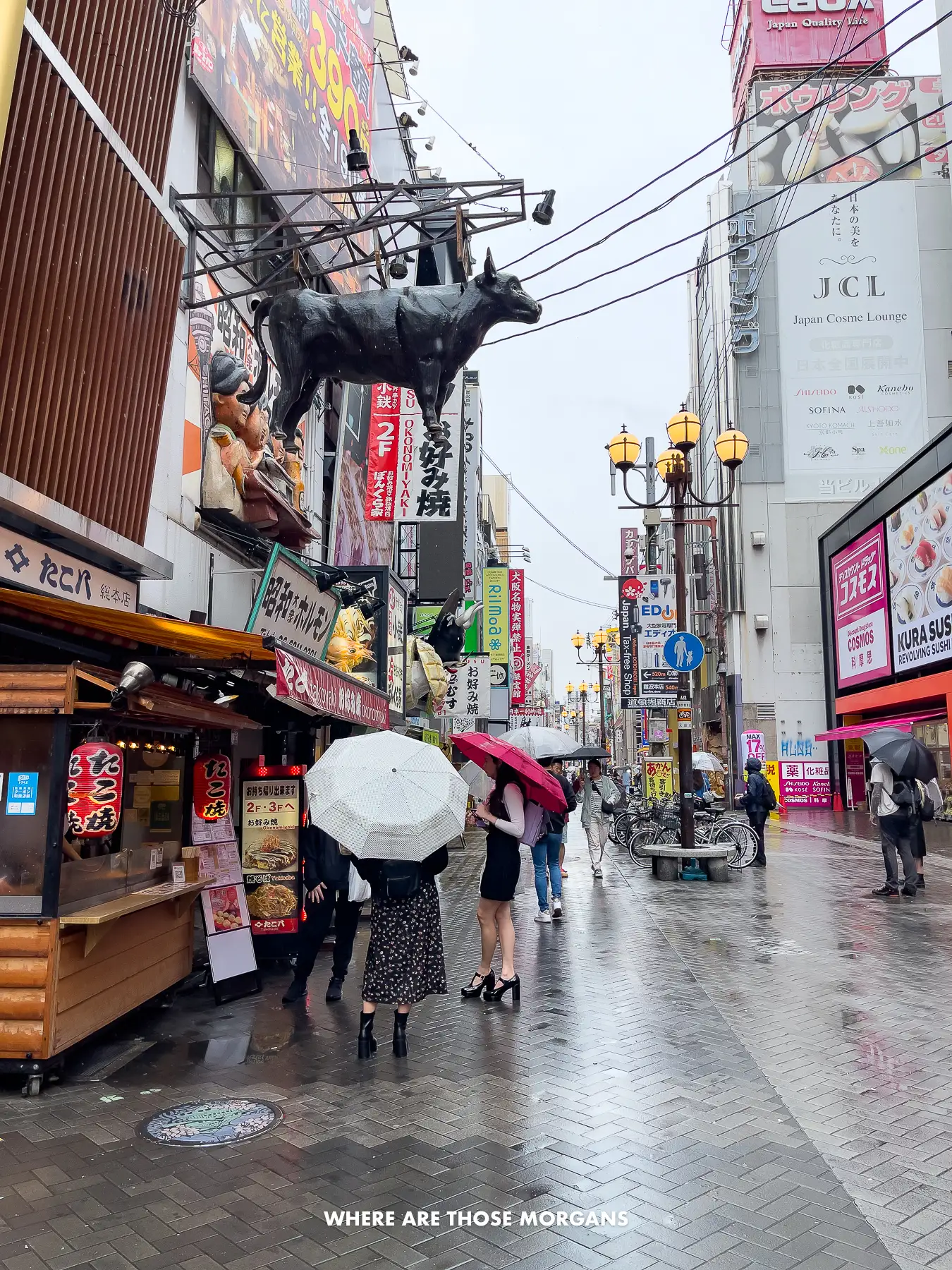
We really liked the high-energy, neon-lit, culture-shock vibe in Dotonbori. For us, it was by far the coolest and most visually appealing part of Osaka, there were endless eateries and bars, and the atmosphere was always bouncing (except the day we had heavy rain and even Dotonbori was totally dead). Plus, Hozen-ji Temple is well worth seeing, and there’s tons of highly rated tours worth doing like this tea ceremony, this nightlife street food tour, this sushi making class, and this go kart street tour.
If we were in our twenties or visited Osaka with friends, we’d probably book a hotel in Dotonbori or slightly north (but not too far north) into Shinsaibashi. Staying there would put us right in the heart of the action near the “Glico Man”, within easy walking distance to the best neon lights and bars. It’s also where we’d stay if the sole purpose of our trip was street food because it’s surrounded by markets, restaurants and food tours.
The two reasons we didn’t stay there in 2023? First, it’s very busy all day and night, and we didn’t want the constant noise and crowds. Second, on average it’s more expensive than anywhere else in the city and we weren’t desperate to pay extra to have that prime-time location. But if you want to be right there in the mix on a first visit to Osaka, you should book your hotel close to the canal in Dotonbori.
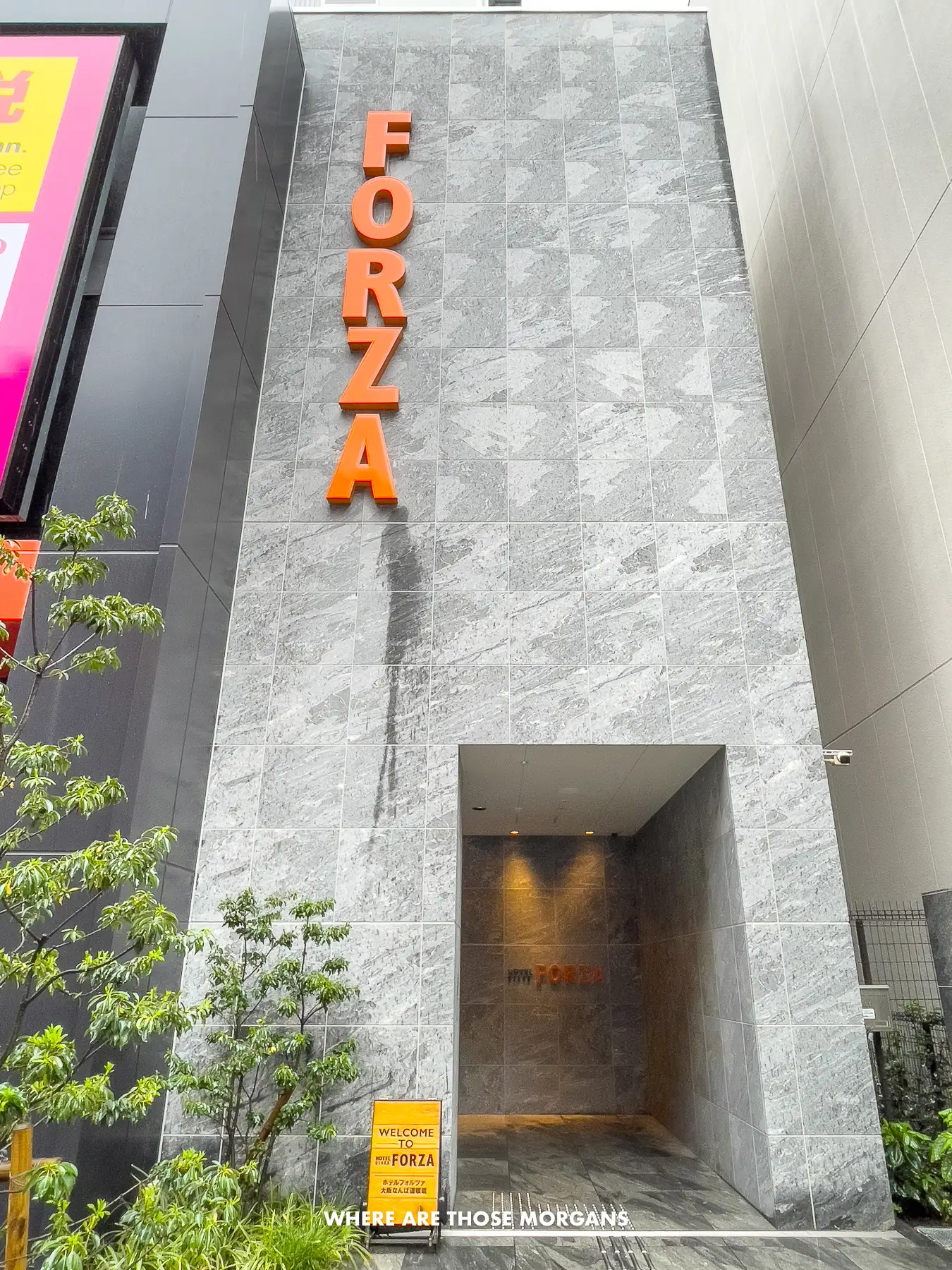
💰 Cheap: The high tech Hotel Forza right on the main Dotonbori strip would be our top budget pick if we wanted to stay in the absolute thick of it. We’d consider Kaneyoshi Ryokan for a cheaper traditional Japanese-style stay, and the tourist friendly Dotonbori Hotel would be another affordable backup with perks like free ramen and beer during happy hour.
💰💰 Mid-range: For a Western-style mid-range stay in Dotonbori we’d start by looking at Cross Hotel, which has a superb location near the canal. A hidden gem option we’d also consider is Hotel K6 with an all-inclusive concept (including free alcohol) and a Bali-resort theme. But our wildcard pick in Osaka’s liveliest area is Onyado Nono Namba, we stayed at this same chain in Nara and had a fantastic traditional Japanese onsen ryokan experience. These three are all excellent lodging options for Osaka, it’s a strong category.
💰💰💰 Luxury: On the upper end of budget we’d book the boutique luxury Hotel the Flag, which looks like a perfect all-rounder in the quieter northern reaches of Shinsaibashi. The nearby Hotel Nikko with city views and instant station access would be a solid backup, and then there’s Mimaru Namba North for high-end apartment-style accommodation in the trendy America-mura area.
Our verdict: We think Dotonbori is the most fun and atmospheric place to stay in Osaka. It’s ideal for younger or more energetic couples, outgoing families with older kids (we wouldn’t want to push our stroller through this area non-stop!), foodies, and anyone taking a shorter trip where being within walking distance of everything is the most important factor. If it was our first time in Osaka again, Dotonbori would be our second choice after Namba.
Pros
✅ Neon lights
✅ Nightlife
✅ Atmosphere
✅ Walkability
Cons
❌ Sensory overload
❌ Very busy
❌ Noisy at night
❌ Tourist bubble
Umeda (Transit Links)
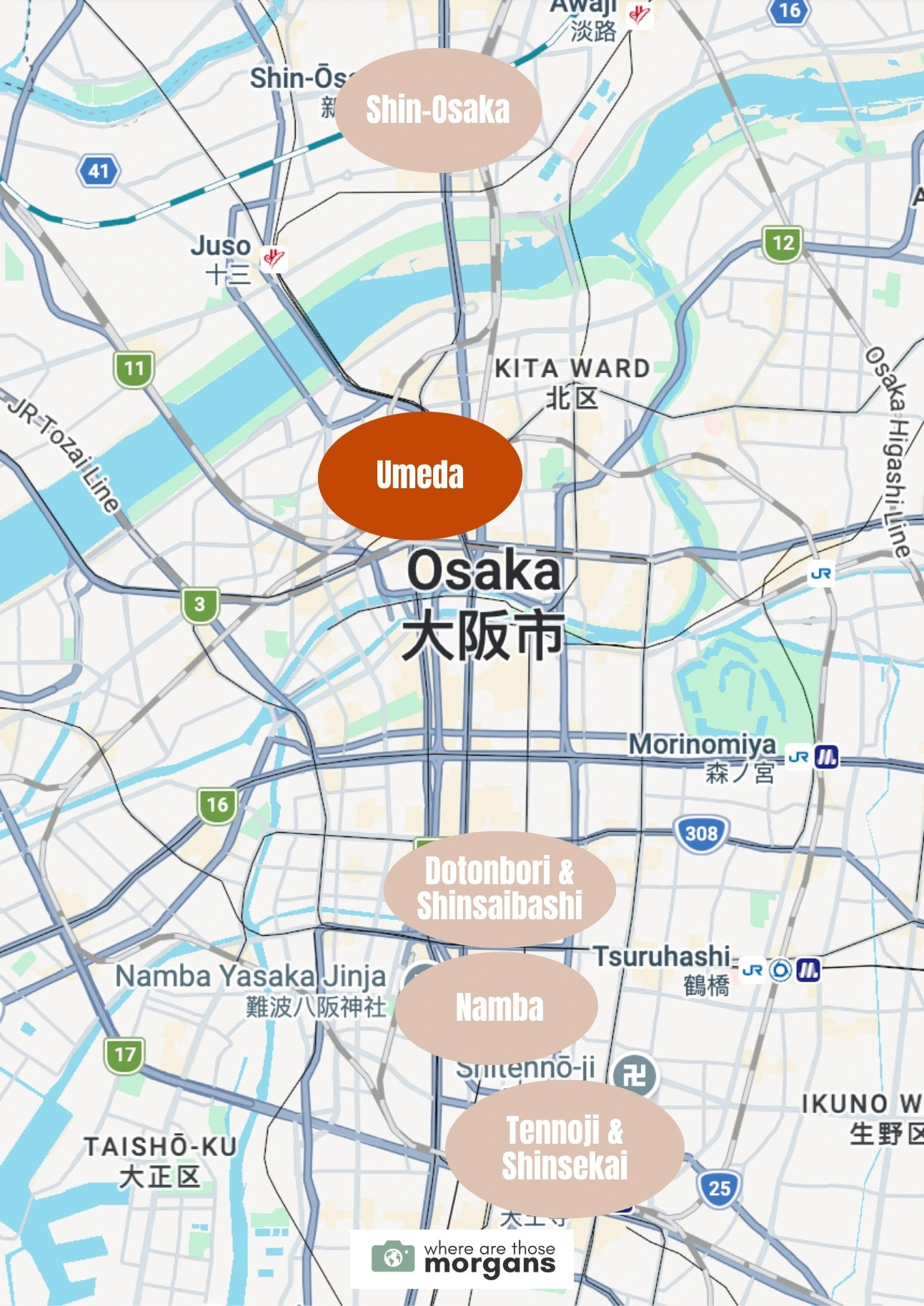
Ask us which place surprised us most in Osaka, and we’d say Umeda. It was totally different to the neon lights, chaos and street culture of Namba and Dotonbori, replaced instead by department stores (including one of the world’s largest underground shopping networks), open-air views from Umeda Sky Building, polished streets and a more high-end vibe. But it still had a cool vibe and it was busy enough without being too much.
Our travel style has always been to immerse ourselves into the thick of it, so we’d naturally choose Namba and Dotonbori first. But if we wanted a more “grown up” place to stay in Osaka, Umeda would be our first choice. It definitely lacks what we picture when we think of Japan, but it’s a solid option with the most classical luxury hotel chains and a massive ace up its sleeve – the best transport connections in the city.
One reason we might choose Umeda over Namba is for a longer stay, let’s say booking 4 or more nights in Osaka. Why? Because Namba can be a sensory overload (Dotonbori is worse) and might get tiresome after 4 nights, whereas Umeda is calmer. Plus, we’d be able to get around the region far more easily from Umeda thanks to its superior transit links.
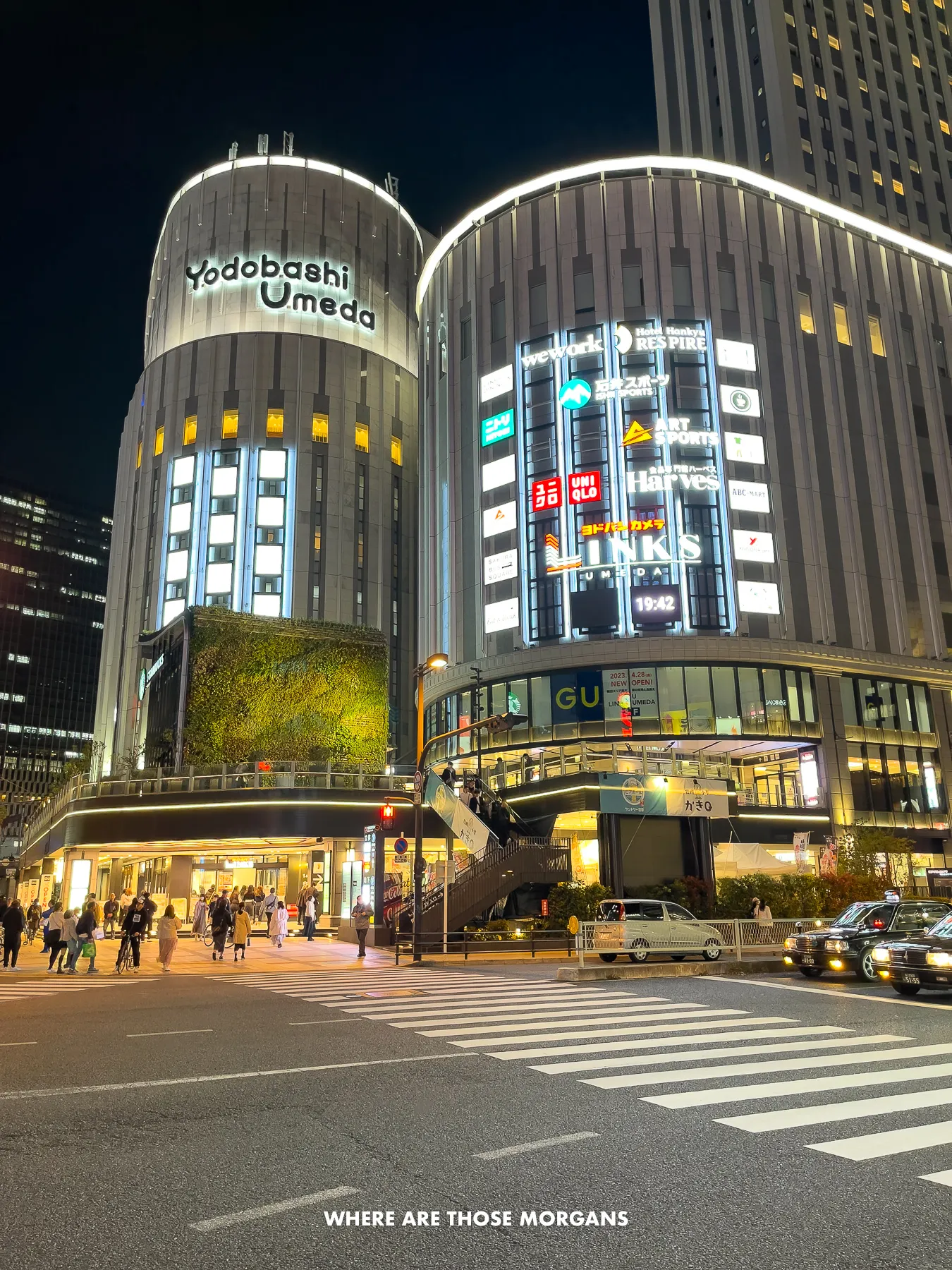
💰 Cheap: If we wanted to stay there as cheaply as possible, we’d compare prices at Hotel Hokke Club which has a top floor public bath, the modern Umedaholic Hotel with large twin rooms, and the lively hipster Moxy Umeda which is popular with the younger crowd. They all look great, but we’ve stayed at Marriott’s cool Moxy hotels in cities like New York and they’re always a fun time.
💰💰 Mid-range: With a decent middle budget for Umeda, we’d take a look at the sleek Villa Fontaine Grand with its high-end spa, the trendy Canopy by Hilton, or the industrial chic Tones Osaka for a boutique-style stay.
💰💰💰 Luxury: This is where Umeda really shines. If we were looking for a real 5-star Osaka hotel experience, we’d happily book the ultra-modern InterContinental Osaka, a stately resort-like escape at The Westin Osaka, or the artsy The Osaka Station Hotel located directly above JR Osaka Station.
Our verdict: The quality of hotels in Umeda is higher across every budget category when compared to Osaka’s other popular neighborhoods. We think it’s the ideal place to stay for thirties-plus couples, business travelers, shoppers, or anyone on a multi-city Japan trip who values transport connections. It lacks tradition, but it provides a more upscale, adult experience.
Pros
✅ Transit hub
✅ Luxury hotels
✅ Not as touristy
✅ Northern location
Cons
❌ Less atmospheric
❌ Far from attractions
❌ Less “Japanese”
❌ Manicured
Tennoji & Shinsekai (Affordable)
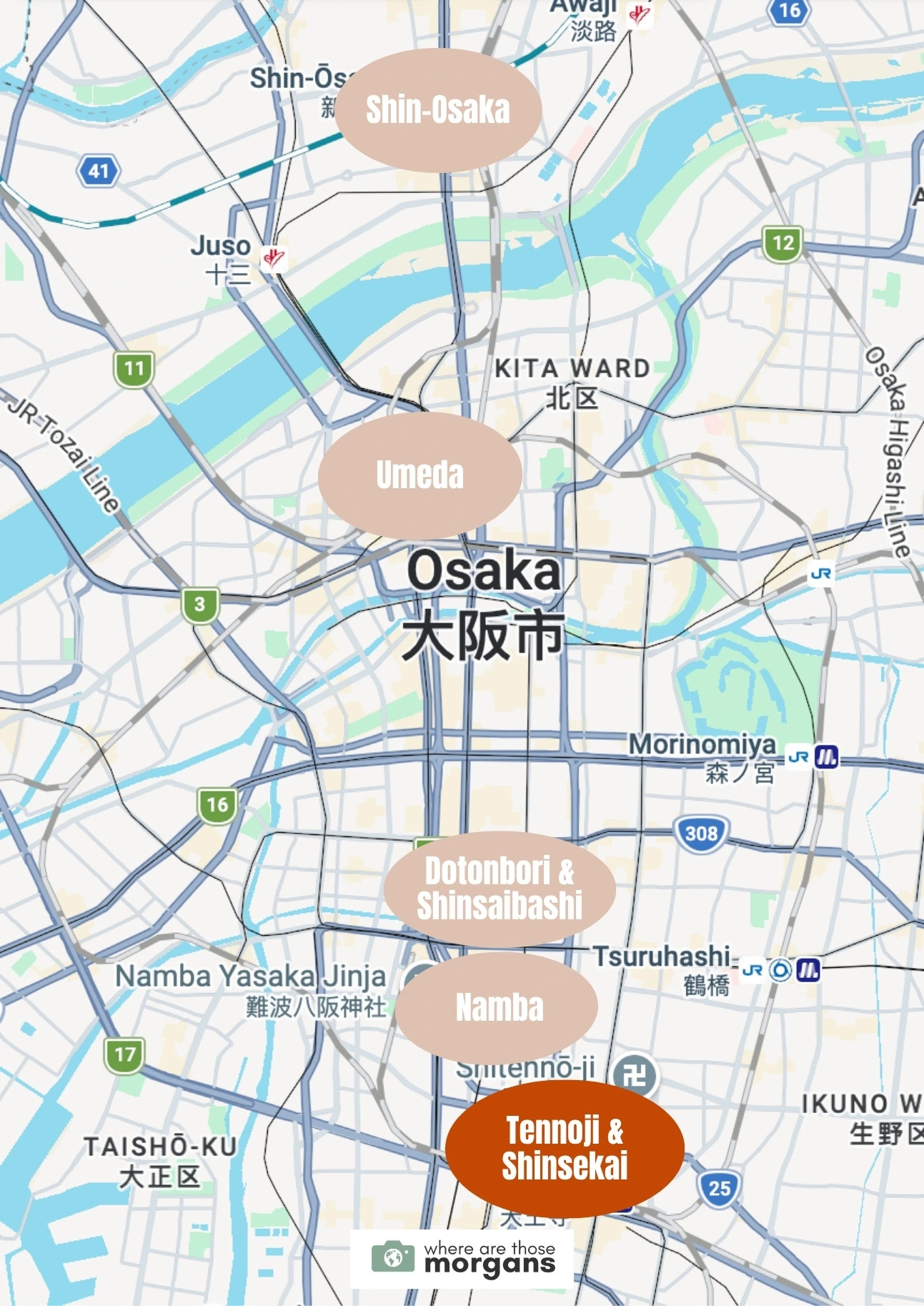
Our hotel in 2018 was near Shin-Imamiya station which is essentially “next-door” to Tennoji, but it was still a good 15-minute walk away so we wouldn’t count it as staying in Tennoji. Knowing what we know now, we should have booked closer to Tennoji station. Regardless, we didn’t spend much time in the south, so we didn’t really get to know the Tennoji area. And that was a mistake.
After spending more time in Tennoji and Shinsekai during our second visit, we began to see what makes this area a bit of a hidden gem option for booking a hotel. Not only does it have solid transport links, but it’s also close to Shitennoji (one of Japan’s oldest temples), the revitalized retro Shinsekai neighborhood, Abeno Harukas for sunset views, Tennoji Park, and Tennoji Zoo. If we stayed in Shinsekai, we’d definitely book this popular foodie tour with 17 dishes.
Most importantly, Tennoji and Shinsekai have tons of cheap hotels without sacrificing too much on location. Most other really cheap hotels in Osaka are in areas we wouldn’t want to stay (like when we stayed near Shin-Imamiya), whereas at least Tennoji and Shinsekai offer a lot of attractions on the doorstep that most first-timer’s are going to visit anyway.
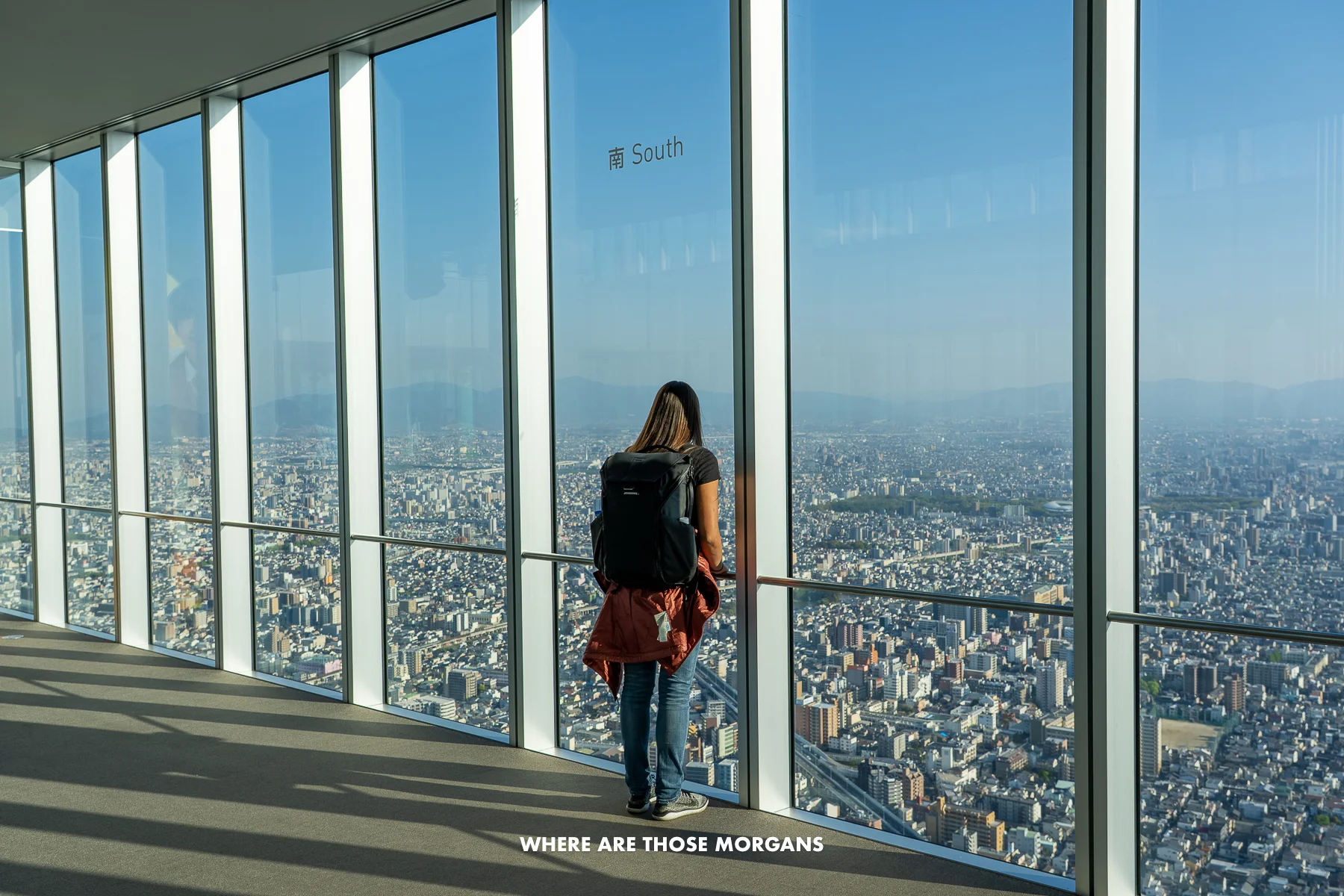
💰 Cheap: On a budget, we’d compare reviews and prices at Anda no Mori Tennoji Tower for a fun Bali-themed stay, Via Inn Abeno for a practical stay near the station, the boutique Hotel 3 O’Clock which has a rooftop terrace, and the modern Koko Hotel Shinsekai if we wanted to be located in the heart of the bustling retro district.
💰💰 Mid-range: With a bit more room in the budget, we’d happily book the sophisticated Hotel Trusty Abeno with a great location and affordable luxury prices. Our backups would be Hiyori Hotel Shinsekai which prides itself on omotenashi (Japanese hospitality), or the aparthotel WellStay Shinsekai if we were visiting with friends or extended family.
💰💰💰 Luxury: If we wanted to splurge, we’d definitely book the 5-star Osaka Marriott Miyako which occupies the top floors of Abeno Harukas. It would be a bucket list experience with amazing views and service. For something different, we’d look at high-end designer apartment experiences at Apartment Hotel 11 Tsutenkaku for the two of us or Ocean Tsutenkaku if we visited with family or a larger group.
Our verdict: We think Tennoji if a great option for budget conscious travelers, families with younger kids, couples who prefer a quieter local feel over tourist-central, and anyone who plans to spend more time in the south of the city around Shinsekai and Shitennoji. It doesn’t have the same level of street food or nightlife as Namba and Dotonbori (although Shinsekai is famed for kushikatsu which means deep-fried skewers), or the high-end feel of Umeda – but it is more authentic Osaka.
Pros
✅ Affordable
✅ Southern attractions
✅ Quiet and local
✅ Decent transit
Cons
❌ Far from north
❌ Fewer quality hotels
❌ Logistically inefficient
❌ Lacking character
Shin-Osaka (Bullet Train)
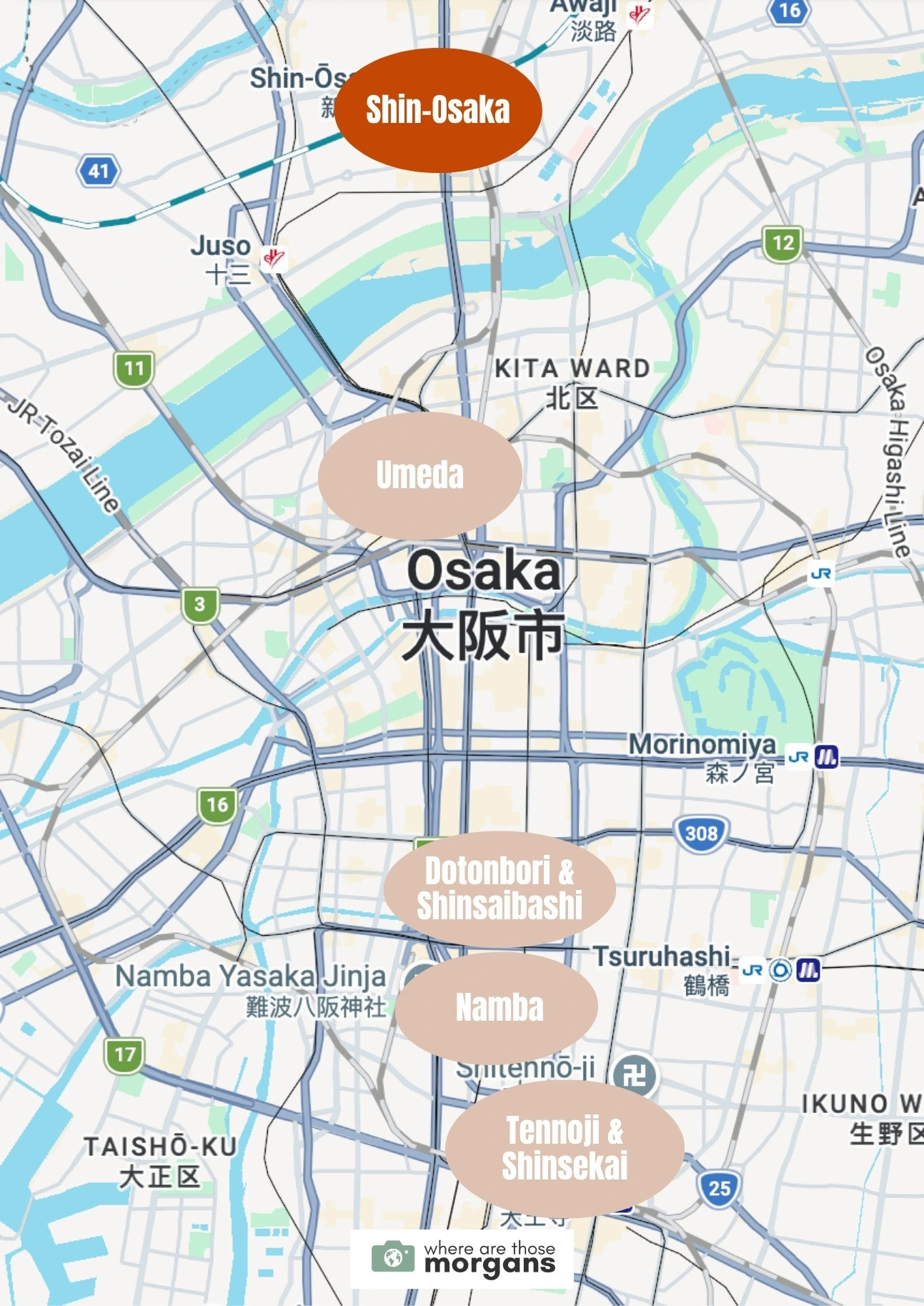
Finally, we want to talk about staying near Shin-Osaka, which isn’t really a neighborhood at all, but more of a bullet train transit junction with hotels. It’s a popular place for solo business travelers to stay, so there’s a lot of business hotels with small and cheap hotel rooms. This is the last place you’d find us booking a hotel in Osaka, but that doesn’t mean it isn’t going to be the exact place you want.
First, why wouldn’t we stay there? Basically because it has no soul, no street food culture, nothing going on in the evening, and no atmosphere whatsoever. All the food options nearby are chains, the hotels are business-centric, and even though it’s only a short subway ride away it would still feel segregated from the rest of the city. It is not how we would envisage a first visit to Osaka.
So why even consider it? Well, because we know what it’s like to spend weeks traveling through Japan by train and getting fed up with lugging suitcases around connecting trains, subways and taxis. Staying in a hotel right at the bullet train station affords maximum convenience. If we only had 2 days in Osaka and planned to spend all day and night exploring, what difference would it make where we crashed?
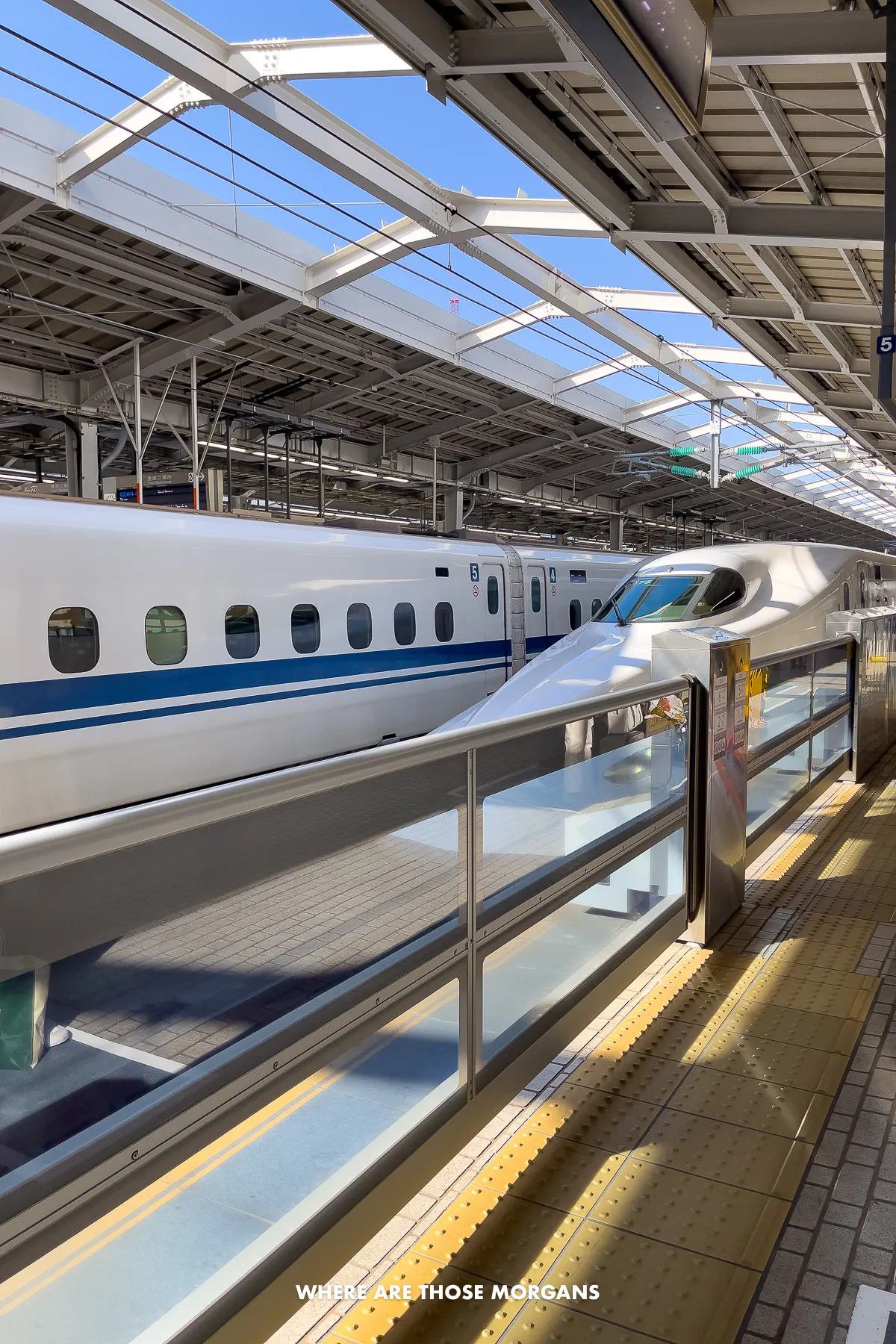
💰 Cheap: If we just needed a cheap place to crash near the bullet train station, we’d book either Via Inn, Smile Hotel, Comfort Hotel, or Shin-Osaka Station Hotel. They would all do a similar job, provide a bed and a shower.
💰💰 Mid-range: On a middle budget we’d book the premium-looking Courtyard by Marriott, the stylish Hotel Androoms with public bath, or the futuristic Remm Shin-Osaka. It would only be for a night or two, so we’d be less bothered about the hotel and more about the price.
💰💰💰 Luxury: If we wanted to stay at Shin Osaka and had a healthy travel budget, we’d book the best luxury-lite option in the area called the Karaksa Hotel Grande. It’s a massive tower with a public bath and great views, plus they offer connecting rooms which would be ideal if we visited in a bigger group. But there aren’t any true 5-star hotels at the bullet train station, they’re really only in Umeda.
Our verdict: Honestly, we personally wouldn’t book a hotel at the Shinkansen station because we prefer staying in lively, neon-lit areas like Namba, Dotonbori or Umeda. But we totally understand why it’s a top choice for travelers moving quickly between cities via the bullet train, or anyone prioritizing logistics over neighborhood soul. It offers ultimate convenience, especially when lugging around big suitcases.
Pros
✅ Shinkansen access
✅ Cheaper hotels
✅ Subway lines
✅ Less chaotic
Cons
❌ No atmosphere
❌ Commute to the city
❌ Lack of dining
❌ Isolated feel
Osaka Neighborhoods Map
Map key:
- Green – Cheap hotels
- Red – Mid range hotels
- Blue – Luxury hotels
How to use this map: Click the map above to activate, then tap any hotel icon to see more information. See a list of all hotels and neighborhoods by clicking the arrow icon in the top left, or see a full version of the map by clicking the “view larger map” icon in the top right.
How to save this map: Click the small star next to the map title – this will add the map to your Google account. Open your Google Maps app, tap “saved”, then tap “maps” and open this map.
Where To Avoid Staying
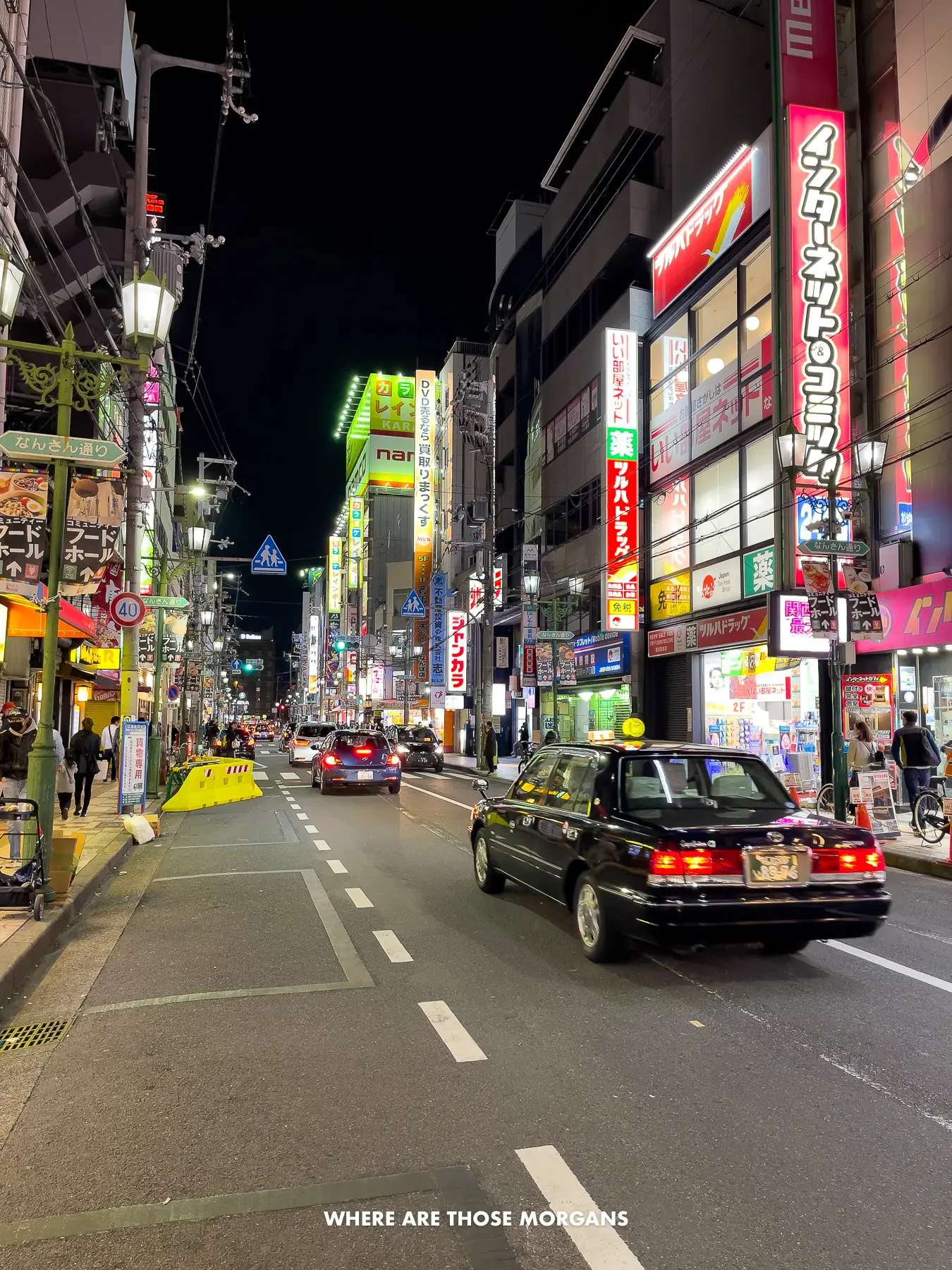
Honmachi: When we first looked at a map of Osaka, we couldn’t understand why the entire middle section of the city called Honmachi was never mentioned for attractions or places to stay. But we quickly learned it’s because that entire area is Osaka’s business district with very little going on, especially over the weekends. Don’t be temped by cheap hotels in this central location, you’ll end up spending your whole trip riding subways to livelier areas.
Osaka Bay: Unless we were going to Osaka specifically to visit Universal Studios, we would avoid booking our hotel in Osaka Bay or Tempozan. It might sound good for visiting the theme park or Osaka aquarium, but this area is 20-30 minutes from central Osaka and has limited dining options.
Fukushima: When researching for our second visit we saw Fukushima touted a few times as an up and coming neighborhood with hidden gem restaurants. And while that might be true, we still wouldn’t book a hotel there because it’s isolated from the rest of the city. Yes, it’s next to Umeda, but at least in Umeda you’d be in a commercial, busy area with attractions and lots more choice.
Osaka Castle: We love Osaka Castle, but to visit, not to stay nearby. There’s really not much going around the northeast of Osaka, so don’t book a hotel near the castle or even across the river into Tenma. You’ll just end up riding trains to get to better tourist areas.
Shin-Osaka: We’ve already mentioned why we wouldn’t stay in Shin-Osaka, but we wanted to include it in our where to skip section to really drive home that it’s only worth it if you really don’t want to deal with lugging suitcases around the city.
Vibe: For us, the key to picking the right place to stay in Osaka is to consider the exact vibe you want. Don’t want crowds? Skip Dotonbori and Namba. Don’t want long transit connections? Skip Tennoji. Prioritizing atmosphere? Skip Shin-Osaka and Tennoji. When we travel, we choose areas based on the vibe we want, rather than the cost or the hotel chain.
Our Top Tips
Accommodation tax: Osaka’s hotel tax is much lower than Kyoto’s. It’s a flat rate per person, per night and only kicks in if your room costs above 7,000 yen. Even the most expensive rooms have a very low tax, especially compared to Kyoto. We’ve always paid tax at the front desk during check in.
Getting around: Don’t worry about buses for getting around like you have to in Kyoto, just stick to trains in Osaka. The subway and JR lines are extensive. Here’s an Osaka metro map.
Luggage: We’ve never used this in Japan but will next time, a luggage delivery service like this one can take your suitcases from Tokyo or Kyoto hotels directly to your Osaka hotel for surprisingly affordable prices. That saves carting them around on bullet trains and removes the need to stay at Shin-Osaka based on logistics with heavy suitcases.
Tennoji: If you book a hotel in Tennoji, don’t go further south than Tennoji station and Abeno Harukas. Shitennoji and Shinsekai are north, and they’re fine. Any further south and there’s nothing at all for tourists.
Smoking vs non-smoking: Smoking rooms still exist in Japan, and we wouldn’t want to risk ending up in a room stinking to high heaven of smoke. We always double check our rooms are non-smoking before booking.
Check-in: We’ve never been able to check in to a hotel early without incurring a fee. If you’ll be arriving in the morning, check with the hotel to see costs for early check ins.
Beds: We always sleep in the same bed when we travel. But in Japan, we only book twin rooms. Why? Because two twins equals much bigger than one full or double bed. Plus, the twin beds in Japan are always so comfy.
And finally, read our guide on how we book cheap hotels to see the easy steps you can follow to grab a cheaper room in Osaka.
Next Steps
We hope our neighborhoods guide helps you figure out where to stay in Osaka.
If you’d like more personalized help, we offer expert travel planning consultations where we answer any questions you have, help you avoid tourist traps and plan out your entire itinerary step by step. See our packages and reviews.
Still researching for your trip?
- Here are the best places to visit in Osaka.
- Here are the top things to do in Kyoto.
- This is how to spend 3 days in Kyoto.
- Here’s exactly where to stay in Kyoto.
- Don’t miss these top Tokyo attractions.
- Here’s our first-timers 5 day Tokyo itinerary.
- These are the best areas to stay in Tokyo.
- This is what to see and do in Nara.
Finally, we recommend reading our Japan travel guide for first-timers to get helpful tips and advice, top attractions to see, itinerary ideas and more.
Happy travels,
Mark and Kristen
Find our guide helpful? Pin it for later!

All Rights Reserved © Where Are Those Morgans, LLC. Republishing this article and/or any of its contents (text, photography, maps, graphics, etc.) in whole or in part is strictly prohibited.

Mark and Kristen spent 6 years traveling the world, visiting over 40 countries across 4 continents and more than 30 US states. They created Where Are Those Morgans in 2018 to help others plan the best possible vacations by writing authentic travel and hiking guides based on their real experiences.
Since the arrival of baby Maya in late 2024, Mark and Kristen’s extensive travels have slowed down but they still take plenty of trips. Where Are Those Morgans now helps millions of travelers each year to visit new places and hike new trails through information-packed blog posts and expert travel guidebooks. Read more about Mark and Kristen.