
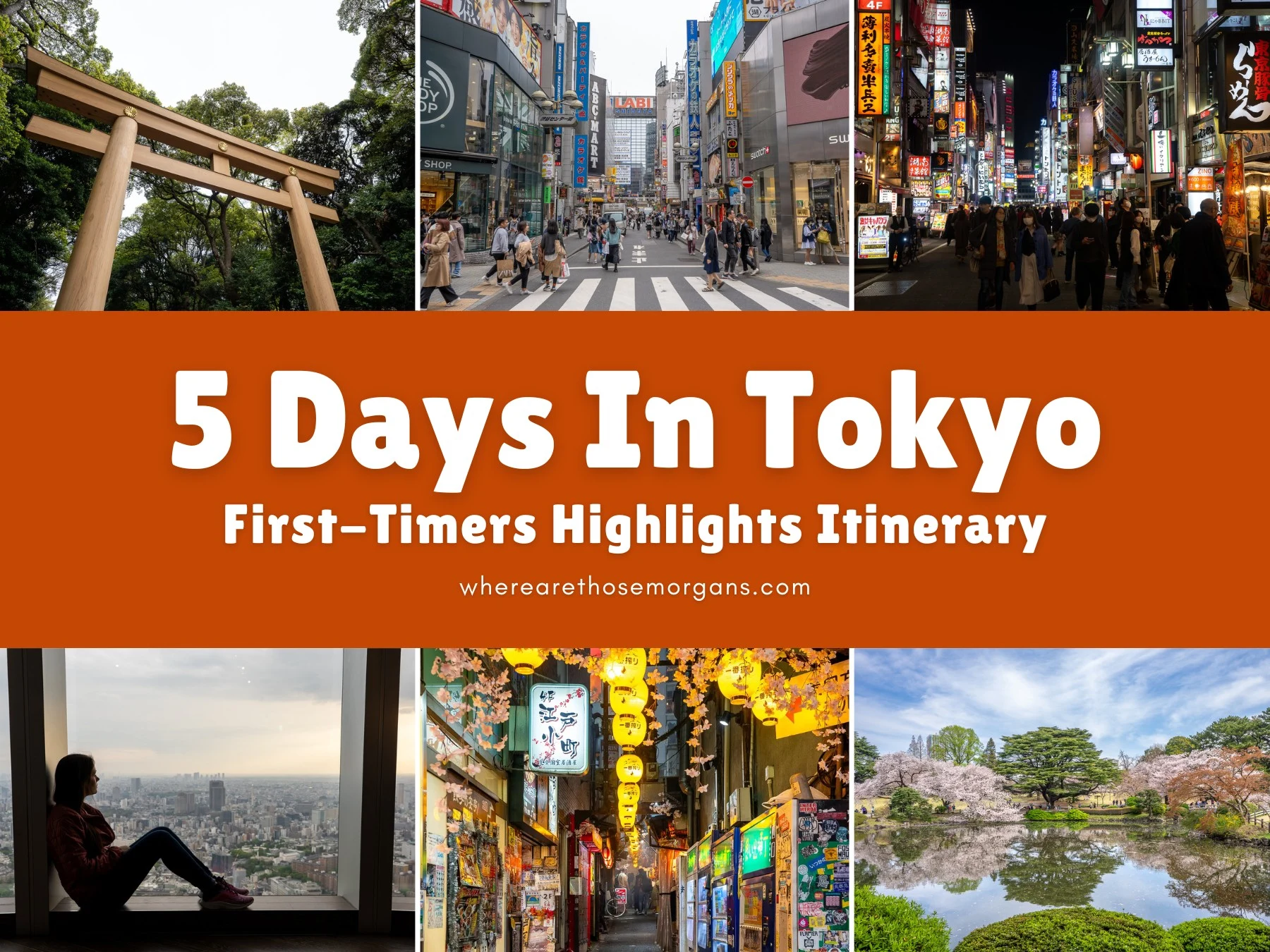
We spent 5 days exploring Tokyo at the end of our first trip to Japan in October 2018, during our 18 month honeymoon around the world. We’d already ticked off Osaka, Kyoto, Nara, Takayama, Kanazawa and the Japanese Alps before our bullet train rolled into Tokyo Station, so we didn’t have to deal with culture shock in the massive capital city. Our budget was super tight, so we built our itinerary around free and cheap activities, we stayed in a more affordable area between Kanda and Akihabara, and we ate at a lot of convenience stores.
Japan ended up being one of our favorite stops, and we couldn’t wait to go back. So in 2023, we booked a 14-day Japan trip at the end of March and start of April to see the cherry blossoms. This time we did our first 3 days and last 2 days of the trip in Tokyo. We had a healthier budget so we stayed in Shinjuku first and near Tokyo Station at the end, we filled our itinerary with fun attractions and cool neighborhoods, and we ate some seriously delicious food.
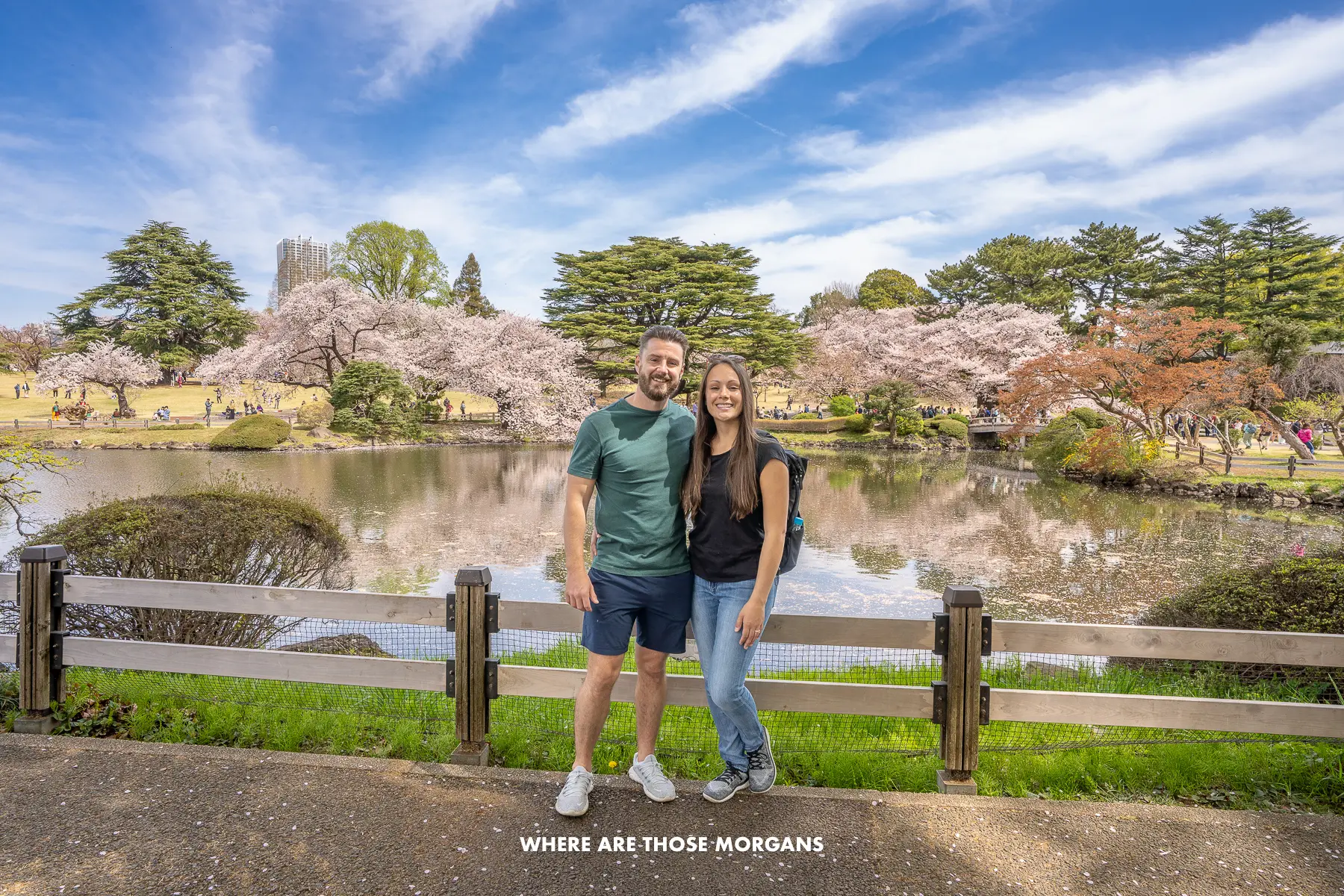
Hi, we’re Mark and Kristen Morgan. We left our scientific careers in 2018 to become travel writers and photographers, and since then our expert guides have helped millions of travel planners take better trips. Read more about us.
Why trust us with your Tokyo itinerary? Across two trips we’ve figured out what’s worth doing, what we wish we did, and how we’d do 5 days in Tokyo if it was our first time again. As always, every photo in this guide is ours.
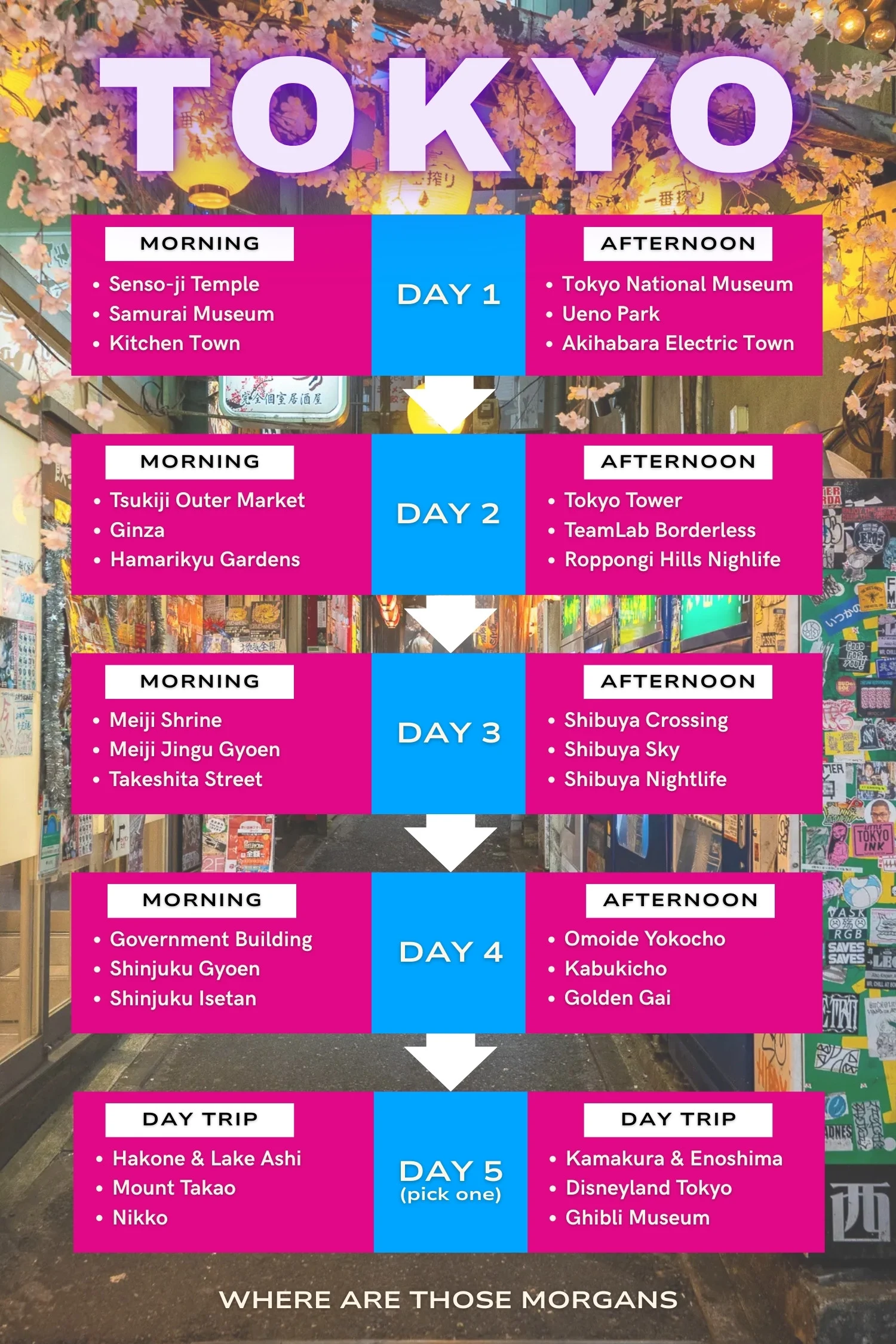
In this guide we walk you step-by-step through our 5-day highlights itinerary – exactly how we’d do Tokyo in a little under a week if it was our first time again. This comprehensive plan is based on our two very different 5 day trips, but adapted to be more efficient based on what worked for us, and more importantly what didn’t. It’s fast-paced and filled with Tokyo’s top attractions – but at the end of each day we explain how we’d slow it down or change it up.
We try to book our attractions in Tokyo (and Japan) through Klook rather than going direct because we discovered it’s usually cheaper. Plus, Klook’s website is easier to navigate than individual attractions and the app holds every ticket in one place. Stick around until the end for our itinerary map, 5-day expense report, and advice on the most important things you need to know. Let’s dive in!
Note: Our content is reader supported and contains affiliate links. If you make a purchase through one of these links, we may earn a small commission at no extra cost to you and it helps us keep this site running.
Need a hand planning your Japan trip? We help independent travelers plan better, stress-free trips. Schedule a video call and we’ll build a Japan itinerary that fits your style, budget and priorities. See our travel planning help.
Day 1: Asakusa, Ueno Park & Akihabara
Our first day would be a nice and easy introduction to Tokyo, especially after a long travel day to Japan. Instead of diving in at the deep end in Shinjuku, we’d begin with the old and traditional part of the city, followed by a fantastic museum and a real “welcome to Tokyo” walk through the Electric Town in Akihabara.
Visit Senso-ji Temple (8:00 AM)
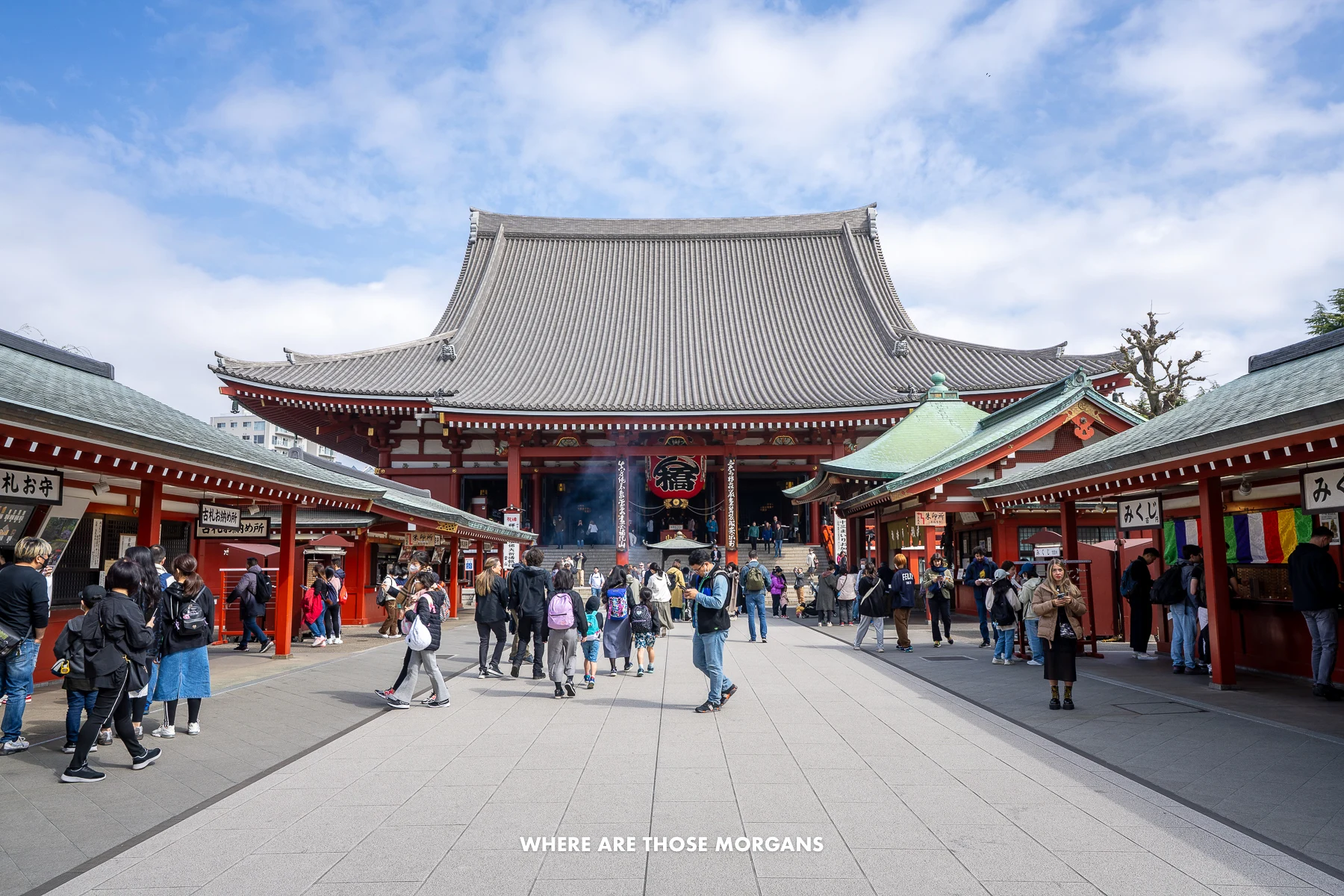
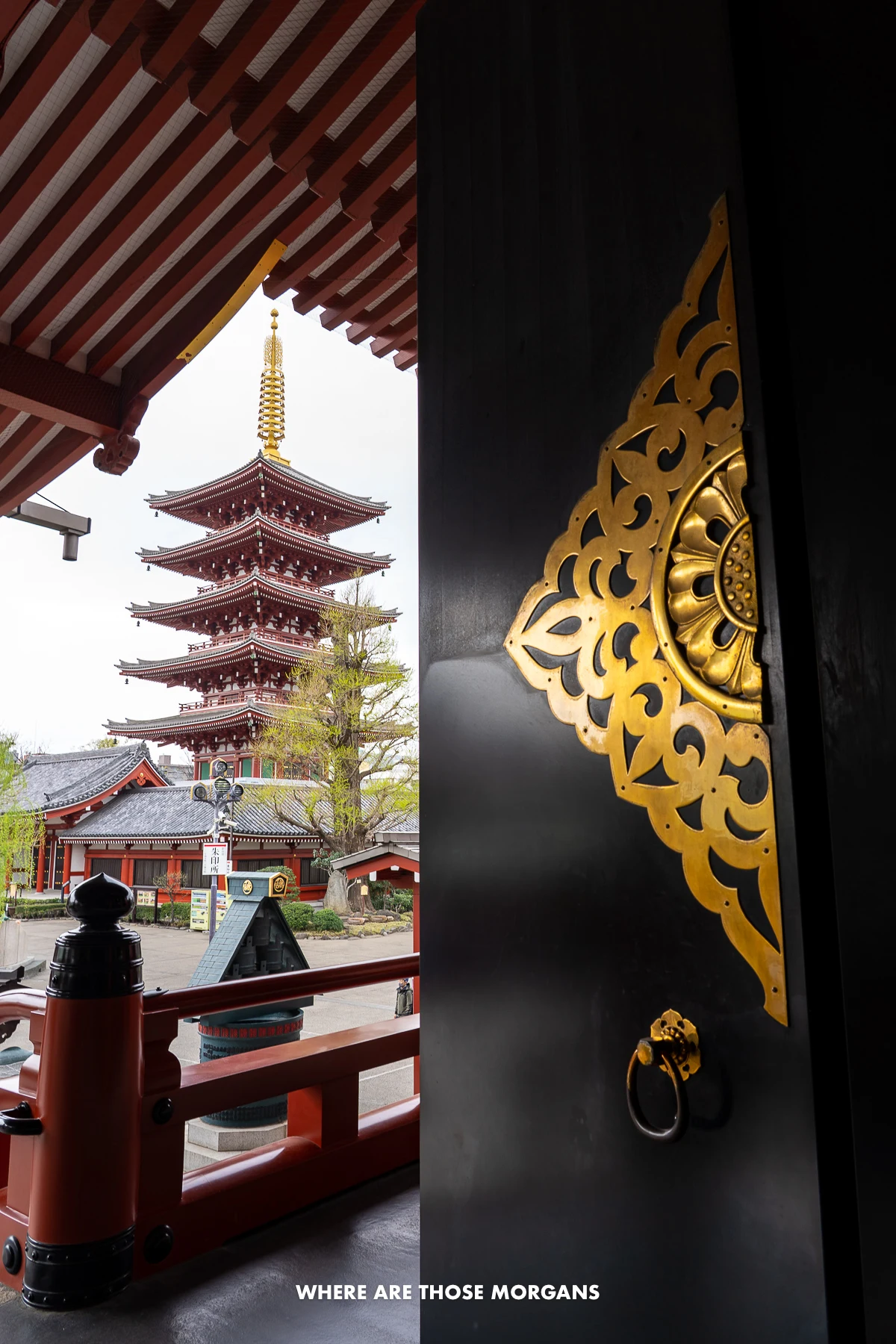
We’d get an early start and hop on the subway (or a combination of JR trains and subway depending on where we booked our hotel – read our guide on where to stay in Tokyo for helpful advice on the best areas) to Asakusa, aiming to arrive by 8:00 AM. Once in Asakusa, we’d walk to Kaminarimon Gate and head straight up Nakamise shopping street to Tokyo’s oldest Buddhist temple called Senso-ji, which was completed in the 7th century.
The temple is open 24 hours, but Nakamise’s shops don’t open until 9:00 AM, so by arriving early we’d avoid the worst of the crowds and be able to enjoy Senso-ji in relative peace. In 2018, we did Senso-ji in the afternoon and it was ridiculously busy, so we turned up at 8:00 AM in 2023 and it was a completely different experience.
At Senso-ji Temple we’d waft smoke over our bodies for healing and good health, shake a metal tin to get a numbered bamboo stick which corresponds to a drawer containing a fortune, and throw coins into a wooden box before bowing twice and offering a silent prayer. Then after exploring the grounds and taking a ton of photos, we’d walk back through Nakamise-dori market and the shops would be just opening.
We’d check out all the local, traditional goods and eat snacks like ningyo-yaki cakes, then we’d pass back through Kaminarimon Gate, cross the road and go to the top floor of the Asakusa Culture Tourist Center – there’s a free hidden gem mini-observation deck with elevated views over Senso-ji (we missed this).
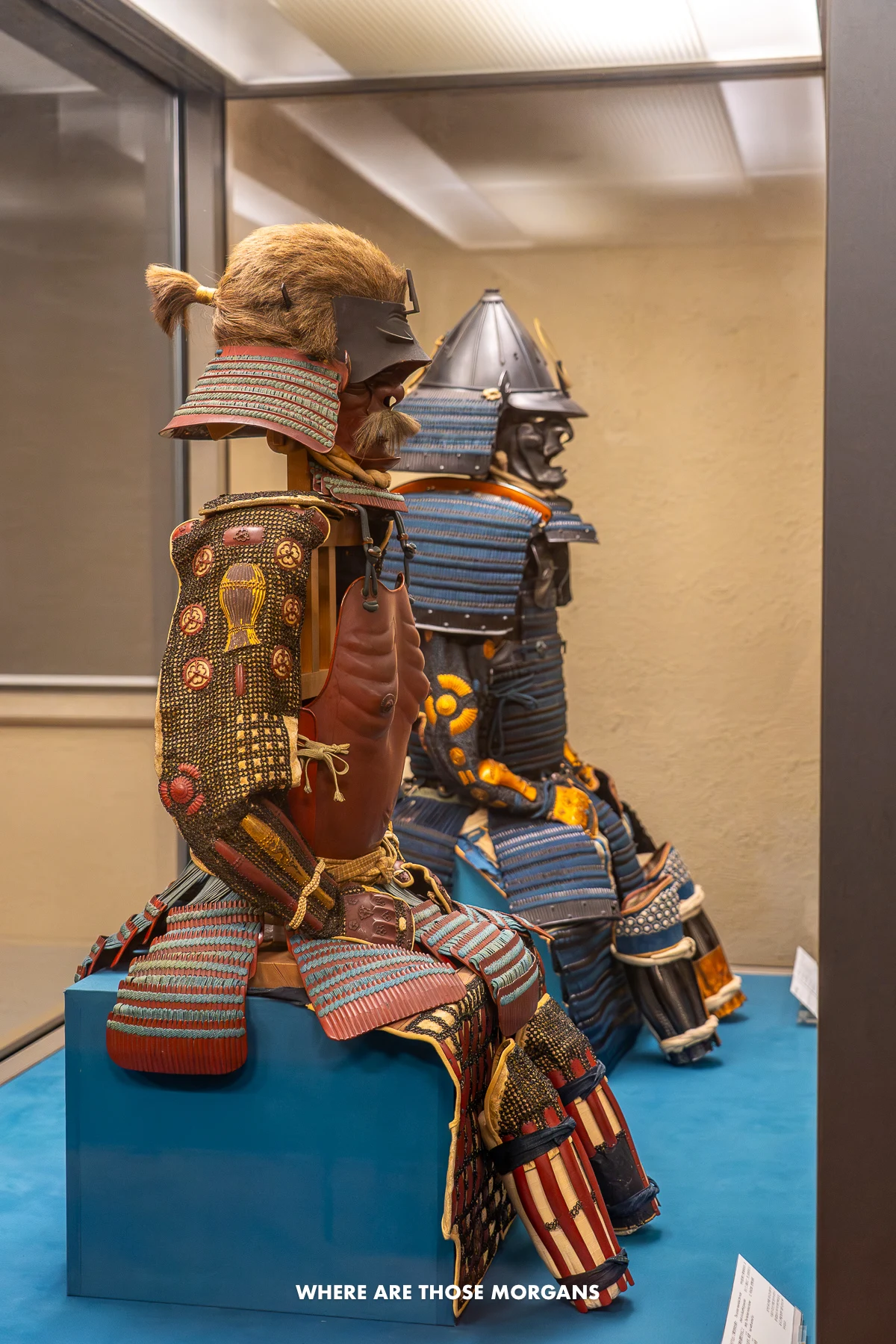
Become A Samurai (10:00 AM)
One of the biggest mistakes we made in Asakusa was not booking the Samurai Ninja Museum in advance. We tried to do it on the day but they had no availability. After the tourist center we’d walk a few minutes west to the museum, learn about Samurai, dress up, hold katanas and throw stars. It’s a 2-hour family friendly interactive samurai experience that looks like a lot of fun, so don’t miss it like we did.
Afterwards, we’d head a few minutes north to grab lunch at Fuji Ramen. Then we’d walk west and turn south on Kappabashi Street to see Tokyo’s famous Kitchen Town. It’s an 800-meter stretch of shops dedicated to everything you could ever need for cooking or running a restaurant, like Japanese kitchen knives, cookware, utensils and our favorite – plastic food samples.
Kristen’s foodie tip: If the Samurai Museum doesn’t interest you, take a look at this popular sushi making class in Asakusa that also starts at 10:00 AM and looks great.
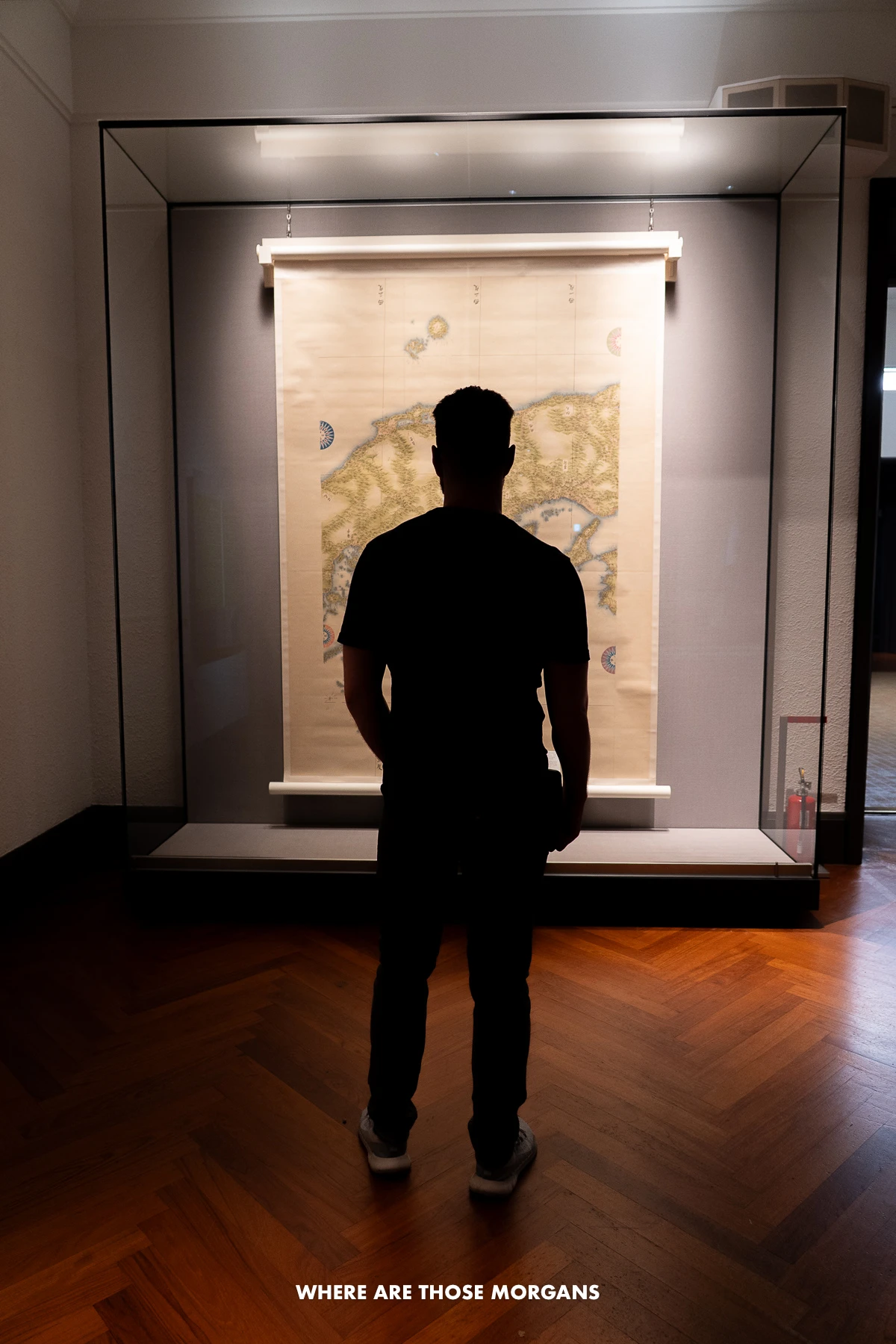
Learn About Japan At The Tokyo National Museum (2:00 PM)
After seeing the quirky kitchen town, we’d walk 25 minutes to the Tokyo National Museum on the northeast side of Ueno Park (or we’d take the orange Ginza subway line from Tawaramachi to Ueno to cut out most of the walking). Ueno Park is home to Tokyo’s classic museums including Tokyo Metropolitan Art Museum, the National Museum of Nature and Science, and the National Museum of Western Art.
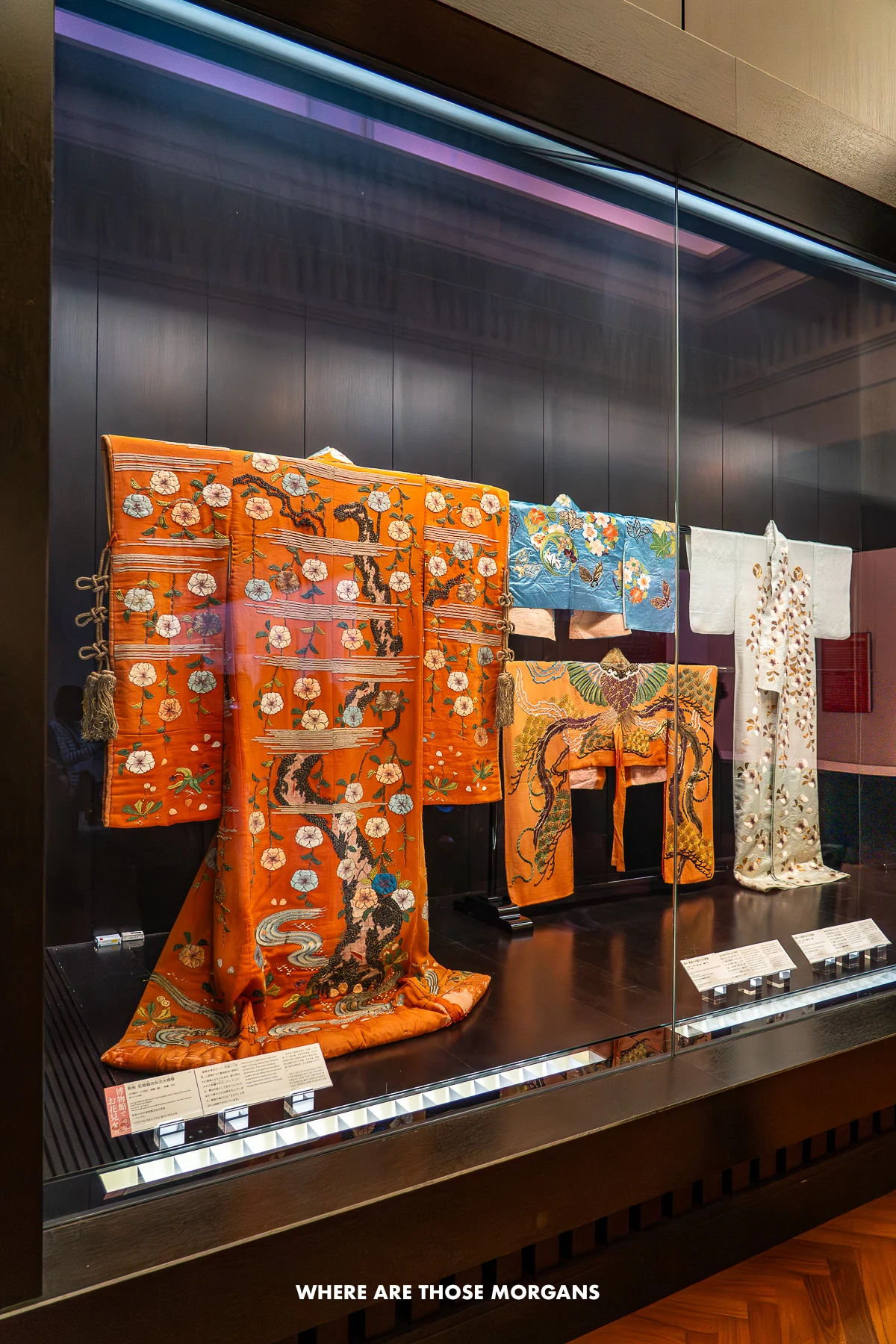
We’re sure they would all be great, but for us it was all about the Tokyo National Museum. We loved walking through 2,000 years of Japanese history and culture, from artifacts and pottery to Buddhism and samurai. It gave us a clear timeline of Japanese evolution, and we spent a good 2 hours inside before getting burned out. Even better? It only cost us around 1,000 yen (US $6.50) each – which is a lot cheaper than popular museums in Paris, Rome or NYC.
Grab A Gyukatsu Dinner (5:00 PM)
After the museum, we’d walk south through Ueno Park and continue down to Usagiya confectionary shop to try traditional Japanese doriyaki – sweet red bean pancakes. A further 8 minutes walk to the south would lead us to a top rated restaurant on the north end of Akihabara called Gyukatsu Ichinisan, which serves breaded fried beef.
Reservations can’t be made and we had to wait 30 minutes to get inside the tiny restaurant, but the food was so good. By going earlier than typical dinner time, we’d hope to beat the worst of the crowds again. If the line was too long, our backup options would be Sushiro (conveyor belt sushi), or Roast Beef Ono on the south side of Akiharaba for a bowl of Wagyu beef and rice – although this one also tends to have long lines and can’t be booked in advance either.
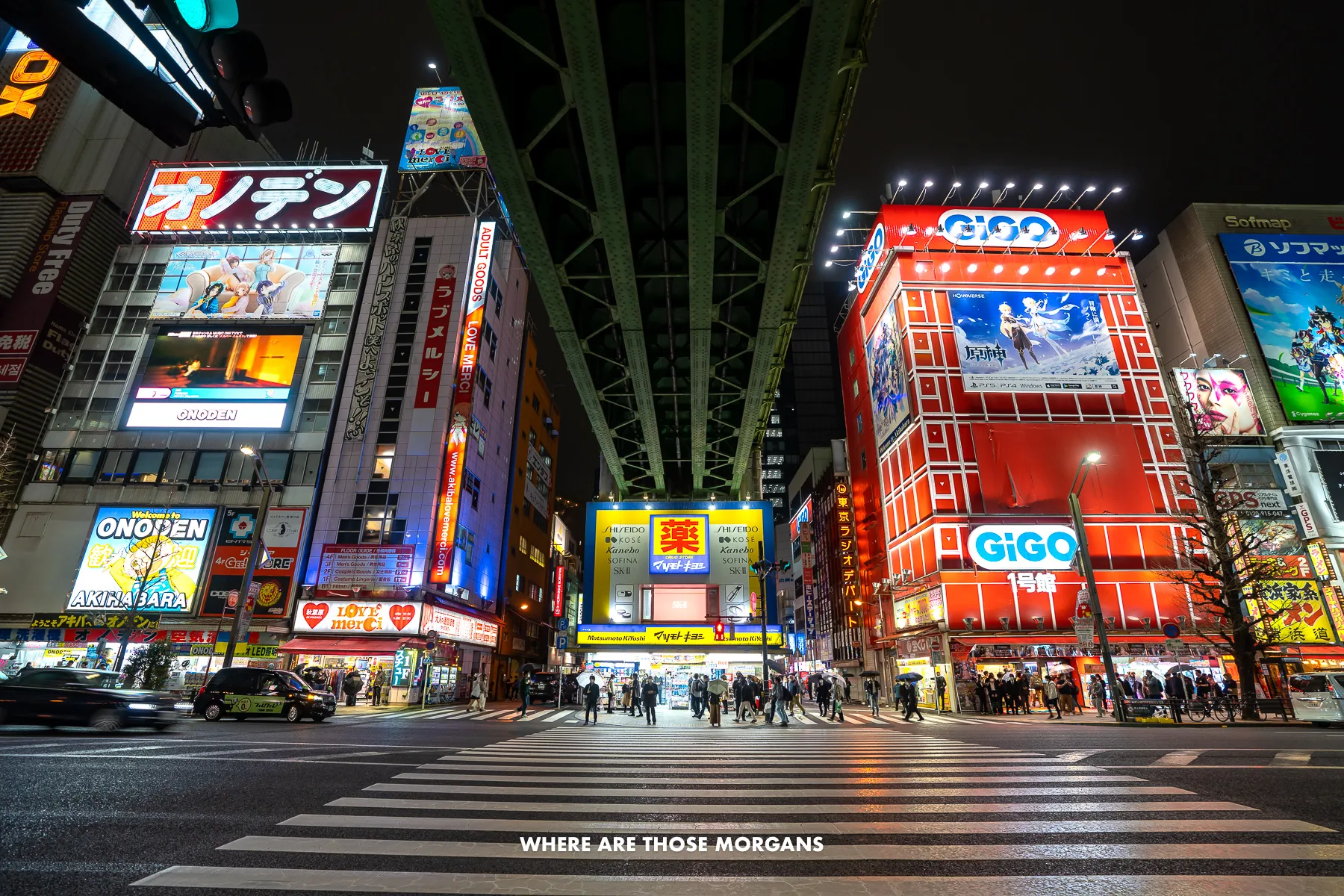
Walk Through Akihabara Electric Town (6:30 PM)
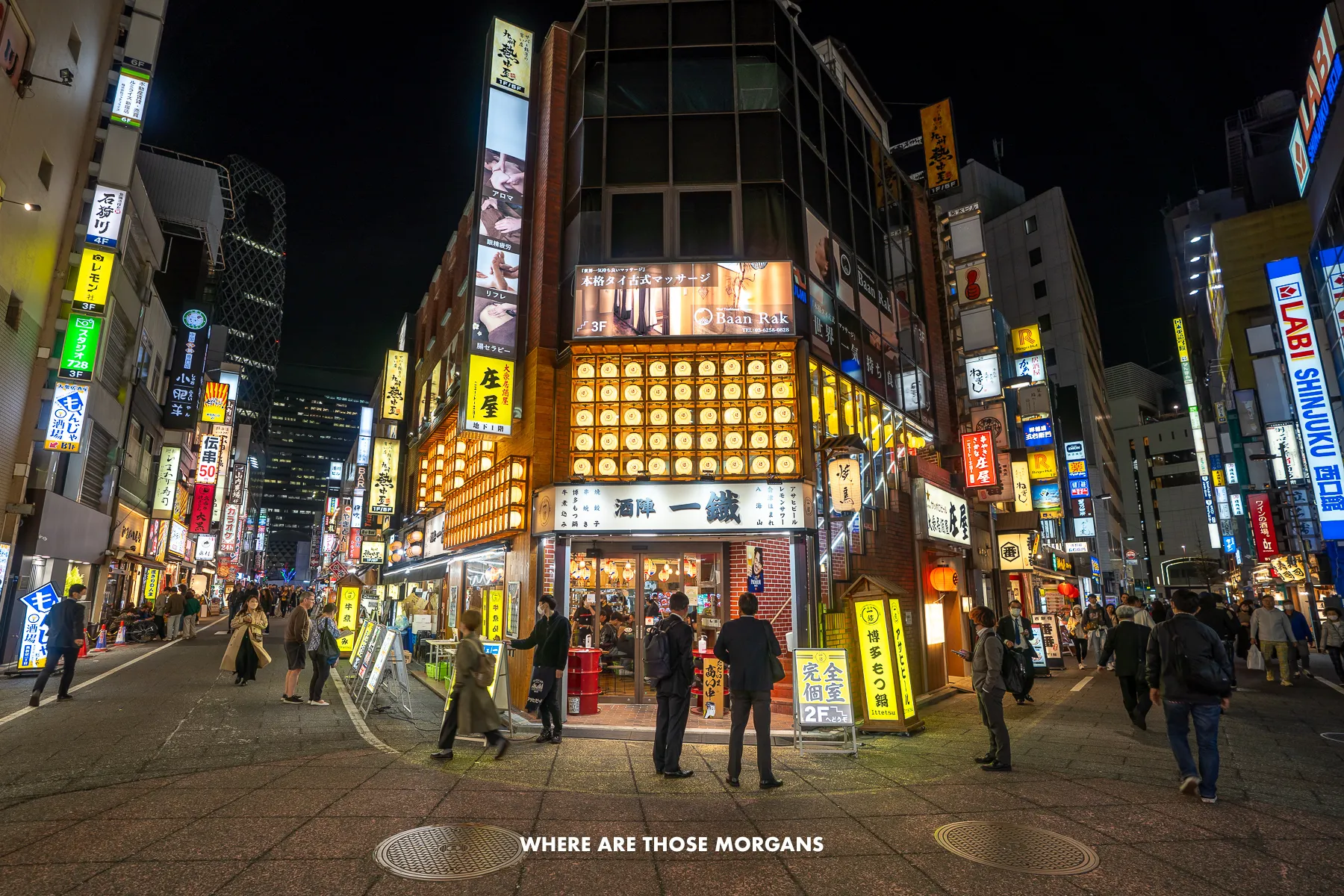
Refueled and a few plum wines deep, we’d spend the next few hours wandering around Akihabara with its neon lights, anime and manga-themed everything, 5-story mega-arcades, and “only in Japan” absurdity. Sounds weird? It is, but we loved it. The first time we walked through Akihabara at night (it’s so much better lit up once it’s dark out) was when we said okay, now we’re really in Tokyo.
For us, Akihabara is best enjoyed without a rigid plan. We just dipped in and out of anything that looked fun, which was pretty much everywhere. We watched snacks being made through a glass window, played arcade games with locals (of all ages!) in GiGO, browsed second hand collectibles in Mandarake, and had a quick look in the sensory overload Don Quijote.
We didn’t do this on either trip, but Akihabara is the best place in Tokyo for trying out a maid cafe where the staff dress in cosplay. Another great thing to do here is shop for electronics at places like Laox or Yodobashi (we actually bought our first camera at the Laox in Akihabara in 2018). It would be getting late by now and we’d probably be wrecked, so we’d call it a day and head back to our hotel.
How to slow it down: The first thing we’d cut on day 1 would be kitchen town – it’s cool and unique but not absolutely essential. After that we’d cut the Samurai Museum or the museum in Ueno Park. The point of this first day is to gently ease in with Asakusa and the neon lights in Akihabara, which is way less overwhelming than Shinjuku.
Day 2: Ginza & Southeast Tokyo
Our second day is a real treat. It’s a bit off the beaten path compared to most other Tokyo itineraries you’ll read – and fair warning, it involves a fair amount of walking – but it hits a ton of great spots efficiently and at the right times of day.
Grab Breakfast At Tsukiji Outer Market (8:00 AM)
We never got around to doing the Tsukiji Outer Market on either trip but we absolutely would do it next time, and we think it’s an unmissable addition to any foodie lovers Tokyo itinerary. We’d get an early start, hop on a subway to Tsukiji or Tsukijishijo Station, and arrive to the fish market by 7:30 AM before it gets too busy.
The plan would be to arrive hungry so we could eat sashimi (raw fish), nigiri (raw fish with rice), sushi, or tamagoyaki (rolled omelette) for breakfast. We’d spend an hour or so walking through the narrow alleys and eating food. It looks touristy and overpriced, but at the same time it’s the best foodie market in Tokyo so that’s the trade-off.
Mark’s market tip: If Tsukiji is a priority for your trip, make it count by booking this popular 2-hour guided tour of the market. There’s an 8:30 AM and 9:00 AM start time, and the guide will take you to the best spots for food.
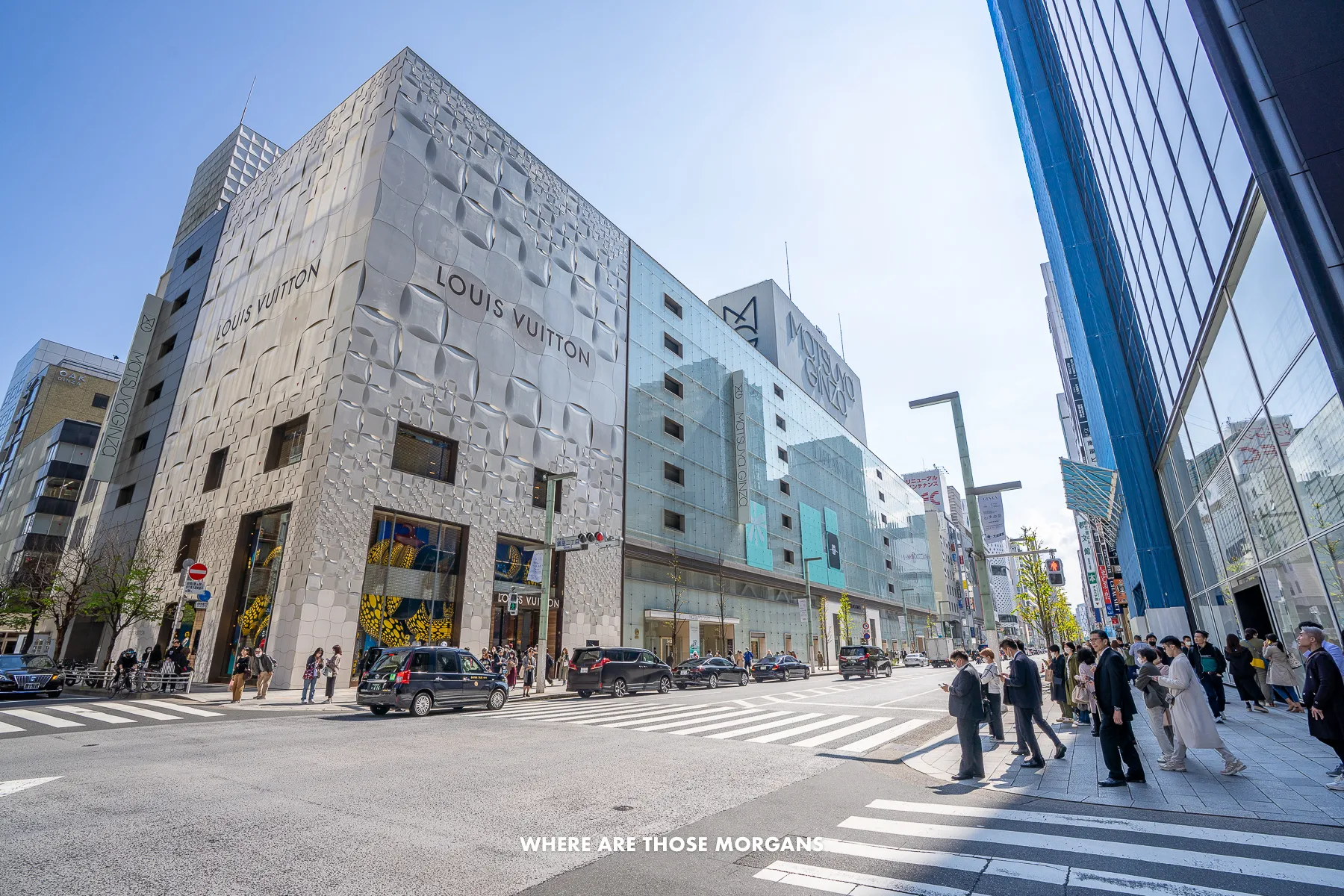
Walk Through High-End Ginza (10:00 AM)
Straight after leaving the market we’d stop in at the nearby Tsukiji Hongan-ji Temple, before walking 10 minutes northwest into the heart of Ginza. We really liked walking through the polished Ginza neighborhood on both our trips to Tokyo. It’s very similar to Fifth Avenue in NYC with grid-shaped streets, wide sidewalks and designer stores.
Nissan Crossing would be our first stop to see sleek Nissan concept cars spinning on revolving platforms. If you’re into cars, this place is unmissable. Next, we’d have a quick look around Ginza’s famous department store called Mitsukoshi, before walking to the Uniqlo flagship store to buy some clothes (we both own a lot of Uniqlo gear from our trips to Japan). Then we’d cross the road for a coffee in Ginza Six shopping mall or a beer in Ginza Lion Beer Hall.
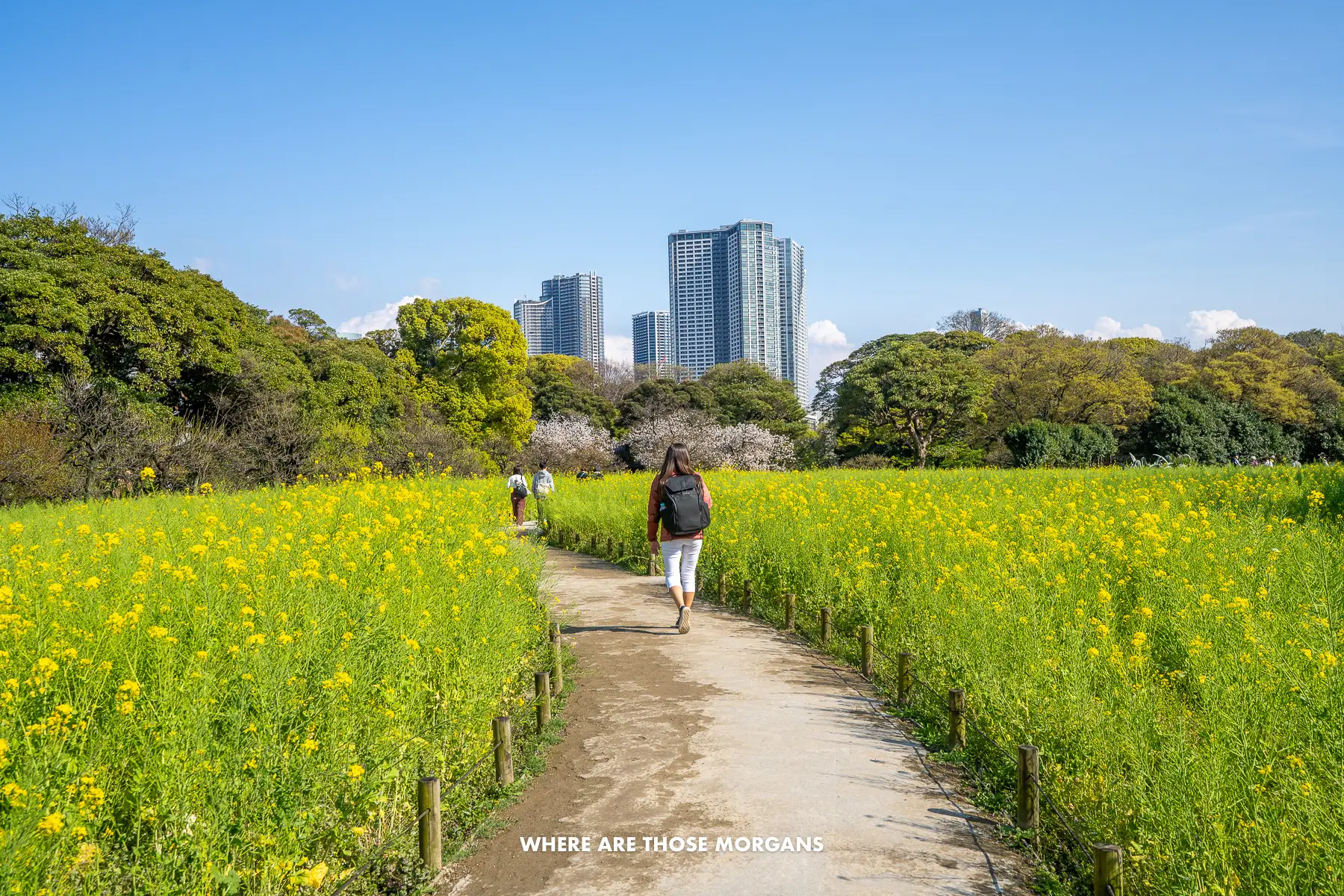
Enjoy The Relaxing Hamarikyu Gardens (12:00 PM)
After a bit more window shopping and people watching, we’d walk 10 minutes south to the northern tip of Hamarikyu Gardens (we entered at Otemon Bridge). Just escaping from Tokyo’s constant bustle made it worth the 300 yen each we paid to get in, but it’s also a serene garden with saltwater tidal ponds and cherry blossoms in spring or fall foliage in the autumn.
All we’d do is spend one hour looping around Nakajima-no-Oike pond, and crossing the cypress bridges to the Nakajima Tea House to sit down for 20 minutes with a matcha tea and wagashi sweets. It would be a nice, short and relaxing stop.
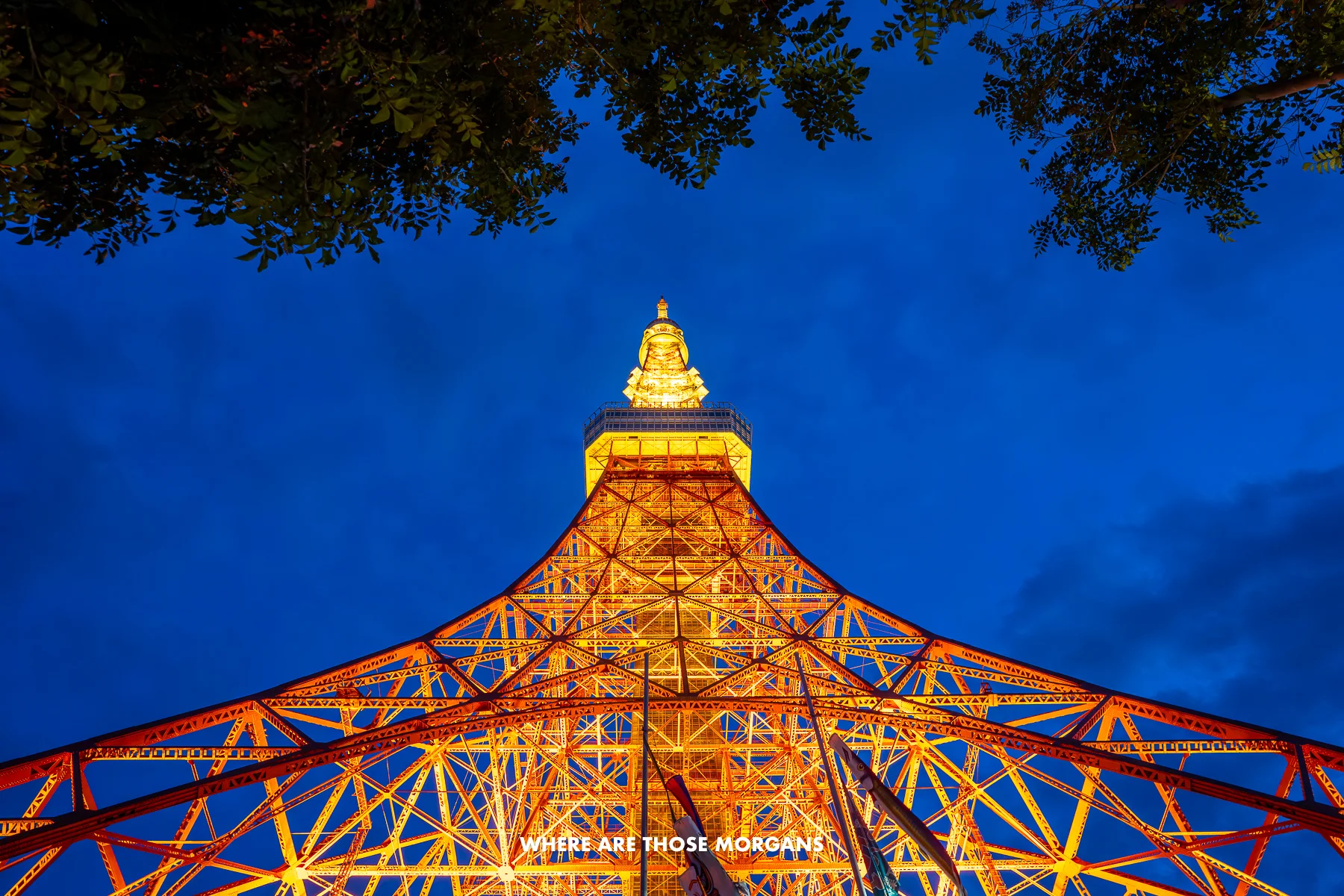
Go Up The Tokyo Tower (1:30 PM)
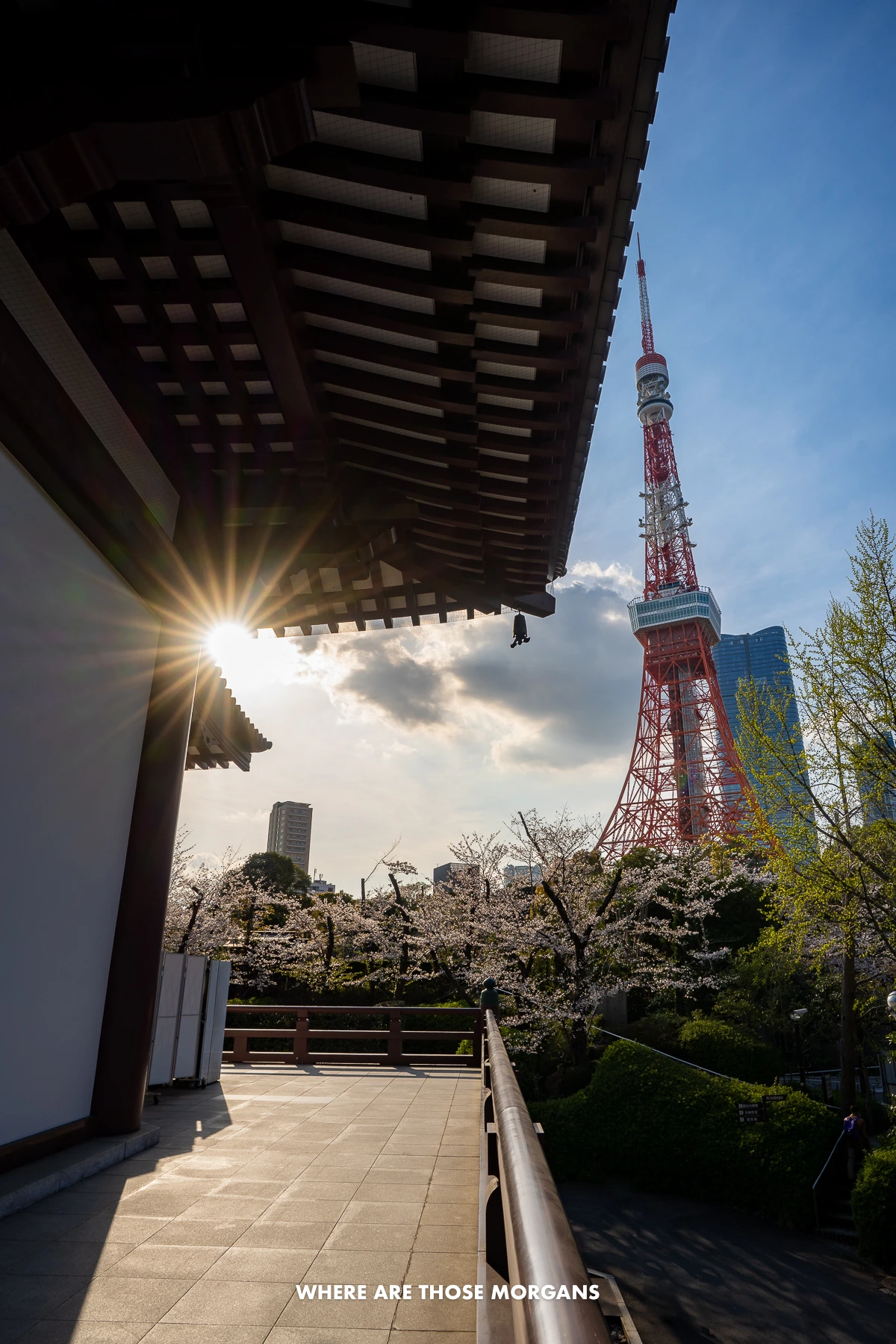
After leaving Hamarikyu Gardens via the same entrance, we’d hop on the Toei Oedo Line from Shiodome to Shibakoen Station, then walk through Shiba Park to Zojo-ji Temple, the Tokugawa shoguns family temple. Compared to the overcrowded Senso-ji Temple, we found the tranquil Zojo-ji Temple – which houses the mausoleums of six Tokugawa samurai warlords – to be almost deserted.
Did you notice how we left out the Tokyo Skytree on day 1 from our Asakusa section? That’s because we didn’t love it. The line to get in was massive, we were crammed in at the top, and it was so high up that everything below looked tiny – which is why we’d include the cheaper, easier and quieter Tokyo Tower into day 2 instead (we would buy tickets in advance before arriving into Tokyo).
After capturing some cool perspective photos of Zojo-ji Temple and Tokyo Tower together, we’d walk less than 5 minutes to the base of the tower and take a lift up to the main deck (1,500 yen / US $9.70) or the top deck (3,300 yen / US $21.30) per adult. We did the top deck for sunset and it didn’t blow us away but it was still good enough. The glass windows made photography difficult, but it had a fun retro 90’s feel.
Mark’s observation deck tip: To be honest, none of Tokyo’s observation decks are the Eiffel Tower or Top of the Rock. The Tokyo Tower was good but not unmissable, and it’s questionable whether the top deck is worth the extra money, but it was cheap enough and gave us a different perspective. In truth, our favorite observation deck was Shibuya Sky which we’ll get to on day 3 of our Tokyo itinerary.
Be Blown Away At TeamLab Borderless (3:00 PM)
Just 5 minutes walk from the Tokyo Tower is the next stop called teamLab Borderless, and this is one you won’t want to miss if you enjoy technology, photography or content creation. Unfortunately, it’s another one we missed because it only reopened in Azabudai Hills in 2024, after our last visit to Tokyo in 2023.
What exactly is teamLab Borderless? Well, it’s a digital art museum where rooms are filled with lights, colors, moving patterns and animations that react in real time to your movements. There’s no set path, you wander freely as art flows from room to room and ceiling to floor. It looks a bit like being inside a computer-made dream.
We think it’s a pretty cool spot that most visitors will enjoy – but especially families with younger kids, couples who like to make content for social media, and anyone who loves tech. It’s at the very top of our wishlist for next time. But here’s the important part – teamLab Borderless is the one attraction in Tokyo that you absolutely must book in advance otherwise you won’t get in.
Grab Dinner In Roppongi Hills (6:00 PM)
Roppongi is the most non-Japanese place we visited in Tokyo. It’s filled with expats and international brands, but it’s still a big part of the city and it has a vibrant nightlife scene so it’s worth checking out to get the full Tokyo experience. To get there after teamLab, we’d hop on the Hibiya Line at Kamiyacho for 2 stops to Roppongi Station.
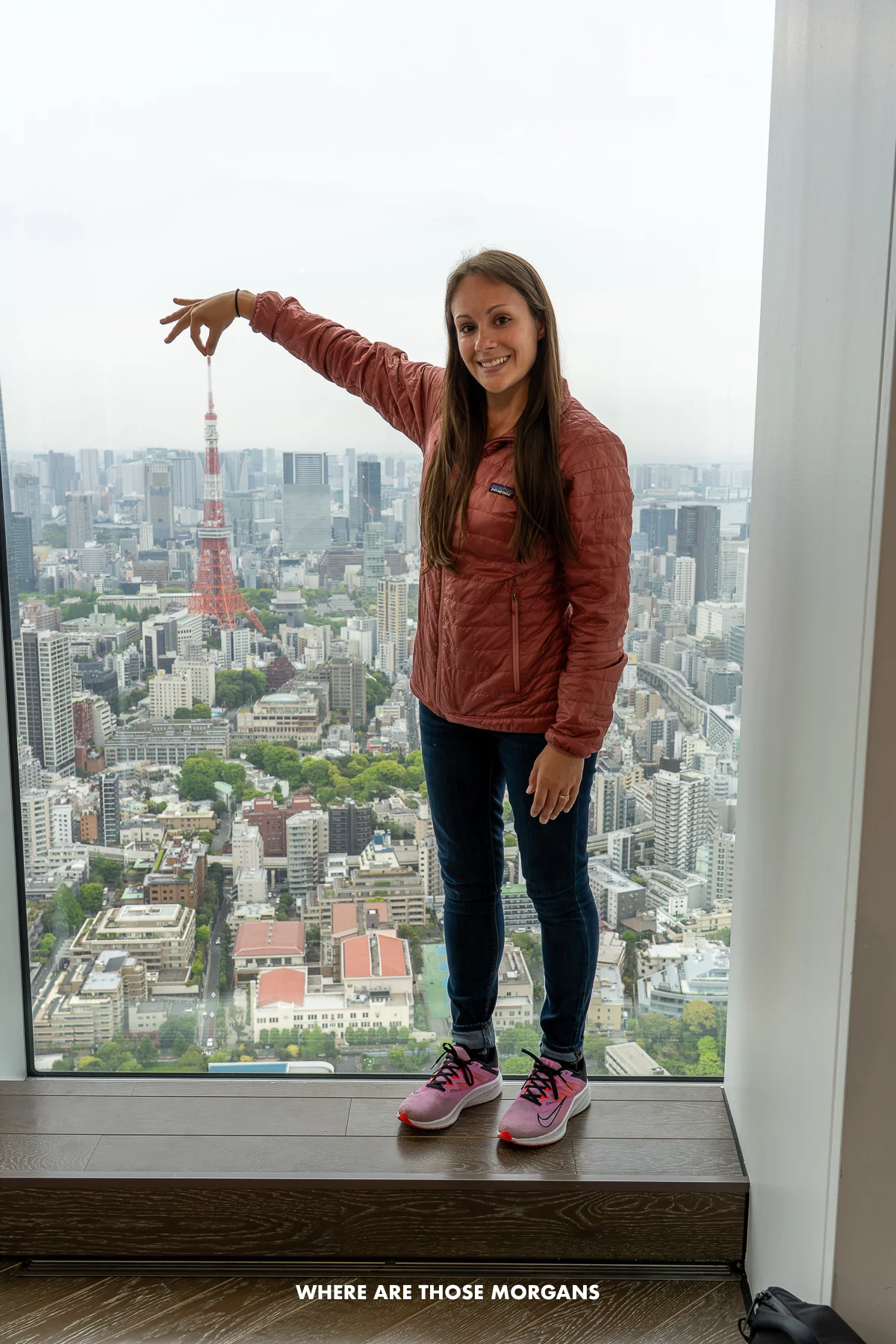
Now, there’d be an option to go up Roppongi Hills Mori Tower to another popular observation deck, which we would do if we didn’t already go up Tokyo Tower earlier. Basically, we’d do one or the other on this itinerary (but you could absolutely do both). Why do Roppongi Hills instead? Well, because it has a close up view of the Tokyo Tower – which we thought looked pretty awesome lit up at night – along with a cool art museum that was an unexpected surprise.
If we didn’t do the observation deck, we’d just hang out, find a few busy bars with a fun vibe and grab dinner at a place like Satsuma for yakiniku-stlye meat (small personal BBQ grills), more ramen at Afuri, or gyoza and dim sum at Gyopao. This area is also known as Tokyo Midtown, and it has one of the liveliest nightlife scenes, so it’s a great place to end day 2.
How to slow it down: This is a long day with a lot going on, and there’s plenty of opportunities to slow it down based on your preferences. Don’t want to do the observation deck? Skip Tokyo Tower. Not interested in the gardens? Go straight from Ginza to the Tokyo Tower. And if that early morning sounds too much or you’re not that into food (or fish!), skip the market.
Day 3: Meiji Shrine, Harajaku & Shibuya
Our third day is so much fun, there’s way less walking involved, no subways are required and there’s a ton of fantastic food to eat. This was one of our favorite days from our March 2023 trip, and we wouldn’t change a thing from how we did it.
Enjoy The Tranquil Meiji Shrine (9:00 AM)
Following a few early and hectic starts, today we’d allow ourselves a calmer morning with a later wake up and breakfast near our hotel. If we were craving Western style food we’d find a caffe with pancakes or waffles (we did this in Shinjuku), then after taking a subway to Harajuku we’d stop for another coffee before starting our walk to Meiji Shrine.
There’s a Lawson at the station if you need to grab a quick and delicious egg sandwich with a cheap can of coffee (sounds weird but convenience store breakfasts are amazing), and there’s a Starbucks or a local coffee spot called Sarutahiko Coffee The Bridge which is where we got our coffee.
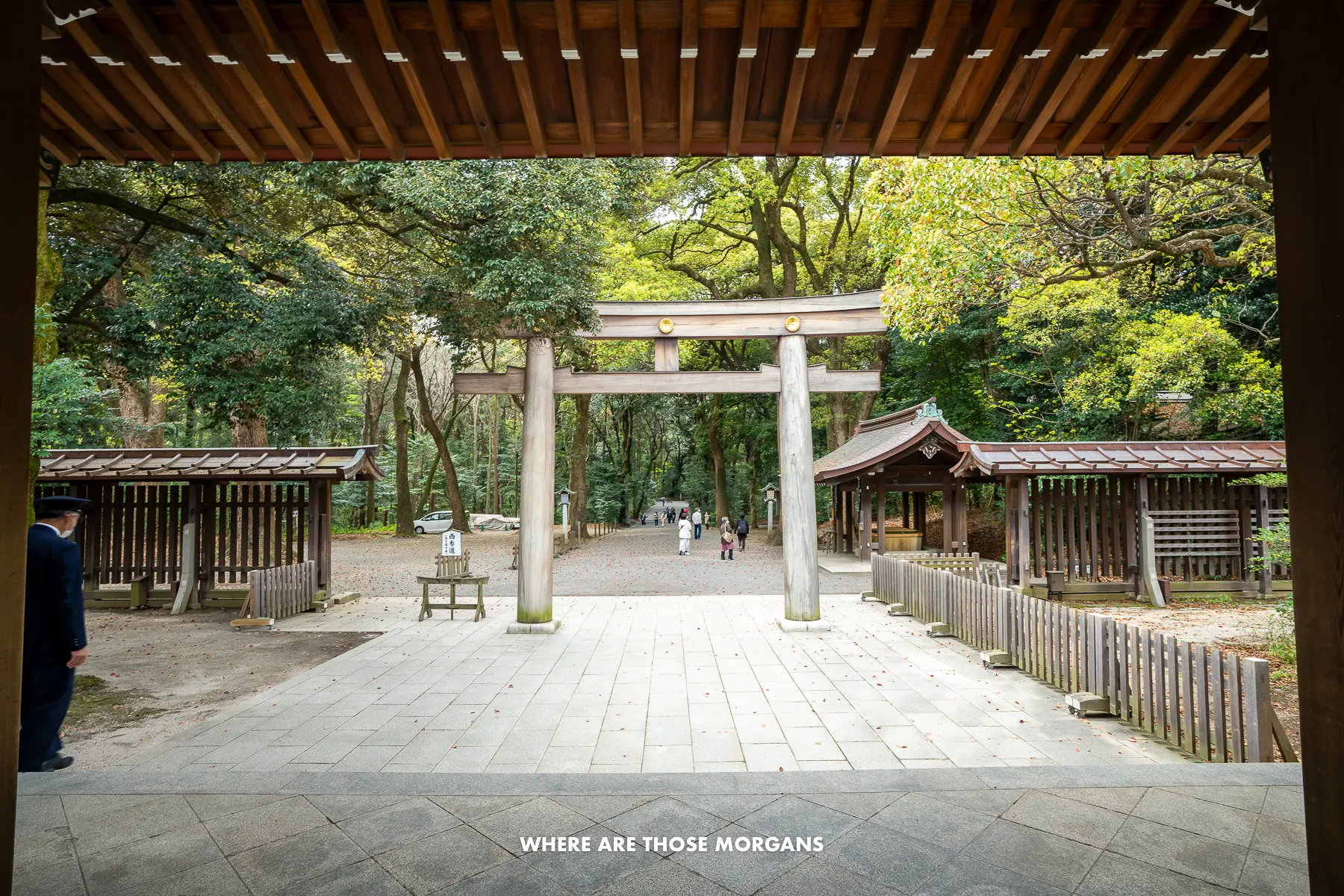
Caloried and caffeined up, we’d begin walking northwest underneath the massive Meiji Jingu Ichino Torii into the lush, peaceful forest. It’s such a nice change of pace from the chaos of the city, so we’d slowly amble along the main path leading to the shrine. Our favorite part of the walk was taking photos of consecrated sake barrels stacked in rows, giant cypress torii gates, and of course the forested Meiji Shrine at the end.
We saw a wedding take place right there in the main part of the shrine, then we walked out to the west side but there wasn’t much there at all, so we went back out of the main entrance and paid 500 yen each to see the Meiji Jingu Gyoen. The famous iris flowers bloom late May to mid June so our March visit was way too early for them, but we still thought the manicured gardens were attractive and relaxing.
Walk The Chaotic Takeshita Street (11:00 AM)
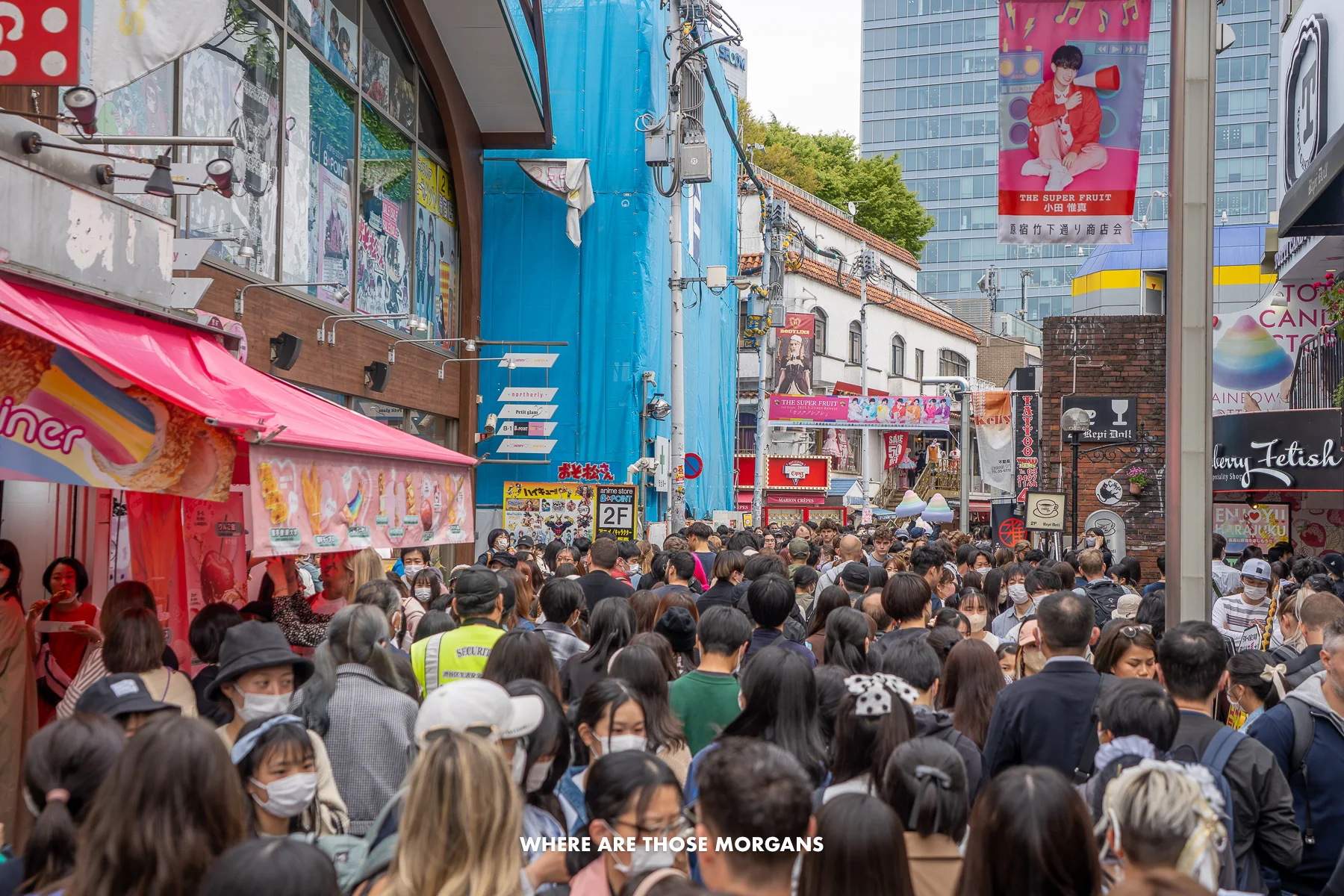
One of the things we love most about Tokyo is going from pure tranquility to sheer chaos in the blink of an eye. Back at Harajuku Station we’d leave the peaceful Meiji Shrine, cross the road, and enter the sensory overload Takeshita Street. This colorful and vibrant street is overflowing with youthful energy and Japanese themes like kawaii (cute culture) and purikura (photo booths with virtual makeovers) – but fair warning, it is ridiculously crowded.
We ate street food crepes as we plotted and weaved our way through the intense crowds of locals and tourists. A lot of other people were eating cotton candy and massive potato spirals, wearing cosplay outfits, shopping for capsule toys and visiting animal themed cafes. Oh, and everyone had phones out taking photos and videos. It was fun, but it was a lot. The density of people quickly wore thin for us, so we ducked out to the side streets.
We think Takeshita Street will divide opinion. Families with younger kids, young couples or anyone with any interest in Japanese themed things will all love it. Anyone else might feel like we did, and find a quick escape. But we still think it’s one of Tokyo’s must-see areas, because it’s part of what makes the city so diverse.
Grab Lunch Between Harajuku & Shibuya (1:00 PM)
Next, we’d take a slow 20-minute walk from Takeshita Street into the heart of Shibuya, stopping for lunch along the way. There’s a bunch of great food options around this area, but we’d plump for ramen at Afuri Karakurenai for top quality taste or Ichiran Shibuya for a touristy but fun experience.
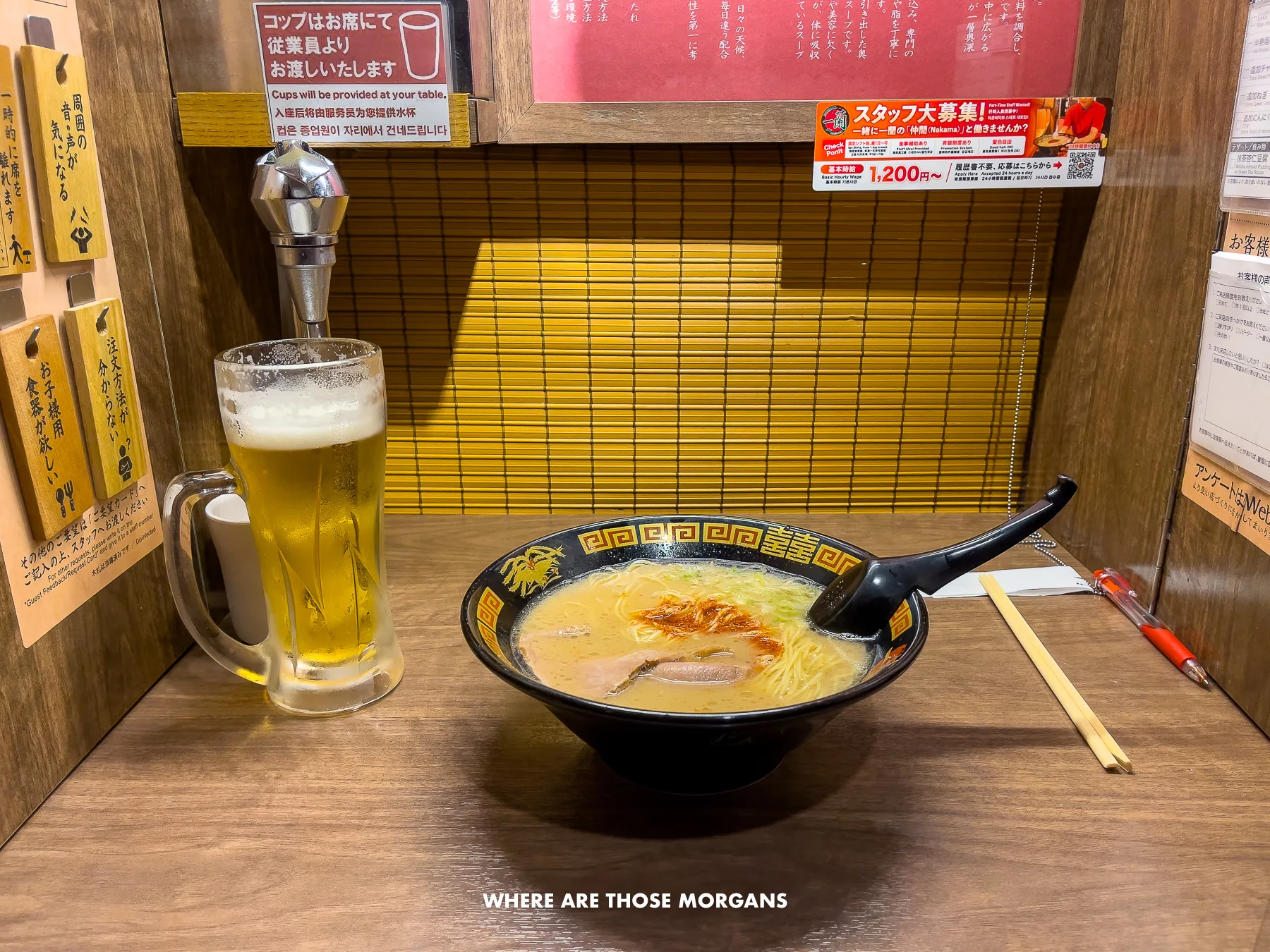
We loved filling out a slip of paper to create our ramen, then being served through sliding windows into our individual cubicles at Ichiran. If you don’t want ramen, there’s also Roast Beef Ohno or Gyukatsu Kyoto to consider in the same area.
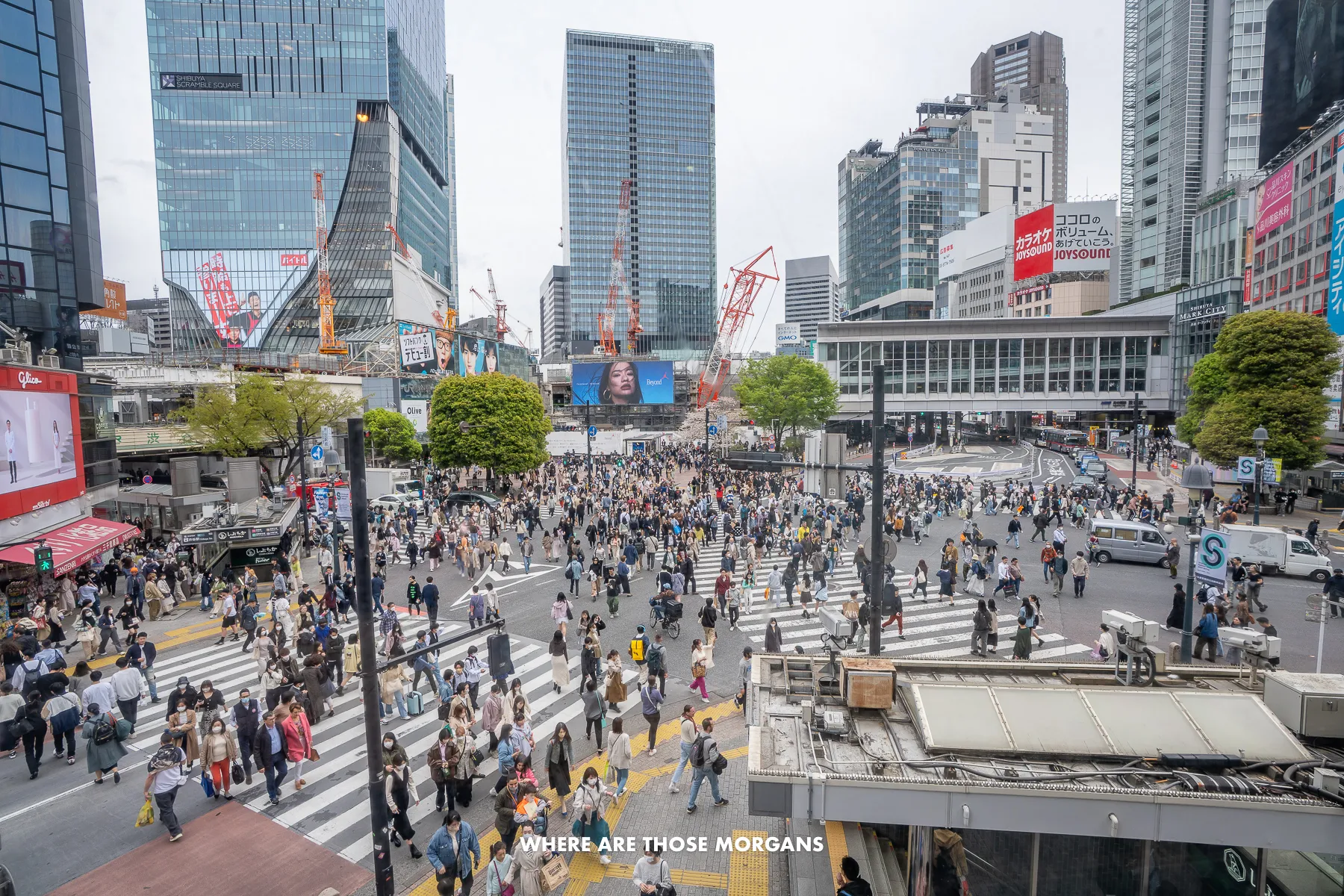
Be One Of A Thousand On Shibuya Crossing (2:30 PM)
After lunch we’d start our afternoon by walking over the eye-opening Shibuya Crossing at least 2 or 3 times to get a real feel for the intense flow of bodies walking in 10 different directions across the intersection. Honestly, we probably crossed at least 10 times combined across our two trips to Tokyo. It’s not going to be peak busy at 2:30 PM so it would be a gentler intro without being too wild.
Once we had our fill of crossings, we’d go up to the second floor of Starbucks to try snagging a window seat for a free, low-down view of the Scramble. We’ve been twice and both times the Starbucks was jam-packed with tourists circling like sharks for a free spot to take a photo. Shibuya is also Tokyo’s trendy shopping area, so we’d spend a bit of time exploring the shops and underground malls.
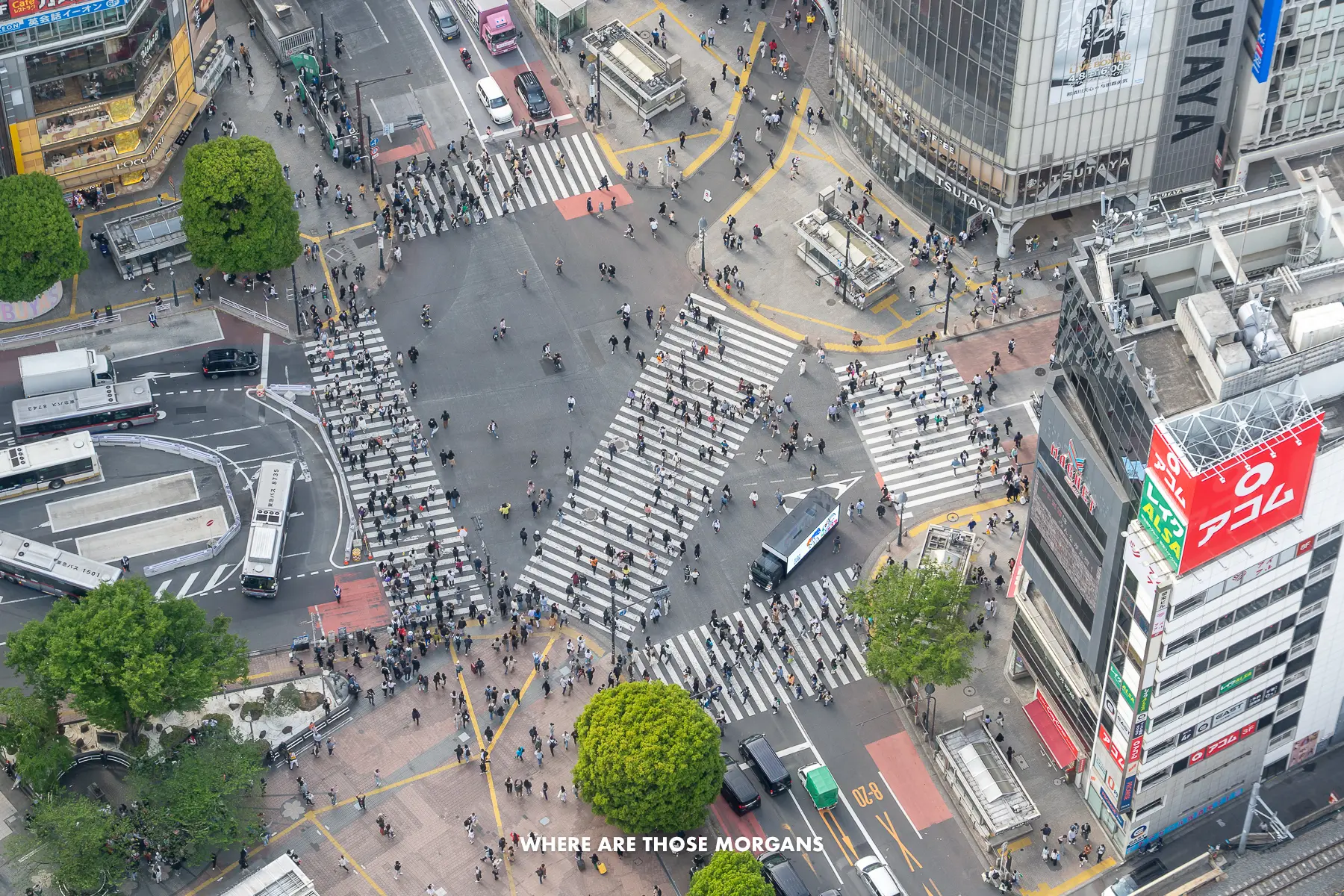
Watch Sunset From Shibuya Sky (4:00 PM)
We’d have already checked Tokyo’s sunset time and pre-booked time slot tickets for Shibuya Sky before arriving into the city. Let’s say sunset is at 6:00 PM (which it roughly is during cherry blossom season and fall when Tokyo is busy with international tourists), so we’d book 4:00 PM time slot tickets to give us enough time in daylight, watch sunset and then see the city lit up at night.
Shibuya Sky was our favorite among Tokyo’s observation decks, even though the rooftop viewing terrace (which is its major selling point) was closed due to bad weather. Our high-up view over Shibuya Scramble was awesome, and the crossing got busier around 5:00 PM onward when workers left and tourists arrived. We would 100% do Shibuya Sky again next time, and we’d hope for better weather!
Kristen’s fun alternative: Not fussed about going up all these observation decks? Have a look at this top rated guided go-kart tour through Shibuya, it looks perfect for groups or families with older kids who want a fun Tokyo-only activity.
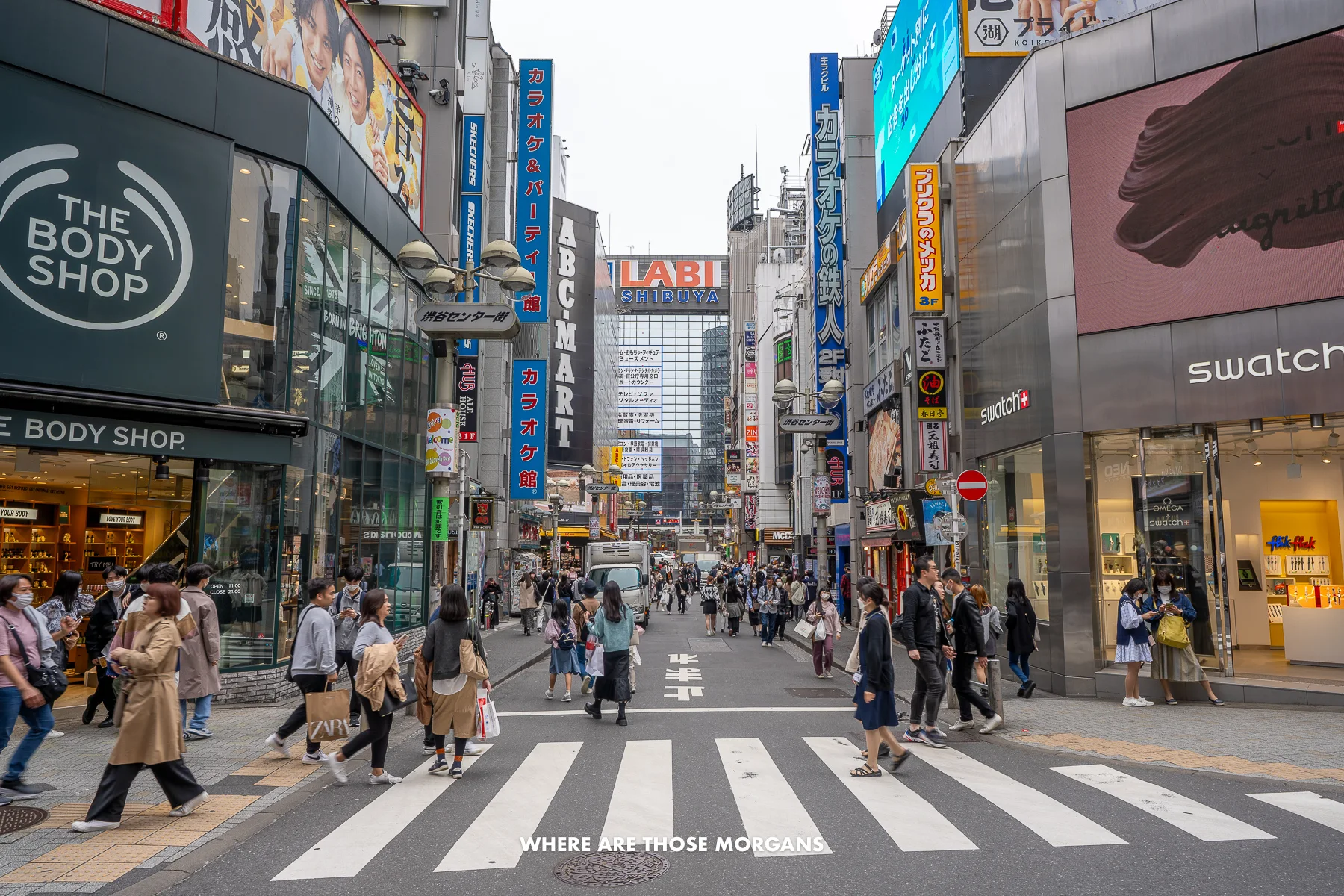
Stay In Shibuya For Dinner & Drinks (6:30 PM)
Shibuya’s nightlife scene is a bit more our style – lively, but down to earth and low-key. After the observation deck, we’d grab dinner at the intimate Hakushu Teppanyaki for a fancy Kobe beef meal (a bit like hibachi in the US but way better). Or there’s also sushi at Matsue, savory pancakes at Tsukishima Monja Okoge and breaded beef at Gyukatsu Motomura. Shibuya is amazing for food, so have a good look around.
After dinner we’d head over to Nonbei Yokocho (also called Drunkard’s Alley) for low-key but busy bar hopping through 100m of neon-lit stalls. We’d try wine bars, sake stands and jazz spots, then maybe grab some yakitori (chicken skewers) later when we needed a snack. If we wanted to keep the night going in Shibuya, we’d go to the Dogenzaka area for higher energy bars – but let’s not ruin day 4 now!
How to slow it down: This is already a relaxing and easy going day, so you wouldn’t have to slow it down, but you might want to cut Takeshita Street if it doesn’t sound like your cup of tea. And if you really want to see the best of Shibuya in the evening, book this popular guided foodie tour with 13 Japanese food tastings in hidden areas (start times of 5:00 PM and 6:00 PM).
Day 4: Shinjuku Day & Night
With three days under our belts, we’d be ready to deep-dive into Shinjuku – Tokyo’s biggest culture shock neighborhood. Our day starts off calmly, then steadily ramps up the energy and neon lights chaos.
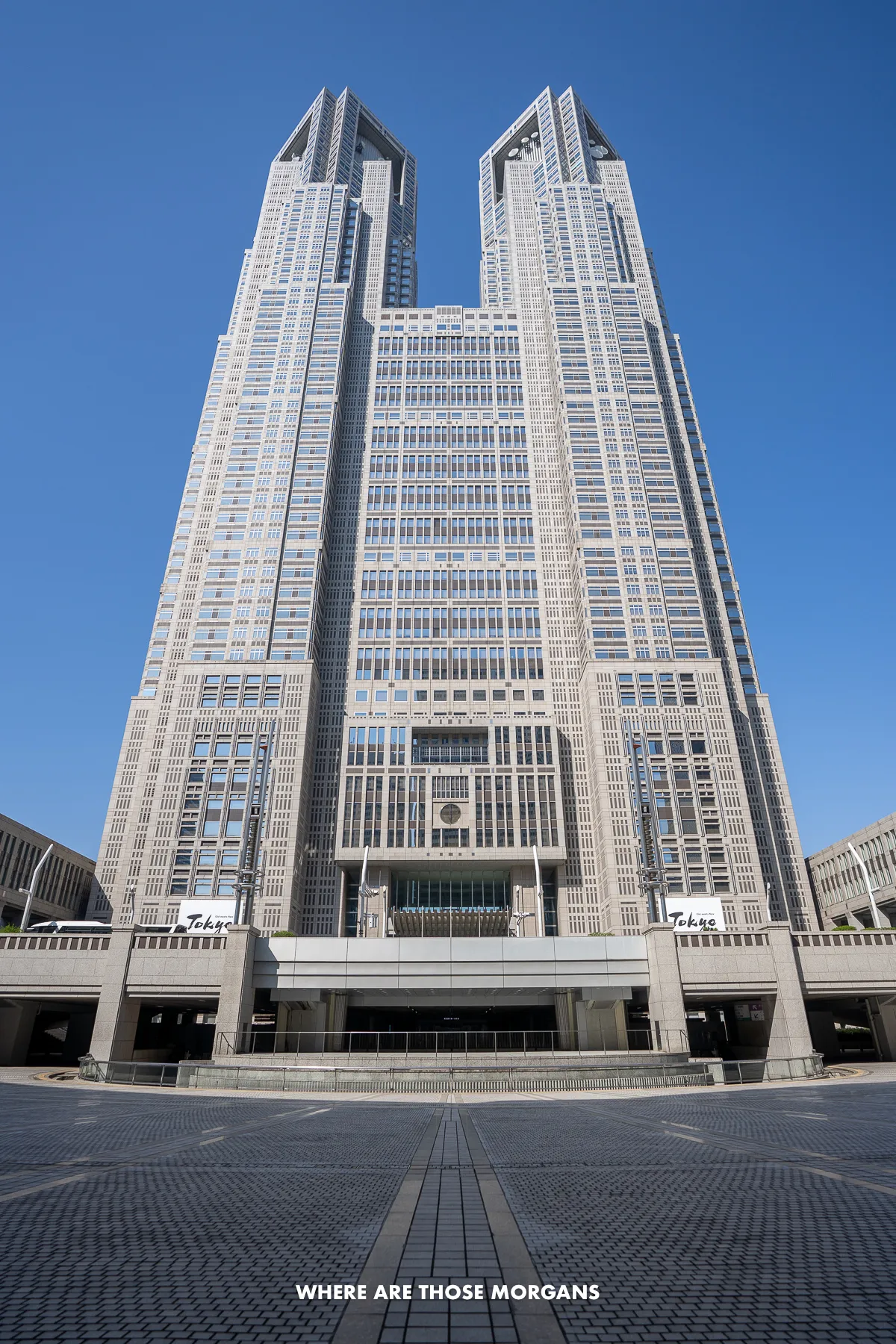
Get Free Views From The Government Building (9:30 AM)
Most people would suggest doing the national garden first and doing the free Tokyo Metropolitan Government Building observation deck later in the afternoon. But we’d do the observation deck as soon as it opened at 9:30 AM to beat the crowds and get clearer west facing views in the hopes of seeing Mount Fuji on the distant horizon. Going in the late afternoon or for sunset means looking directly at the sun to see Mt. Fuji, and dealing with long lines to get in.
So, after a casual breakfast we’d make our way to west Shinjuku, go up the free tower for expansive city views, hopefully see Mt. Fuji and then head back down. Once at ground level, we’d walk east through Nishishinjuku and pass through Shinjuku Station to see the “busiest transport hub in the world”, before entering the national garden at the northwest gate near Shinjuku-gyoemmae Station.
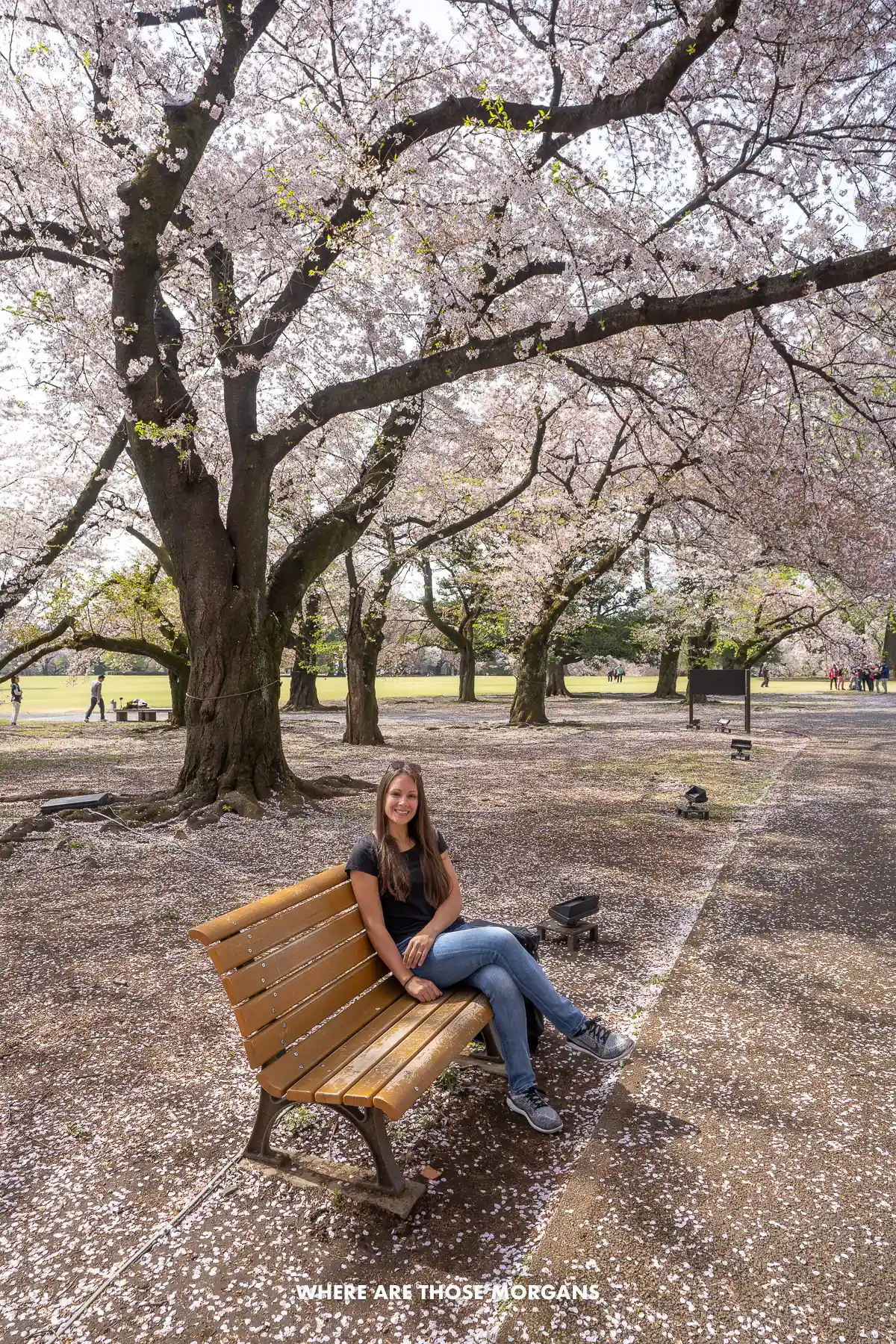
Stroll Around Shinjuku Gyoen National Garden (11:00 AM)
We visited Tokyo during cherry blossom season and visited as many popular spots as we could. Shinjuku Gyeon was one of our favorites for a few reasons – it was massive so the crowds felt thinner rather than concentrated, it had different cherry blossom spots so everyone wasn’t crowded around the exact same area, and the rest of the garden was stunning (it wasn’t just a cherry blossom photo op).
We’d pay 500 yen each to get inside Shinjuku Gyeon (it’s well worth a few dollars), walk around the traditional Japanese, English landscape and French formal gardens, drink a Starbucks coffee on their pond-view deck, and leave via the same northwest with far too many photos. On the way out we’d stop at a 7-Eleven or FamilyMart to grab snacks from the hot counter (Kristen loves the corndogs called American dogs and boneless fried chicken called nanachiki, and Mark can’t get enough of the potato croquettes called korokke).
Kristen’s planning tip: Shijuku Gyoen is closed on Mondays and Tuesdays. If it’s something you really want to do and day 4 of our Tokyo itinerary falls on a Monday or Tuesday, switch it with another day.
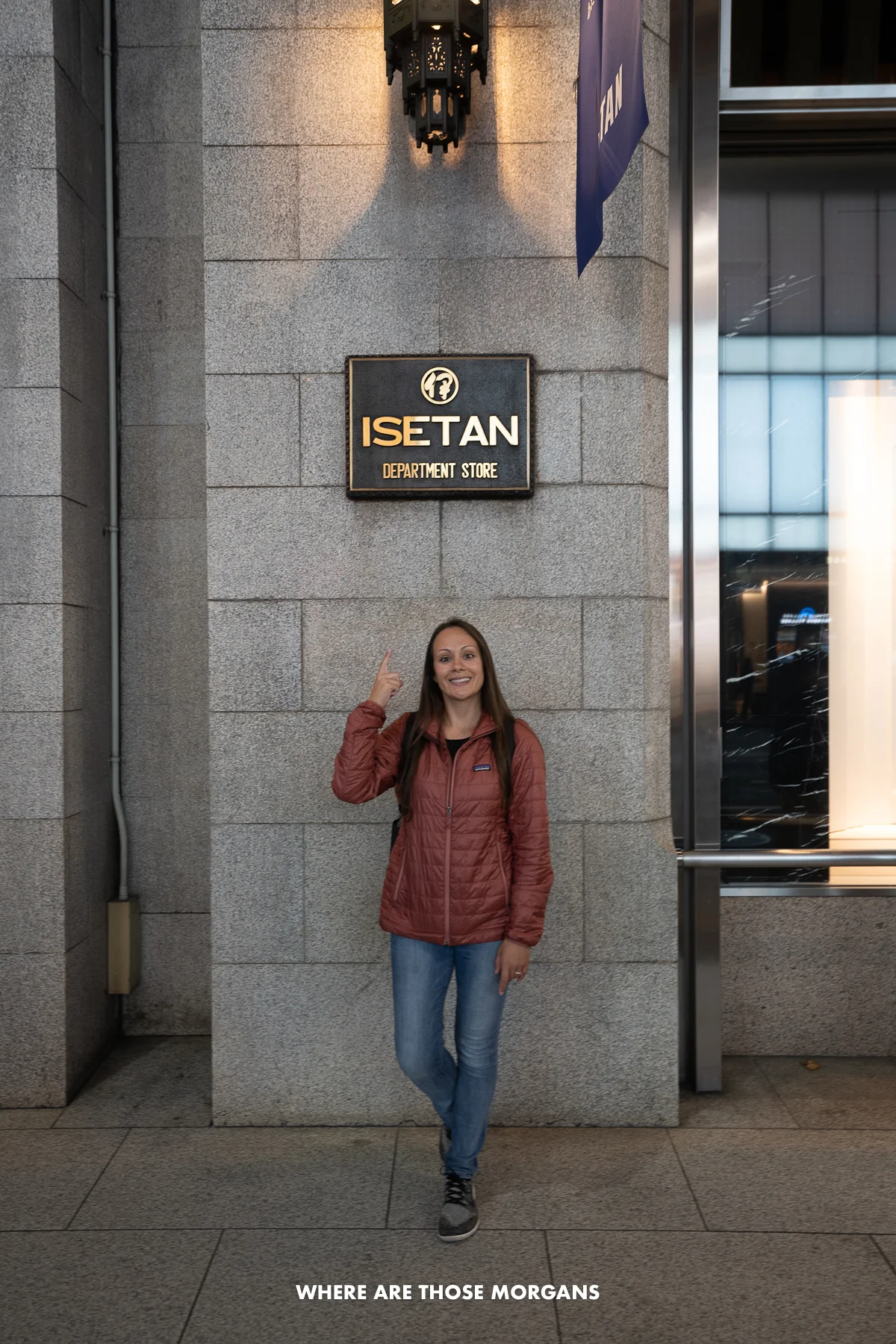
Shop Shinjuku’s Department Stores (1:00 PM)
After the garden and top-up at 7-Eleven, we’d walk to the 16-story Takashiyama Times Square to get a taste of what it’s like to shop in Tokyo. It’s basically a massive department store showing off the scale and comprehensiveness of retail in the city – and honestly it felt like a city within itself, filled with fashion, bookstores and things you’d buy for the house.
Next we’d walk over to Isetan in east Shinjuku to explore one of the most famous department stores in all of Japan. This one was way more high-end so we didn’t bother looking in any stores, but it’s cool to see – and we did go down to the basement to check out the depachika (food hall) and grab another coffee to keep us going.
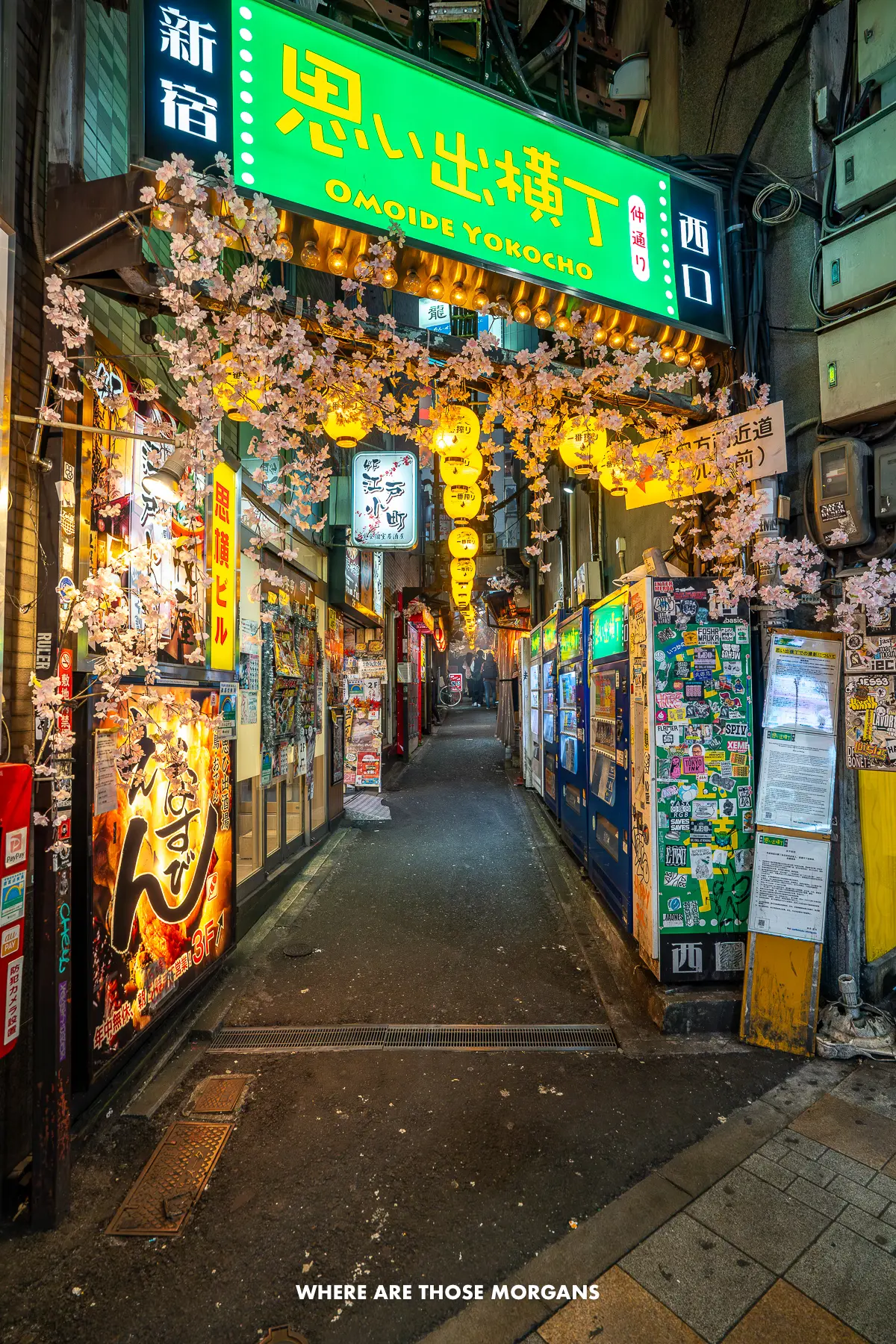
Eat Yakitori Along Omoide Yokocho Memory Lane (3:00 PM)
From Isetan, we’d walk 5 minutes west to one of Shinjuku’s most famous spots called Omoide Yokocho Memory Lane. It’s a super photogenic narrow alley flanked with tiny eateries and bars – and the touristy thing to do here is eat yakitori (chicken skewers), so we’d be happy to oblige yet again.
We’ll be honest, Memory Lane is more impressive and has a better vibe at night when the alley is lit up against the night sky. But it’s also much busier in the evenings, so by going in the mid-afternoon we’d avoid the crowds and still get the experience. Plus, we could always come back later in the evening for a drink.
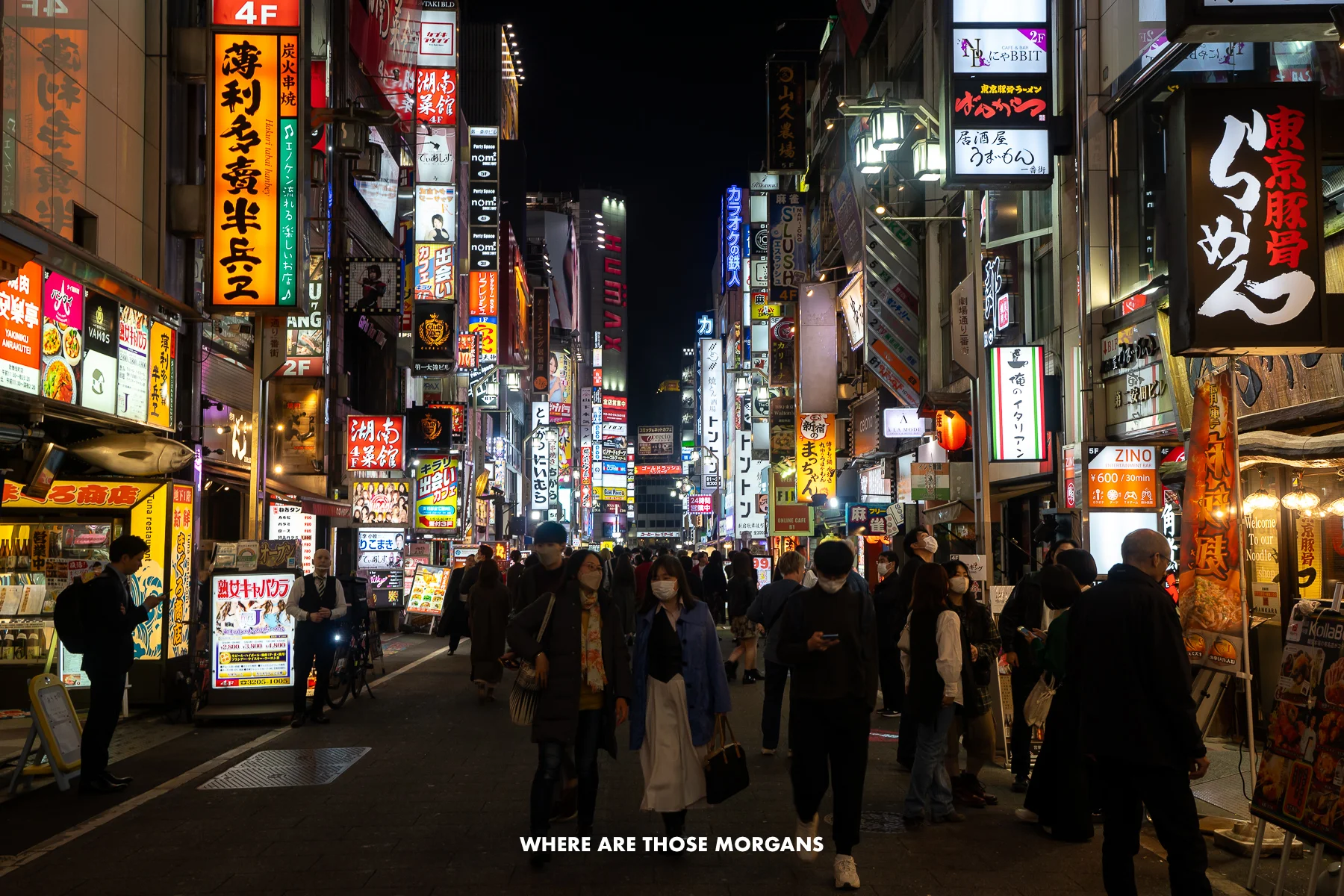
Explore Tokyo’s “Gritty” Kabukicho Area (3:30 PM)
Imagine if Times Square met the Las Vegas Strip but it was way more condensed and intense in a tiny area. That’s Kabukicho – Tokyo’s entertainment district with neon lights and busy streets. The big difference? Even though this is Tokyo’s “gritty” red light area, it’s still perfectly safe to walk around. We’ve done it by day and night, and we’ve never had a single issue.
Back in 2018 we did the Robot Restaurant which was so unique and fun. That’s gone now, but it’s been replaced by Samurai Restaurant Time which looks similar, so check it out. There’s also the Godzilla Head to snap a cheesy photo, the Ninja Trick House for shuriken throwing, and a massive amount of places to eat or drink.
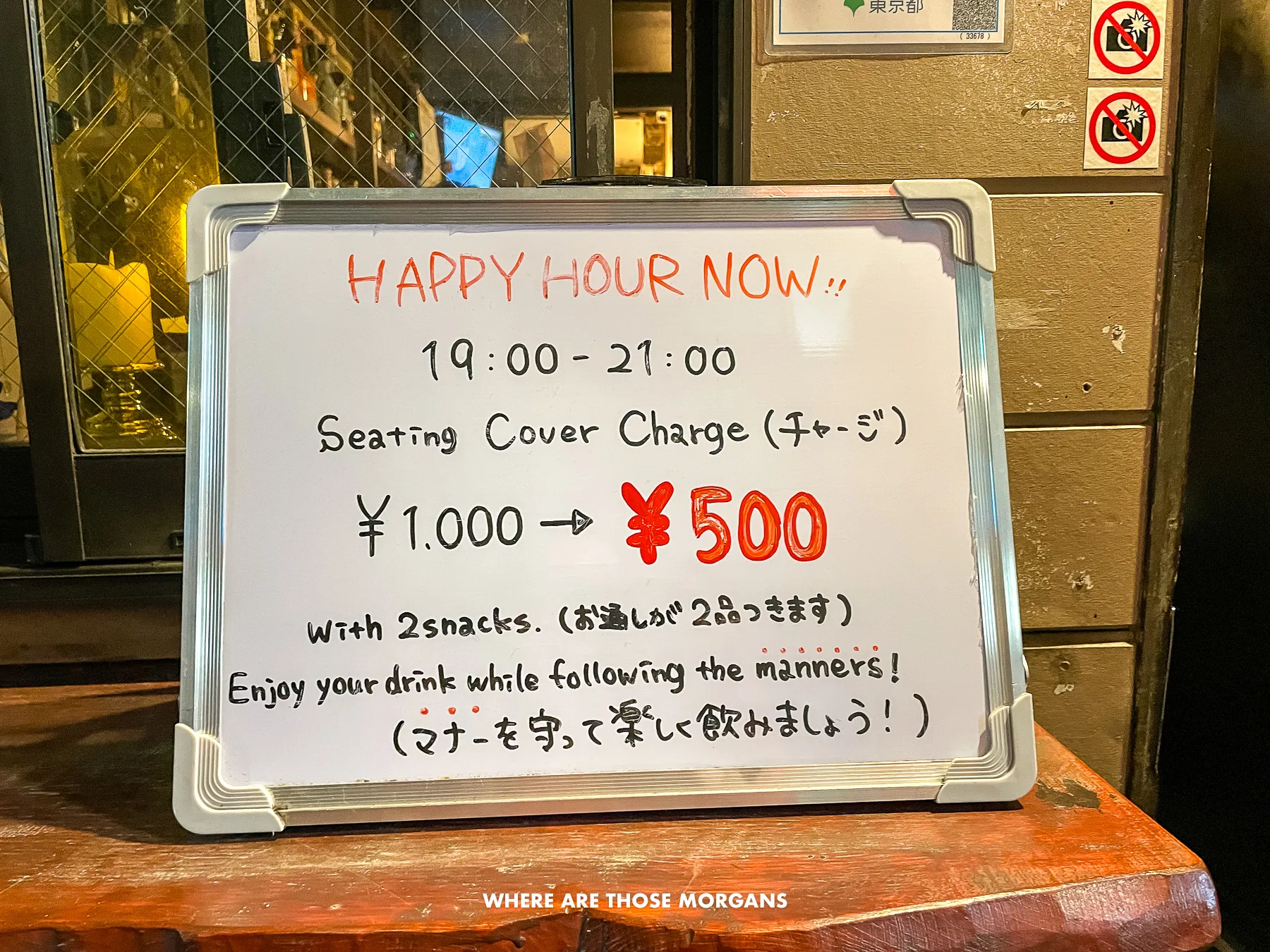
Grab Dinner & Drinks In Golden Gai (5:30 PM)
Shinjuku is extremely touristy, and Golden Gai is definitely a cog in that commercialized tourist conveyor belt. But it’s still a fun spot worth experiencing. From Kabukicho we’d actually start by walking beyond Golden Gai to see Hanazono Shrine (which looks cool lit up) for a few minutes, then we’d double back, enter the atmospheric Golden Gai area which houses over 200 tiny micro bars, and choose a place to grab our first drink.
Each bar is so small that it can only seat between 4 – 10 people, which makes it a unique and intimate experience. We bar-hopped through 3 different pubs in 2023 and met a bunch of other travelers who were all loving it. If you like the sound of this but don’t want to do it yourself, takes you to the best spots. After a few drinks we’d head back into Kabukicho or any other part of the sprawling Shinjuku for dinner. Have a look around, there’s hundreds of great spots to choose between.
How to slow it down: We wouldn’t slow this day down, but we would consider including a few of the excellent tours running in Shinjuku – like this top rated Sumo show and this popular foodie tour with 13 tastings (both have various start times throughout the day).
Day 5: Take A Day Trip
Those four days just about cover Tokyo’s major attractions, experiences and neighborhoods. There’s probably tons of hidden or secluded off the beaten path areas left to discover, but this is a first timers Tokyo itinerary ticking off the most popular things to do. For our final day, we’d skip the Imperial Palace (we did it and it was so underwhelming) and instead we’d take a day trip. There’s tons of options, but we’d narrow down to the following ideas:
Option 1: Hakone & Lake Ashi
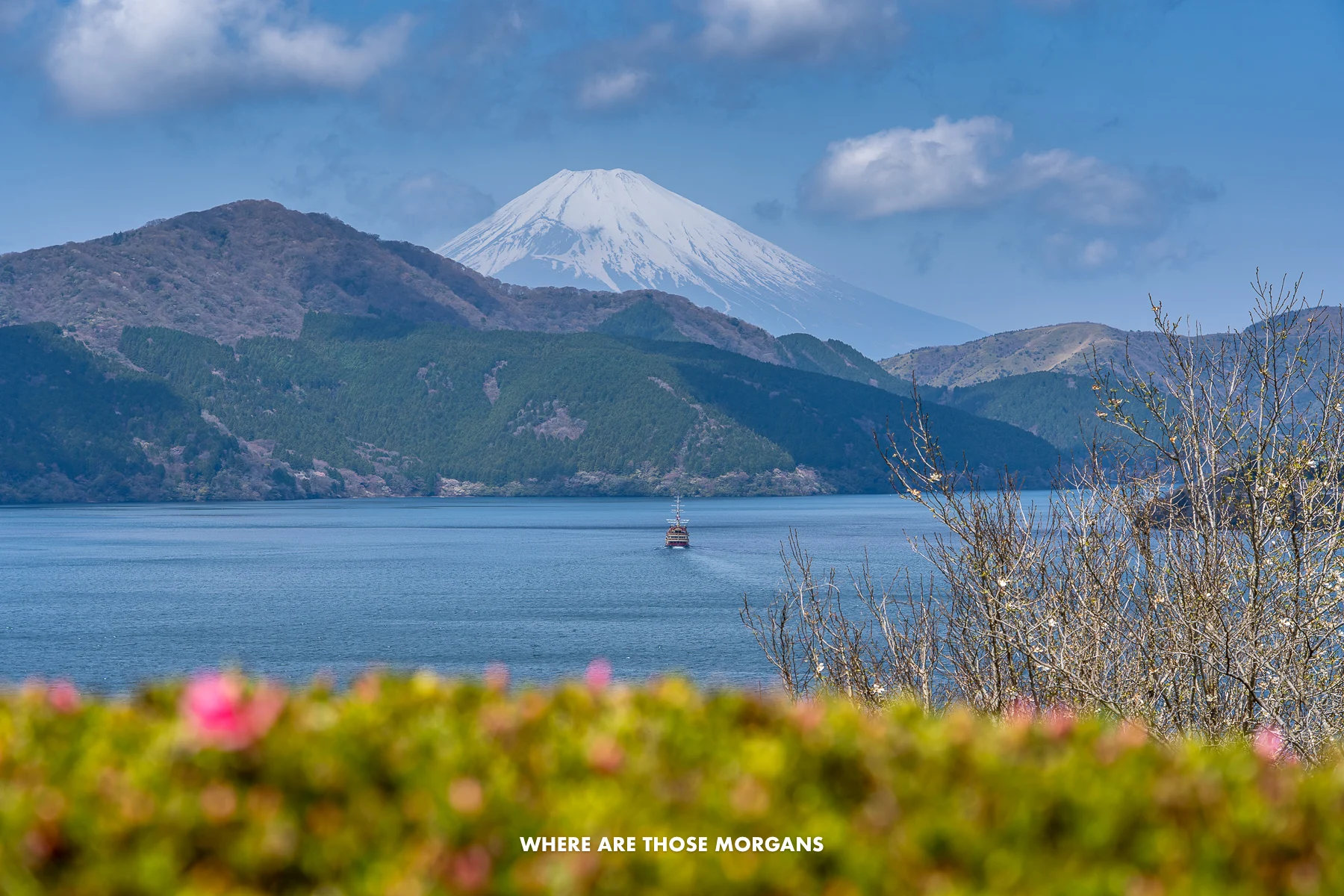
Hakone and Lake Ashi with Mt. Fuji views is the classic Tokyo day trip. We actually spent a night on the north side of Lake Ashi on the way back to Tokyo from Osaka near the end of our 2023 trip, and we were surprised at how quiet it was despite being peak cherry blossom season. But if we were just doing 5 days in Tokyo with a few days in Kyoto and Osaka, we’d use our fifth day in Tokyo to day trip Hakone via the Romancecar express train from Shinjuku – which takes 1 hour 30 minutes each way.
After arriving into Hakone, we’d take the Hakone Tozan Mountain Railway, get off at Chokokunomori to walk around the Hakone Open-Air Sculpture Museum, get back on a following train to the final stop at Gora, take the steep cable car to Sounzan, hop on the Hakone Ropeway to cross a volcanic alley and sulfur vents, see Mount Fuji directly ahead (as long as it’s clear), arrive into Togendai (this is where we stayed), jump on the Pirate Ship crossing Lake Ashi to Hakonemachi and then take a bus back Hakone JR Station for the Romancecar back to Shinjuku.
Kristen’s tour tip: Don’t want to deal with transport logistics yourself or want to actually stand on Mt. Fuji? Book a guided tour like this popular day tour that goes to Hakone and the 5th station on Mt. Fuji with a bullet train return to Tokyo, or this private tour to the same places plus a few more for just your group (up to 5 people).
Option 2: Mt. Takao
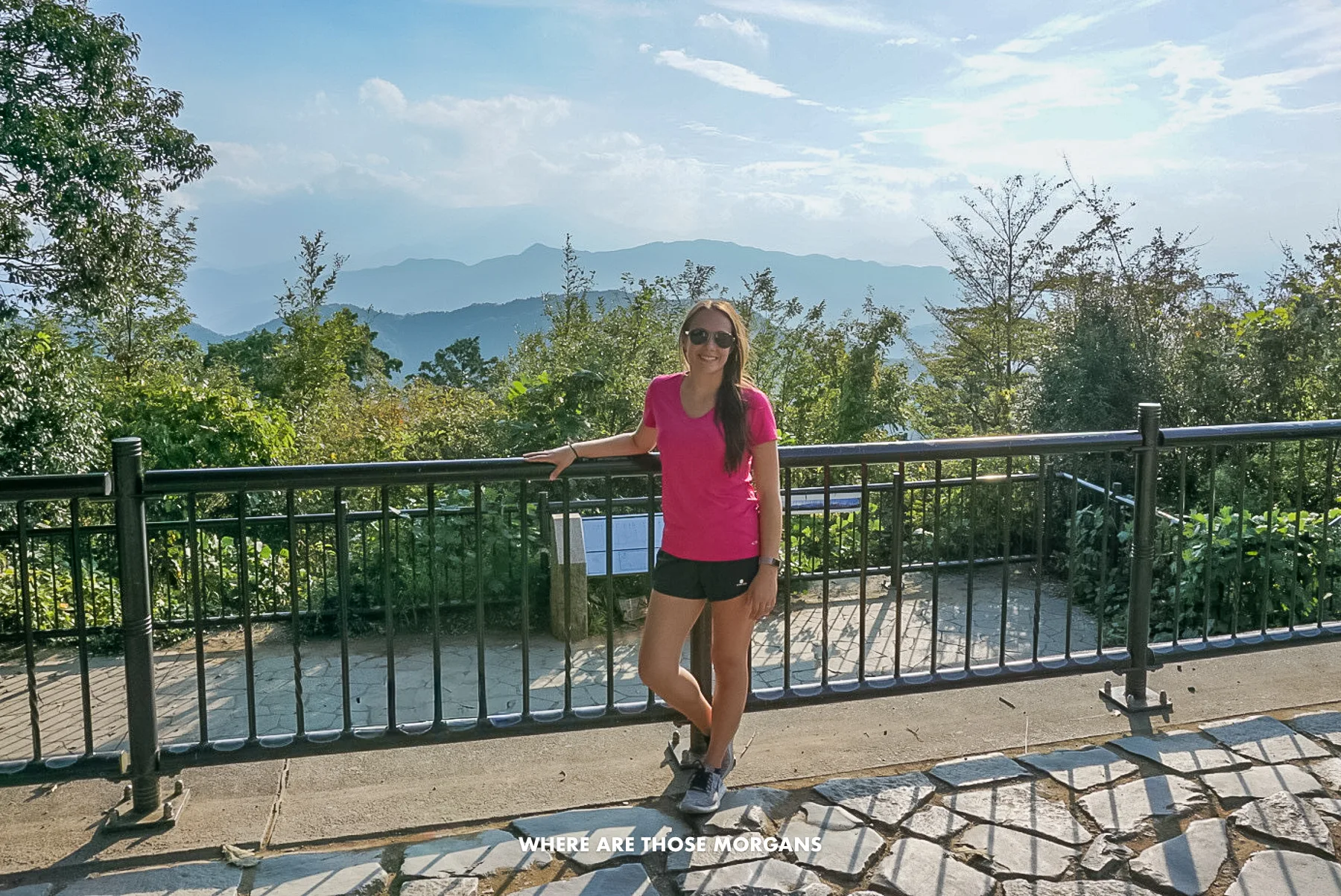
One of our favorite ways to get (very!) distant Mt. Fuji views is to take a much easier day trip to hike up Mt. Takao. We did this in October 2018 and absolutely loved it. The hike was quiet, the temples and scenery were stunning, and we got a great workout to burn off some of the ridiculously tasty food we couldn’t stop eating.
Our travel day was simple, we took the Keio Line from Shinjuku for an hour, hiked 2.4 miles (3.8 km) one way up a moderately challenging forested mountain path with 1,300 feet (400 meters) elevation gain, descended and then took the same train back to Tokyo. Our summit view was okay, but it was hazy and cloudy so our Mount Fuji view wasn’t clear. There were cable car and a chair lift options to cut out the hiking – but we wanted to climb up for the exercise, so we just took the chair lift down at the end and that did save a lot of effort.
Mark’s hiking tip: If you don’t fancy the steep climb, book this combo ticket with round trip trains from Tokyo and access to the cable car which cuts out most of the hard work.
Option 3: Nikko
We haven’t done Nikko but it’s on our radar for next time now that we’ve seen Hakone and hiked Mt. Takao. Nikko is further away in the mountains to the north of Tokyo, and it takes almost 2 hours each way from Asakusa so that’s 4 hours just sat on trains.
After arriving we’d either figure out local buses ourselves or book this private guided tour to reach the World Heritage shrine area and visit the likes of Nikko Toshogu, Rinno-ji and Futarasan Shrine. If the weather was crystal clear or it was peak fall foliage season, we’d plan for a much longer day and take more buses to reach Lake Chuzenji and Kegon Falls.
Option 4: Kamakura & Enoshima
Around one hour south of Tokyo on the Yokosuka Line from Tokyo Station or via the Romancecar, Kamakura is a coastal town that we’d like to visit next time. It’s home to the giant outdoor Buddha called Kotoku-in, temples and a chilled out seaside atmosphere. We’d also visit nearby Enoshima Island for shrines, caves and ocean views.
This would be a calmer, more balanced day trip with less time sat on trains and way fewer logistics to deal with than the likes of Hakone. From what we can gather by researching, it seems like the Kamakura and Enoshina day trip could be described as being “like a smaller Kyoto on the coastline”.
Option 5: Disneyland Or Ghibli Museum
The final day trip we’d consider taking on the last day of our Tokyo itinerary would be Disneyland or the Ghibli Museum if we visited with our kids. Either of these two options applies mostly to families, younger couples, groups of friends or anyone with a big interest in Studio Ghibli movies like Spirited Away. The big thing here is to make sure you book tickets well in advance, especially for Ghibli which sells out months ahead.
Disneyland is just 15 minutes from Tokyo Station on the JR Keiyo Line to Maihama, so it’s a really easy day trip option for families. The Ghibli Museum is 20 minutes from Shinjuku or 30 minutes from Tokyo Station on the JR Chuo Line. From there it’s a 15-minute walk through Inokashira Park to the museum.
Tokyo Itinerary Map
Map key:
- Red – Day 1
- Blue – Day 2
- Green – Day 3
- Orange – Day 4
- Purple – Day trip options
How to use this map: Click the map above to activate, zoom in and out, and tap any icon to see more information. See a list of all attractions by clicking the arrow icon in the top left, or see a full version of the map by clicking the “view larger map” icon in the top right. When you’re in Tokyo you can open the map, tap the next place you want to visit and get directions. Stops for each day on the map are listed in order, so you can easily follow the route.
How to save this map: Click the small star next to the map title – this will add the map to your Google account. Open your Google Maps app, tap “saved”, then tap “maps” and open this map.
Planning For 5 Days In Tokyo
From our extensive time spent in Tokyo, we learned about budgeting and key tips you should know before your trip. These are the things we would love to have known before we visited:
5-Day Budget Breakdown
We don’t believe in “Tokyo is too expensive” to visit. Sure, if you stay at a fancy hotel and eat Kobe beef every day, it will cost a lot. But it doesn’t have to be an expensive vacation.
We found it so easy to keep expenses down during our 5-day trip in 2018, simply by choosing a cheaper hotel and eating at convenience stores or skipping the most touristy ramen spots. Getting around is cheap enough, and most of the best things to do are free or surprisingly affordable for a major city.
In 2023, we spent a bit more money on our two hotels (3 days in Shinjuku and 2 days near Tokyo Station) and food because we had a bigger budget available. But overall, we still found it cheaper than trips we’ve taken to places like Paris, London, NYC, Rome and Singapore.
Now, it’s impossible for us to give you an accurate “here’s exactly how much you’ll spend” on this trip because of the massive variation in every person’s style, taste and budget. But roughly speaking, here’s how much a couple might spend by following our itinerary (5 days and 5 nights):
- Hotel: 150,000 yen (US $1,000)
- Food & Dining: 75,000 yen (US $500)
- Attractions: 25,000 yen (US $160)
- Transport: 15,000 yen (US $100)
- Total: 253,000 yen (US $1,760)
Now, you absolutely could do it cheaper or you could easily spend 3-4 times that much. It all depends on how you prefer to travel. But as mid-range travelers, this is a best-guess estimate of how much we’d spend if it was our first time in Tokyo following this itinerary.
What You Need To Know
Arrival: Japan has an online pre-arrival system that speeds up immigration and customs. We didn’t fill this out before our last trip and we had to fill in forms after landing which slowed us down getting through Narita. It’s not essential, but it makes arrival smoother.
Getting around: Tokyo’s rail system with JR, private rail and the subway is massive and confusing. But it is efficient, trains are on time, the stations are clean and safe, and signs are in English. We recommend getting a pre-paid Suica IC card to use for all trains around Tokyo. It saves having to buy individual tickets every time and it’s legit. Consider buying a JR Pass for bullet trains and getting around Japan’s cities, but price it up and make sure it works out cheaper. Also, we just used Google Maps for navigating with data roaming. If you don’t have data, get a cheap eSim – just make sure your phone is eligible first.
Physical demands: We walked A LOT of steps both times we visited Tokyo. It’s enormous, and even though we used the trains, we were still easily racking up 20,000+ steps per day. We wore comfy running shoes every day, and wouldn’t do it any other way next time.
Money: Some smaller restaurants, food stalls and shrines take cash, but cards are widely accepted across Tokyo. Tipping isn’t a thing, so the price on the menu is what you pay. Finally, we used ATM’s in convenience stores when we needed to get cash out.
Dining: Very few restaurants take reservations, and lots of the popular spots are small inside so lines are something we just got used to dealing with. Our advice is to eat outside of regular lunch and dinner hours to avoid wasting time in long queues. Also, convenience stores like 7-Eleven, Lawson and FamilyMart are the best, we used them every day for snacks and drinks.
Next Steps
We hope our 5-day itinerary helps you figure out how to spend your days in Tokyo.
If you’d like more personalized help, we offer expert planning consultations where we answer any questions you have, help you avoid tourist traps and plan the perfect itinerary based on how you like to travel. Book a 1-on-1 call.
Still researching for your trip?
- Don’t miss these top Tokyo experiences.
- These are the top areas to stay in Tokyo.
- Here’s what to see and do in Kyoto.
- Follow our Kyoto itinerary for first timers.
- Here are the top places to stay in Kyoto.
- These are the top Osaka attractions.
- Here’s how to spend 2 days in Osaka.
- Here are the best areas to stay in Osaka.
- These are Nara’s top attractions.
- Here are the top places to visit in Japan.
- Our favorite 2 week route through Japan.
Finally, we recommend reading our Japan travel guide for first-timers to get helpful tips and advice, top attractions to see, itinerary ideas and more.
Happy travels,
Mark and Kristen
Was this post helpful? Pin it for your visit!
All Rights Reserved © Where Are Those Morgans, LLC. Republishing this article and/or any of its contents (text, photography, maps, graphics, etc.) in whole or in part is strictly prohibited.

Mark and Kristen spent 6 years traveling the world, visiting over 40 countries across 4 continents and more than 30 US states. They created Where Are Those Morgans in 2018 to help others plan the best possible vacations by writing authentic travel and hiking guides based on their real experiences.
Since the arrival of baby Maya in late 2024, Mark and Kristen’s extensive travels have slowed down but they still take plenty of trips. Where Are Those Morgans now helps millions of travelers each year to visit new places and hike new trails through information-packed blog posts and expert travel guidebooks. Read more about Mark and Kristen.